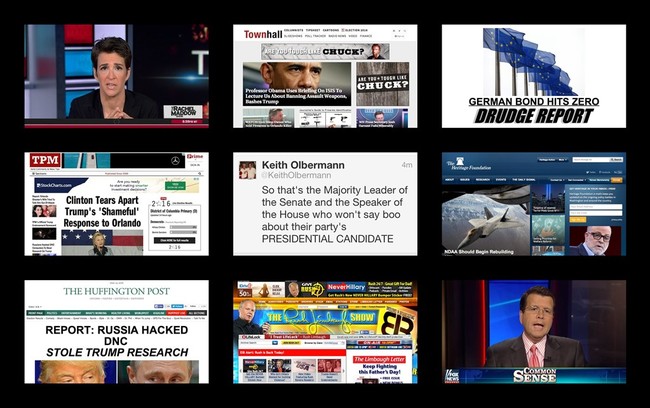
At first glance, watching the Criterion Collection‘s new 4K Blu-Ray release of 1976’s Network, it’s hard at first to match up the volcanic anger of Paddy Chayefsky’s writing with what we remember about the state of television in the mid-1970s. It all seems so quaint and nostalgic in retrospect — the news came in reassuringly small dabs of a half-hour of local info at 6 p.m., followed by a half-hour of national news at 6:30, rather than today’s competing 24-hour news channels on the cable dial.
Weeknights ended with the urbane yet accessible and largely politically neutral Johnny Carson at 11:30. The NFL meant a few hours of local games on Sunday afternoons and the big weekly primetime matchup on Monday nights, rather than the ability to choose the games you want to see, and a league-owned 24/7 cable channel. Daytime programming consisted of endless game shows, and primetime programming consisted of endless cop shows and sitcoms. The most radical thing on network television was NBC’s Saturday Night Live, which had only just debuted in the fall of 1975, and in its first few years, the sting of its hard left political worldview was mitigated somewhat by its often incredibly funny writing, and the manic energy and charisma of its now legendary initial cast.
As men of the left, while Chayefsky and Lumet may have had issues with mid-20th century television in terms of style and content, they probably didn’t object all that much to its sheer firepower when over the target du jour. In 1968, Walter Cronkite helped to tip the Vietnam War when he declared the Tet Offensive a victory for the NVA in 1968, when in reality, the Americans had won. The following year, after 35 years of Democrats and the centrist Eisenhower in office, the three networks began obsessing over Nixon, ultimately crafting the myths of Watergate, hastening his demise.
Watergate would likely have gotten lost in today’s insanely fast-moving and overloaded news cycles powered by network television, cable television, talk radio, the Internet, and social media, but in 1974, a media monoculture with only three commercial TV networks could monomaniacally endlessly regurgitate the story. You were never quite sure what exactly Nixon did that was wrong (or if it was something that had been done by previous presidents), but it must have been really, really bad to piss off all the talking heads inside your 22-inch Sony Trinitron screen.
Bite Your ‘Mao Tse Tung Hour’
Chayefsky’s script mocks the Patty Hearst story with a weekly show called The Mao Tse Tung Hour, but the following decade, when Lumet directed a film inspired by the similarly radical chic Weathermen bombings of the early 1970s, he took the side of the people setting the bombs, casting Taxi’s beloved everyman star Judd Hirsch as an aging former terrorist with a family hiding from the FBI in 1988’s Running on Empty:
Robert Conquest’s First Law of Politics states that “Everyone is conservative about what he knows best.” In his 2020 retrospective of Network, Kyle Smith, then of National Review Online, quoted one of its funniest moments, when an Angela Davis-inspired communist terrorist who is one of the stars of the “Mao Tse Tung Hour” channeled her inner Milton Friedman to, as Mel Brooks would say, Count DeMonet:
For anyone who has ever seen a television contract — a genre that tends to resemble Bertrand Russell’s Principia Mathematica, only with more formulas — the scene is a spiffy inside joke, but even if you’re unfamiliar with the biz, the scene is still hilarious:
Don’t f*** with my distribution costs! I’m making a lousy 215 per segment. I’m already deficiting 25 grand a week with Metro. I’m paying William Morris 10 percent off the top and I’m giving this turkey ten thou per segment and five more to this fruitcake! And Helen, don’t start no sh** with me about a piece again. I’m paying Metro 20 percent for all foreign and Canadian distribution and that’s after recoupment! The Communist party’s not gonna see a nickel out of this goddamn show till after we go into syndication!
It’s a safe bet that Obama’s mentor and former Weatherman Bill Ayers had similar conversations when negotiating his book deals.
Since the above character was likely inspired by early 1970s black radical Angela Davis, it’s worth noting the real Davis was shouting anti-Nixon rhetoric in 1972 that would be echoed almost verbatim by Democratic presidential nominee Kamala Harris in 2024 about President Trump:
The MSNBC propaganda line that “America is spiraling towards fascism” is a long and tired left-wing tradition. Here’s Angela Davis in 1972, making the argument that that America under Nixon was like Germany just “before Hitler seized power.” Ridiculous then, ridiculous now. pic.twitter.com/9P86o9CUOp
— Christopher F. Rufo ⚔️ (@christopherrufo) September 20, 2022
Walter Cronkite, the Original Howard Beale
Similarly, Smith writes that in Network, Faye Dunaway’s character, “Diana Christensen, the movie’s evil-genius programmer, who blurs and then obliterates the line between news and entertainment, turns the money-losing news division into a profit center by adding sensationalist elements. She brings in a soothsayer and a weekly documentary show told from the point of view of terrorists. Most notoriously, she encourages Walter Cronkite to become Father Coughlin.”
While Peter Finch plays an avuncular newsman who, when staring down the barrel of being fired, transforms from a Cronkite clone into a role model for Keith Olbermann, the real Cronkite really wasn’t that far behind, according to his biographer and fellow lefty, Douglas Brinkley:
As managing editor of the CBS Evening News, Cronkite seemed to relish pricking Goldwater from time to time for sport. In late July [1964], he introduced a report from CBS correspondent Daniel Schorr, a hard-and-fast liberal working from Munich. With an almost tongue-in-cheek smile, Cronkite said, “Whether or not Senator Goldwater wins the nomination, he is going places, the first place being Germany.” Schorr then went on a tear, saying, “It looks as though Senator Goldwater, if nominated, will be starting his campaign in Bavaria, the center of Germany’s right wing.” The backstory was merely that Goldwater had accepted an invitation from Lieutenant General William Quinn for a quick holiday at Berchtesgaden, a U.S. Army recreational center in Germany. But Schorr made the takeaway point that Berchtesgaden was once “Hitler’s stomping ground.” Goldwater, trying to show off his NATO bona fides, had granted an interview with Der Spiegel in which he mentioned a possible trip to Germany soon. Some Democratic opposition researcher floated the idea that Goldwater was infatuated with the Nazis. It was ugly stuff. What was even uglier was the way Cronkite and Schorr elevated the story to CBS Evening News status.
* * * * * * * * *
[N]ow that Neil Armstrong had walked on the Moon, Cronkite sensed that ecology would soon replace space exploration as the national obsession. CBS News producer Ron Bonn recalled precisely when Cronkite put the Network on the front line of the fight. “It was New Year’s Day, 1970, and Walter walked into the Broadcast Center and said, ‘God damn it, we’ve got to get on this environmental story,’” Bonn recalled. “When Walter said ‘God damn it,’ things happened.”
Cronkite pulled Bonn from nearly all other CBS duties for eight weeks so he could investigate environmental degradation. He wanted a whole new regular series on the CBS Evening News—inspired by [Rachel Carson’s] Silent Spring, the philosophy of René Dubos, and those amazing photos of Earth taken by the Apollo 8 astronauts. The CBS Evening News segments were to be called “Can the World Be Saved?” “We wanted to grapple first with air pollution, the unbreathable air,” Bonn recalled. “But then we wanted to deal with the primary underlying problem, which was overpopulation.”
That last sentence is, of course, a reference to the recently deceased doomsday environmentalist Paul Ehrlich, whose 1968 book The Population Bomb was hugely influential among his fellow leftists in the broadcast world. Even centrists such as Johnny Carson felt obliged to obsess over Ehrlich, and Carson had him on The Tonight Show, one of the most desirable network shows for guests in all fields of entertainment, a whopping 18 times (some sources quote the number as being over 20) from 1970 to 1981.
Also in 1968, according to Victor Lasky in his 1977 book, It Didn’t Start With Watergate, shortly after the presidential election, LBJ told Richard Nixon’s incoming vice president:
“Young man,” he had told [Spiro] Agnew, “we have in this country two big television networks, NBC and CBS. We have two news magazines, Newsweek and Time. We have two wire services, AP and UPI. We have two pollsters, Gallup and Harris. We have two big newspapers—the Washington Post and The New York Times. They’re all so damned big they think they own the country. But, young man, don’t get any ideas about fighting…”
Agnew famously ignored Johnson’s advice, beginning the right-wing pushback against the DNC-MSM that continues to this day. Chayefsky and Lumet’s Network was somewhat in the same spirit, but was essentially a far-left screed against what at the time was a nominally center-left medium.
Similarly, television’s framing of the Vietnam War did much to cause Americans to question their resolve to fight it. As Newsweek’s Howard Fineman wrote in January of 2005, in response to “Rathergate” being unable to get the media’s preferred candidate over the top, in an article headlined, “The ‘Media Party’ is over: CBS’ downfall is just the tip of the iceberg:”
The notion of a neutral, non-partisan mainstream press was, to me at least, worth holding onto. Now it’s pretty much dead, at least as the public sees things. The seeds of its demise were sown with the best of intentions in the late 1960s, when the AMMP [American Mainstream Media Party] was founded in good measure (and ironically enough) by CBS. Old folks may remember the moment: Walter Cronkite stepped from behind the podium of presumed objectivity to become an outright foe of the war in Vietnam. Later, he and CBS’s star White House reporter, Dan Rather, went to painstaking lengths to make Watergate understandable to viewers, which helped seal Richard Nixon’s fate as the first President to resign. The crusades of Vietnam and Watergate seemed like a good idea at the time, even a noble one, not only to the press but perhaps to a majority of Americans. The problem was that, once the AMMP declared its existence by taking sides, there was no going back. A party was born.
Keith Olbermann, the Successor to Howard Beale
In the 1980s, Tom Wolfe liked to discuss his theory of “information ricochet” with interviewers:
The Hell’s Angels, for example, didn’t exist until the movie The Wild One. They looked at The Wild One and said, “Oh, that’s the way it’s done.” So they took their own name and insignia and stuff, and Roger Corman came by and said, “Oh, that’s the way it’s done,” and made a movie called The Wild Angels. And the Hell’s Angels came by and said, “That’s a nice idea; we’ll do that.” That’s information ricochet.
There’s no doubt that much to Chayefsky and Lumet’s chagrin, TV executives watched Network as a how-to guide. Keith Olbermann’s career at MSNBC seemed very much like a bad Howard Beale impersonation, and in his 2020 retrospective on Network, Kyle Smith compared Glenn Beck’s time at Fox News to Beale. (Perhaps it’s yet another sign of TV’s slow fade into a legacy medium that Tucker Carlson saved his full transformation into Howard Beale for after his stint at Fox News.)
While Chayefsky and Lumet certainly found much to complain about television in the 1970s (and rightly so), at least Howard Beale was trying to remind people about the woes of life in the mid-1970s. Chayefsky and Lumet had no idea that in the next century, social media would have the power to radically rewire people’s brains far more than network TV. I don’t recall anyone having screaming meltdowns because Chico and the Man was canceled in 1978, and if they did, unlike today, they’d have no way with the push of a button on their mobile phone to distribute them to the rest of the world (language warning in the post below):

(Note, video clip since deleted from Twitter/X but available on the Wayback Machine. Make sure you have your audio turned down as much as possible before pressing play. We’re talking full-on Beatles at Shea Stadium levels of screaming here.)
The Criterion Collection’s 4K scan of Network looks great (there’s also a standard HD Blu-Ray disc of the movie included as well for those lacking a 4K player). As is typical of a movie that gets the full Criterion Collection treatment, there’s a variety of bonus features, including a 2006 director’s commentary from Lumet, and several “making of” clips, also from 2006. Also included is a documentary titled Paddy Chayefsky, Collector of Words, which features historical interviews with Chayefsky, and some recently shot thoughts on his history and legacy from a variety of names in the film and television industries, whose ideologies run the entire gamut from center left to far left, including James L. Brooks, Billy Crystal, Robert Klein, Mel Brooks, Jason Alexander, Aaron Sorkin, and Oliver Stone.
And, astonishingly enough, Keith Olbermann, who tells his interviewer, “What was the one thing, [the] one thread that you pulled on that unraveled the whole world of television news and turned it into this nightmare that it becomes in the Howard Beale environment? And the answer would be, making news part of the entertainment monolith.” Fortunately, that never happened to Olbermann during his many stops across the cable television dial over the last 20 years:
But what about the film itself? Chayefsky’s writing is densely packed and relentless; the film never has a chance to breathe. As Roger Ebert noted in his original 1976 review, “we have a supremely well-acted, intelligent film that tries for too much, that attacks not only television but also most of the other ills of the 1970s:”
We are asked to laugh at, be moved by, or get angry about such a long list of subjects: Sexism and ageism and revolutionary ripoffs and upper-middle-class anomie and capitalist exploitation and Neilsen ratings and psychics and that perennial standby, the failure to communicate. Paddy Chayefsky’s script isn’t a bad one, but he finally loses control of it. There’s just too much he wanted to say. By the movie’s end, the anchorman is obviously totally insane and is being exploited by blindly ambitious programmers on the one hand and corrupt businessmen on the other, and the scale of evil is so vast we’ve lost track of the human values.
And yet, still, what a rich and interesting movie this is. Lumet’s direction is so taut, that maybe we don’t realize that it leaves some unfinished business. It attempts to deal with a brief, cheerless love affair between Holden and Dunaway, but doesn’t really allow us to understand it. It attempts to suggest that multinational corporations are the only true contemporary government, but does so in a scene that slips too broadly into satire, so that we’re not sure Chayefsky means it. It deals with Holden’s relationship with his wife of twenty-five years, but inconclusively.
Network is now something of a time capsule. Before cable TV, before personal computers, before Weblogs, before social media, before YouTube, network television was the supreme top-down medium, in which a handful of men in New York boardrooms, and a few hundred writers and producers in Hollywood decided what America would see each night when they turned on their televisions. It wasn’t pretty, it was far from a true portrait of the nation as a whole in the 1970s, but it was impossible to ignore.
Editor’s Note: Do you enjoy PJ Media’s conservative reporting that takes on the radical left and woke media? Support our work so that we can continue to bring you the truth. Join PJ Media VIP and use the promo code FIGHT to get 60% off your VIP membership!