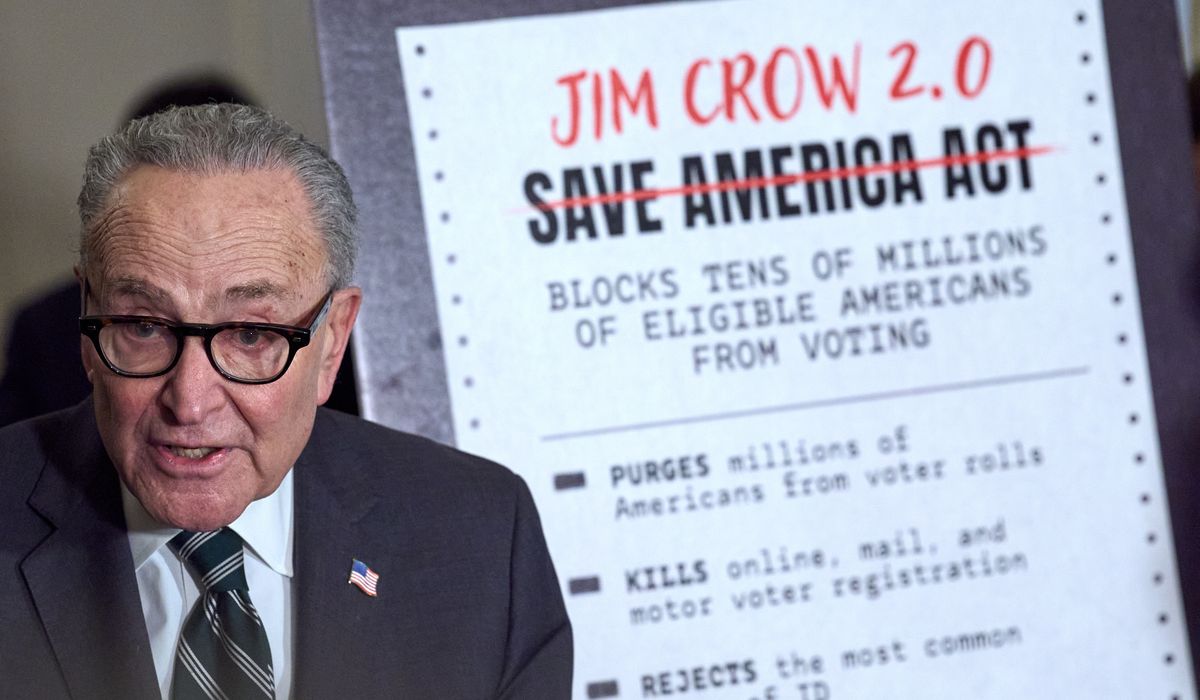
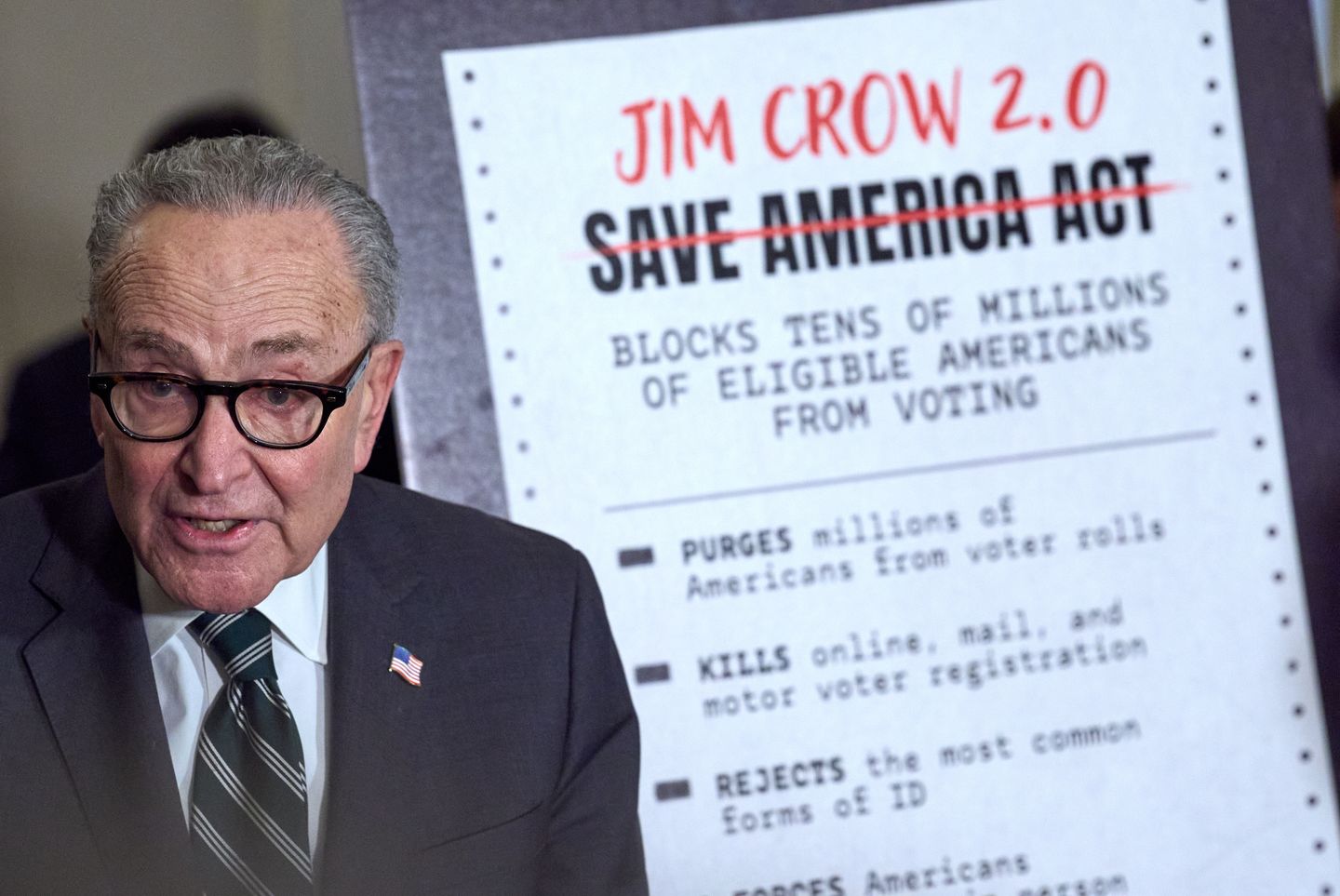
Senate Democrats on Thursday blocked a Republican proposal to institute a national voter ID requirement.
The voter ID measure was brought up in the context of a broader election bill, the SAVE America Act, that also requires proof of citizenship to register to vote and a process for cleaning up state voter rolls.
Although the underlying bill already included a voter ID requirement, Republicans wanted to offer it as a standalone amendment to see where Democrats stood since several have claimed their opposition to the SAVE America Act is not about voter ID.
“Democrats have been trying to have their cake and eat it too, pretending they stand with the overwhelming majority of Americans who support photo IDs at the polls while declining any occasion to put their money where their mouth is and support actual legislation,” said Senate Majority Leader John Thune, South Dakota Republican.
Three dozen states already have voter ID requirements, and polls repeatedly show roughly 80% of Americans support making voters show a photo ID to cast their ballot.
No Democrats voted for the Republicans’ voter ID amendment. It failed in a 53-47 party-line vote, short of the 60 needed to overcome a filibuster.
Senate Minority Leader Charles E. Schumer called the voter ID proposal “a wolf in sheep’s clothing.”
“The amendment Republicans are pushing today would impose the single strictest voter ID law in America — stricter than Texas, stricter than Florida, stricter than any state in the country,” the New York Democrat said.
The GOP amendment provides five photo ID options that voters can use to prove their identity when casting a ballot: a state-issued driver’s license or identification card, a U.S. passport, a military ID or a tribal ID.
The measure says individuals who show up to vote without an ID can cast a provisional ballot and will have three days to provide their local election officials with an ID if they want their vote to be counted.
Individuals voting by mail must provide a photocopy of their ID or an affidavit on why they can’t obtain one along with the last four digits of their Social Security number. Overseas military members and some elderly and disabled people would be exempt from this requirement when voting absentee.
“This so-called voter ID amendment would impose new requirements on the tens of millions of Americans who choose or rely on voting by mail,” Sen. Alex Padilla, California Democrat, said, calling it a “new and unnecessary obstacle” to a form of voting that more and more Americans prefer.
“President Trump voted by mail in Florida,” he said. “Is it good enough for the president, but not good enough for us? Secure enough for the president, but not secure enough for the American people?”
Mr. Padilla said the GOP proposal would also “block common forms of IDs,” including veteran and student IDs and tribal IDs that do not have expiration dates.
Mr. Schumer said Democrats support a bill called the Freedom to Vote Act that includes voter ID standards based on West Virginia law.
That measure allows a much broader set of identification options, including student and employee IDs, government benefit cards, bank or debit cards, utility bills, and gun, hunting or fishing licenses.
It also permits voters an alternative to providing an ID by submitting “a sworn written statement, signed in the presence of the official by an adult who has known the individual for at least six months under penalty of perjury, attesting to the individual’s identity.”
Sen. John Husted, former Ohio secretary of state who offered the Republican amendment, said the forms of identification his proposal allows are ones Americans must show frequently in their everyday lives.
“Americans are required to show a photo ID when they rent a car, when they start a job, when they board a plane,” he said. “It’s a common-sense requirement for Americans to show a photo ID when they vote.”