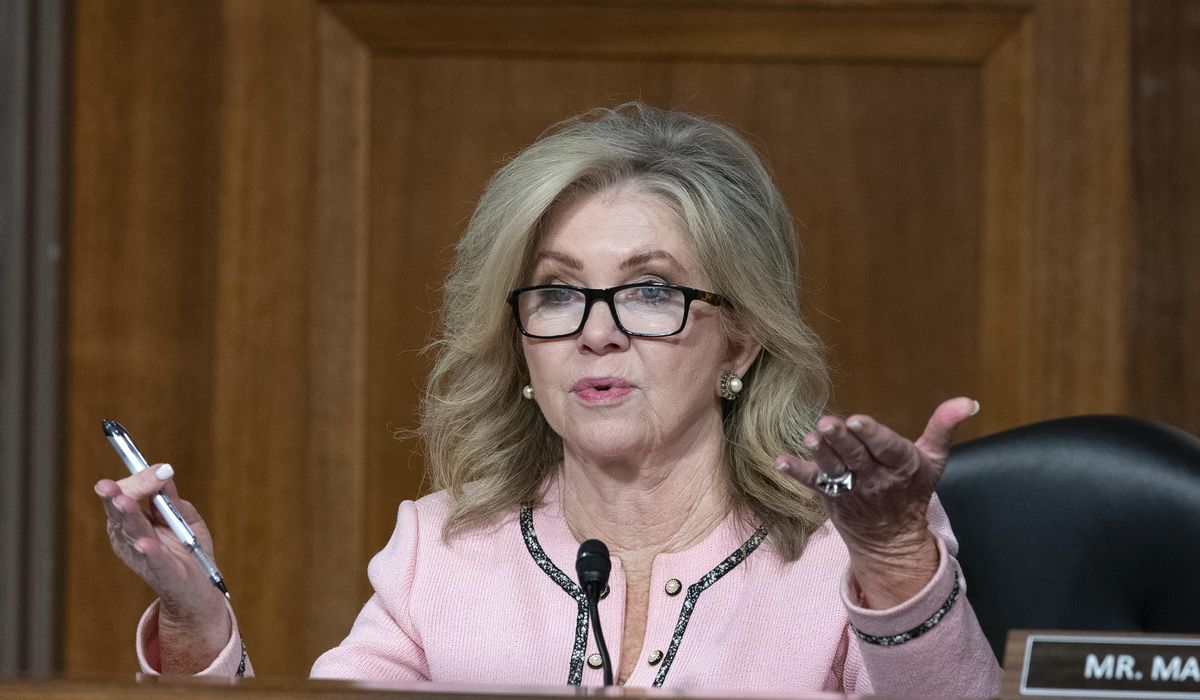
Planned Parenthood affiliates are offering Botox and other aesthetic treatments while operating as a tax-exempt charitable organization, and Sen. Marsha Blackburn said this abuses its nonprofit status.
The Tennessee Republican penned a March 26 letter to Robert Malone, director of Exempt Organizations and Government Entities at the Internal Revenue Service, regarding the reproductive health service’s initiative to provide the neurotoxin injection.
She cites a Wall Street Journal article on Planned Parenthood Mar Monte in Northern California, the organization’s largest affiliate, offering Botox to smooth crow’s feet or IV hydration services, including its regular access to birth control, abortions and testing for sexually transmitted infections.
Ms. Blackburn said this marks a “significant shift from the organization’s claim to be a charitable health care organization providing public health services.”
The adoption of the new business model is intended to generate revenue and offset a $100 million shortfall resulting from federal funding cuts, according to Planned Parenthood’s website.
“We are in a world where we are defunded and cannot rely upon federal dollars for reimbursement,” it says.
Planned Parenthood faced a financial crisis in the past year, with more than 50 clinics closing nationwide and others consolidating.
The revenue generated by these new services will cover the costs of the organization’s traditional sexual and abortion treatment.
Ms. Blackburn said Planned Parenthood is appealing to the women’s beauty market “in an effort to abuse” its nonprofit status after President Trump’s One Big Beautiful Bill restricted federal Medicaid funding for tax-exempt community abortion providers.
She argues that the expansion is “not the result of a single rogue affiliate, but a top-down expansion and messaging effort.”
“These developments not only raise concerns about Planned Parenthood growing beyond its original mission statement, but also about the use of its federally supported resources in that expansion,” she wrote in the letter.
Federal cost-allocation rules mandate that recipients of federal funding clearly separate costs associated with federally supported activities from unrelated or nonfederally funded activities. These rules ensure that federal grants are used solely for authorized purposes and do not subsidize unrelated commercial services.
Nonprofits can engage in activities unrelated to their charitable mission, but income from those activities may be subject to the Unrelated Business Income Tax, and Ms. Blackburn said even modest participation in these services could “easily” exceed the $1,000 reporting threshold.
Ms. Blackburn asked the IRS to examine whether this use of tax-exempt status to generate new revenue streams complies with federal nonprofit and grant-funding requirements and respond to her inquiry by Friday.