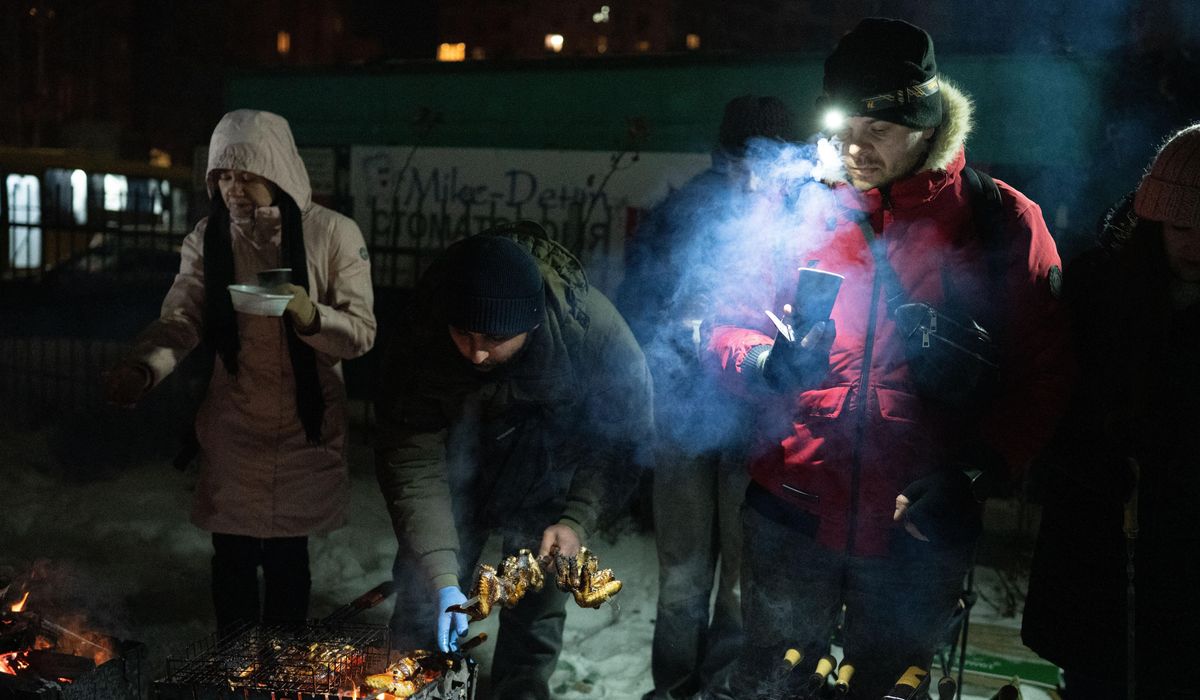
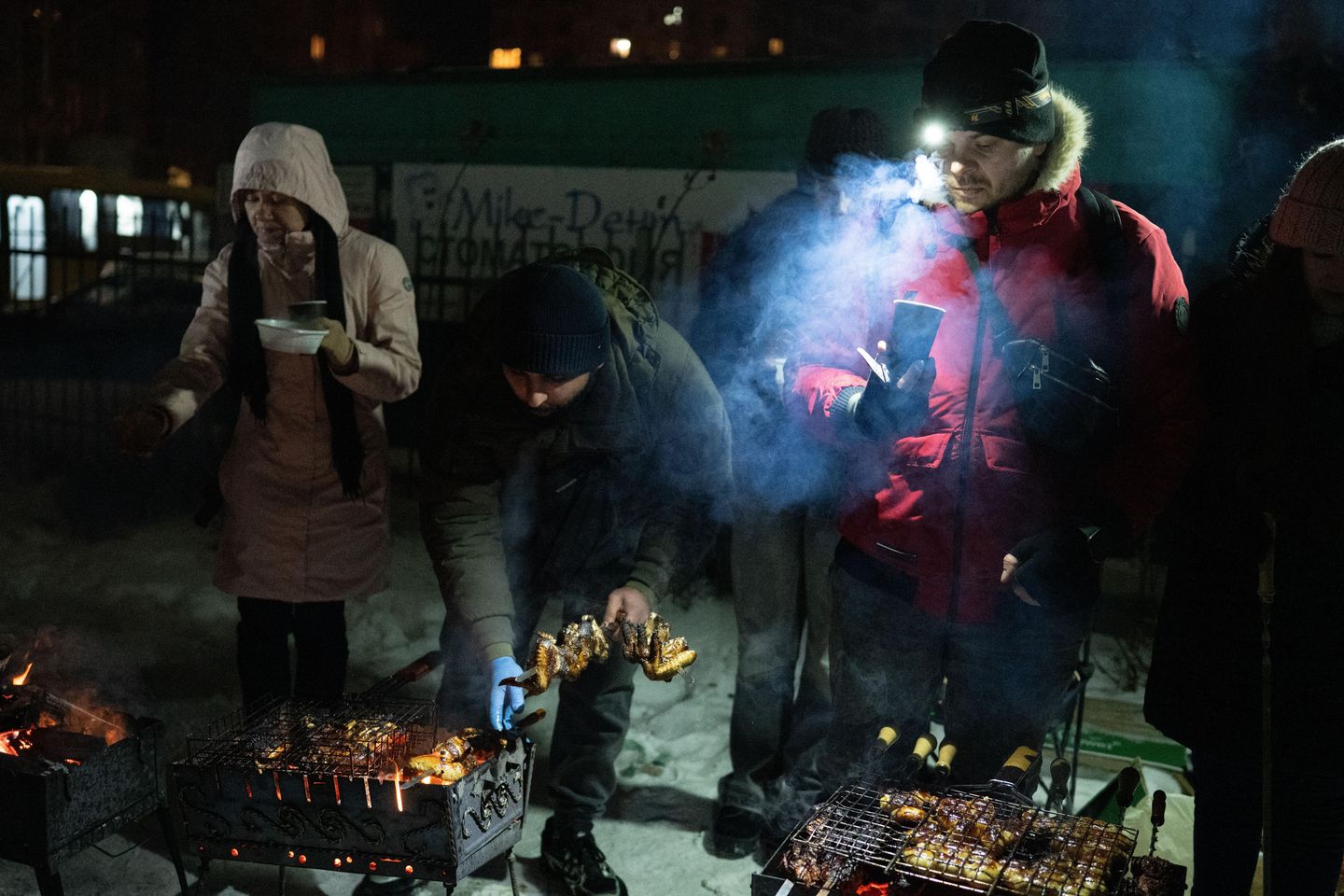
KYIV, Ukraine — After another wave of Russian missile and drone attacks early Friday against Ukraine’s energy infrastructure, almost a million people in the Ukrainian capital were without power on a night when the low temperature hit 10 degrees Fahrenheit.
Earlier in the week, President Volodymyr Zelenskyy had warned that more than half of the city already had no electricity in the wake of Russian strikes on energy facilities.
Russia’s renewed pressure on Kyiv has fractured a power grid already weakened by years of war, with Ukrainian power company Ukrenergo acknowledging the energy situation had “significantly worsened,” forcing emergency outages across most regions.
Oleksandr Kharchenko, a Kyiv-based energy expert and the director of the Energy Industry Research Center, said the latest phase of Russia’s campaign has exposed a familiar weakness in a new way. The same energy facilities have been targeted repeatedly throughout the war, but attacks now arrive with such intensity that Ukraine’s air defenses cannot reliably blunt the impact.
“The situation is extremely complicated,” Mr. Kharchenko said. “We lost a significant amount of generation capacity, including inside Kyiv, which is critical both for electricity and for heating.”
According to Mr. Kharchenko, the damage is less about improved Russian targeting and more about sheer volume. “They attacked the same facilities they have targeted many times before,” he said. “The difference is the scale. It was never 18 missiles in one wave that could reach their targets.”
Ballistic missiles, which are harder to intercept, have played a particularly destructive role. When even a small number get through, they can disable equipment that then takes weeks or longer to replace.
A city divided by outages
On the ground, the impact has been uneven, sometimes varying sharply from one district to the next. Joshua Kroeker, a Kyiv resident and CEO of risk consultancy group “Reaktion Group,” said recent strikes left some parts of the city relatively intact while others were plunged into prolonged outages.
“Some parts of the city were hit much harder than others,” Mr. Kroeker said. “The right bank was a little better off — some areas never lost power at all. But in my apartment in central Kyiv, we had no water, no heating and no electricity for several days.”
After the attacks, services gradually begin to return as repair crews work around the clock to restore heating to thousands of homes and fix damaged combined heat-and-power plants. But each new strike resets the counter.
“Most of the left bank of Kyiv is currently without electricity,” Mr. Kroeker said in the hours after Friday’s overnight attack, adding that many residents he spoke with still had heating. “The right bank is mixed. Some people have power, some don’t. But the situation remains extremely critical.”
According to industry sources familiar with grid operations, Russia has increasingly focused on a two-pronged strategy: striking generation facilities located inside or near major cities such as Kyiv, Kharkiv and Chernihiv, while simultaneously targeting the large substations and transformers that connect those cities to the national grid.
The goal, these sources say, is to reduce local generation while limiting a city’s ability to import power from other regions. Major urban centers typically rely on only a handful of high-voltage substations. Once those nodes are damaged, electricity may still flow through low-voltage lines, but not in volumes sufficient to meet residential demand, heating needs, water pumping and other critical services.
Extreme cold has acted as a force multiplier. Prolonged outages chill apartment blocks, and when power is restored, demand surges as residents charge batteries, run heaters and restart appliances. That sudden spike can trigger secondary equipment failures unrelated to direct strikes. Repairs, meanwhile, slow as crews work outdoors in sub-zero conditions and spare parts become scarcer after years of attrition.
Targeted terror
At the World Economic Forum in Davos, Switzerland, Maxim Timchenko, head of Ukrainian energy company DTEK, framed the attacks in blunt terms and used the platform to press for urgent international action: “These are targeted attacks against civilian infrastructure,” Mr. Timchenko told attendees last week in Switzerland. “It’s not related to any military infrastructure or military enterprises. It’s purely terror against our people.”
He cited the intensity of recent strikes on individual facilities. “Just last week, one of our power stations was attacked by five ballistic missiles and 26 drones,” he said. “None of our defence systems can protect infrastructure from this level of intensity.”
Mr. Timchenko laid out what he described as a four-point priority list. “Number one, we need more diplomatic pressure — to force at least an energy ceasefire,” he said. “Number two, we need air defence. There are solutions that can protect our power stations. We just need more.”
“Number three, we need equipment,” he added, pointing to shortages of transformers for the electricity grid and compressors for gas infrastructure. “And number four, we need funding. We know what needs to be done to recover thermal power stations, but we need more funding to do it.”
European partners have rushed emergency generators and equipment to Ukraine, but energy officials argue that stopgap measures cannot substitute for interceptors and hardened protection for key infrastructure.
Recent diplomatic efforts have moved into high gear even as Russian strikes continue. Ukraine, Russia and the United States have resumed trilateral talks in Abu Dhabi, the first of their kind at this level since the invasion began, with discussions focused on territorial disputes and broader security guarantees rather than an immediate ceasefire.
Mr. Zelenskyy said it was “still too early to draw conclusions,” but framed the talks as a test of whether diplomacy can keep pace with a winter campaign aimed at breaking Ukraine’s civilian infrastructure.
Poland and the European Union have announced shipments of hundreds of emergency generators and heaters to help civilians endure outages during sub-zero temperatures, and Ukrainian officials have called on OSCE and allied partners to accelerate the delivery of air-defense systems to protect critical infrastructure.
Heating: The new front line
In winter conditions, electricity outages alone are survivable. Heating failures, however, are not. That distinction, Mr. Kharchenko warned, is where blackouts become life-threatening.
“Kyiv’s heating system was very seriously damaged” last week, he said. While much of the heat supply has been restored, he warned that the system remains fragile. “If the heating system is destroyed and even 1 million people are left without heat in minus-20 degrees Celsius, many of them are at real risk of freezing.”
Mr. Timchenko has argued that Ukraine must redesign its heating system for wartime resilience. About 45% of heat supply, he said, comes from centralized plants.
Those, he says, are easy targets for missile strikes. Decentralized district heating, by contrast, is far harder to disable and more resilient under attack.
Kyiv has already been forced into crisis mode. At one point in mid-January, the city was receiving only about half of the electricity it needs, with residents enduring 18 to 20 hours a day without power in some districts.
Despite the damage, Ukrainian engineers have repeatedly managed to pull the grid back from the brink. Mr. Kharchenko believes a return to a managed system of scheduled outages is still possible, but only if air defenses can blunt future waves of strikes.
“If we can use air defense properly, I believe we can restore the system again,” he said. “Not to a perfect level, but to something like late December or early January, with predictable, manageable outages.” He estimates that such stabilization could take two to three weeks, provided attacks do not continue at full intensity.
That condition remains decisive. Recent Russian barrages have involved hundreds of drones and dozens of missiles, including ballistic weapons, repeatedly testing Ukraine’s defenses.
The campaign has become a contest between Ukraine’s ability to repair, reroute and improvise and Russia’s capacity to keep saturating the system.
For residents such as Mr. Kroeker, the strategic debate collapses into basics: whether water runs, whether radiators warm, whether families can remain in their apartments.
“If we see further attacks in the next week or two, the situation could deteriorate very quickly,” he said. “We’re already seeing stretches of four or five days without electricity, heating or even running water in some areas.”
Mr. Kharchenko, however, argues that the stakes go well beyond inconvenience or economic disruption. Strikes on heating infrastructure, he says, carry an explicitly lethal dimension in a city of high-rise buildings and elderly residents.
“This is an attack meant to kill the city,” Mr. Kharchenko said. “If the heating system is destroyed and even 1 million people are left without heat in minus-20 degrees Celsius, many of them are at real risk of freezing.”
For Ukrainian energy officials and residents alike, the anger is sharpened by the sense that this danger is both foreseeable and preventable. Each successful interception reduces the threat dramatically; each shortage of air-defense missiles magnifies it.
As winter deepens, the question for Kyiv is no longer whether the grid can be repaired but whether the next wave can be stopped in time to keep the city alive.