LONDON — Polish officials say four tunnels discovered under the border with neighboring Russian ally Belarus were being used to bring illegal immigrants into Poland as part of Russian President Vladimir Putin’s ongoing hybrid war on Europe.
According to media reports and experts who spoke to The Washington Times, authorities have evidence connecting the tunnels to Gaza and the underground network constructed there by the terror group Hamas.
“Officers of the Podlaskie Border Guard Unit have uncovered a total of four tunnels under the border with Belarus, all in 2025,” Lt. Col. Katarzyna Zdanowicz, from the Polish Border Guard Service, said in an interview with the British newspaper The Telegraph.
In December, Poland discovered a particularly large tunnel that had been used by at least 180 illegal migrants to breach the border near the village of Narewka in eastern Poland. Most of the migrants captured who had used the tunnel were from Afghanistan and Pakistan.
Polish authorities said the tunnel ran 164 feet through Belarusian territory before exiting at a point roughly 33 feet into Poland.
Poland and other European governments have accused Russia and Belarus of facilitating the flow of illegal migrants to Europe as part of a hybrid warfare strategy. Both Moscow and Minsk have repeatedly denied such accusations as baseless.
On Feb. 18, Poland’s Interior Ministry proposed extending the state of emergency on Poland’s border with Belarus, which has been in place since 2021.
The legislation restricts non-residents’ access to the region, among other measures. European human rights groups have criticized the legislation for preventing the delivery of aid to would-be migrants.
Last March, Poland suspended the right to seek asylum at the Belarus–Poland border, with the support of the European Commission. The legal manoeuvres have done little to halt the flow of would-be migrants.
According to Polish authorities, an estimated 30,000 attempts were made last year to enter the European Union through the porous borders of Belarus — Russia’s closest ally in Eastern Europe. Many of the efforts are increasingly desperate. On the night of Nov. 5, a group of six migrants wrapped themselves in razor wire and forced their way across, slashing the tires of two law enforcement vehicles along the way, according to local press reports.
Since 2021, dozens have died attempting to cross the border, often from hypothermia, malnourishment or drowning.
The terrain along the border ranges from rough swampland to the Białowieża Forest, the continent’s last old-growth woodland in a lowland area. The UNESCO World Heritage site is home to bison, moose and wolves, among other large animals.
“Physical and electronic security measures at the border, such as thermal imaging cameras and detection systems, allow us to immediately respond to any attempted violations of the state border, even underground ones,” said Col. Zdanowicz last month in a media statement.
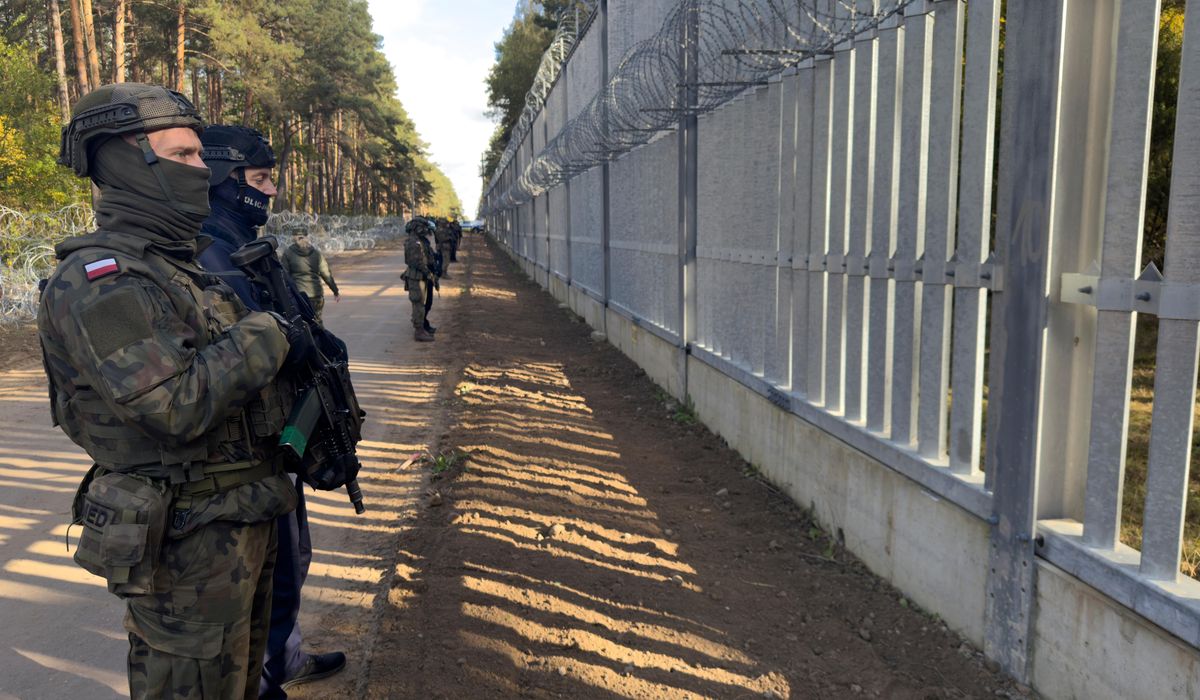
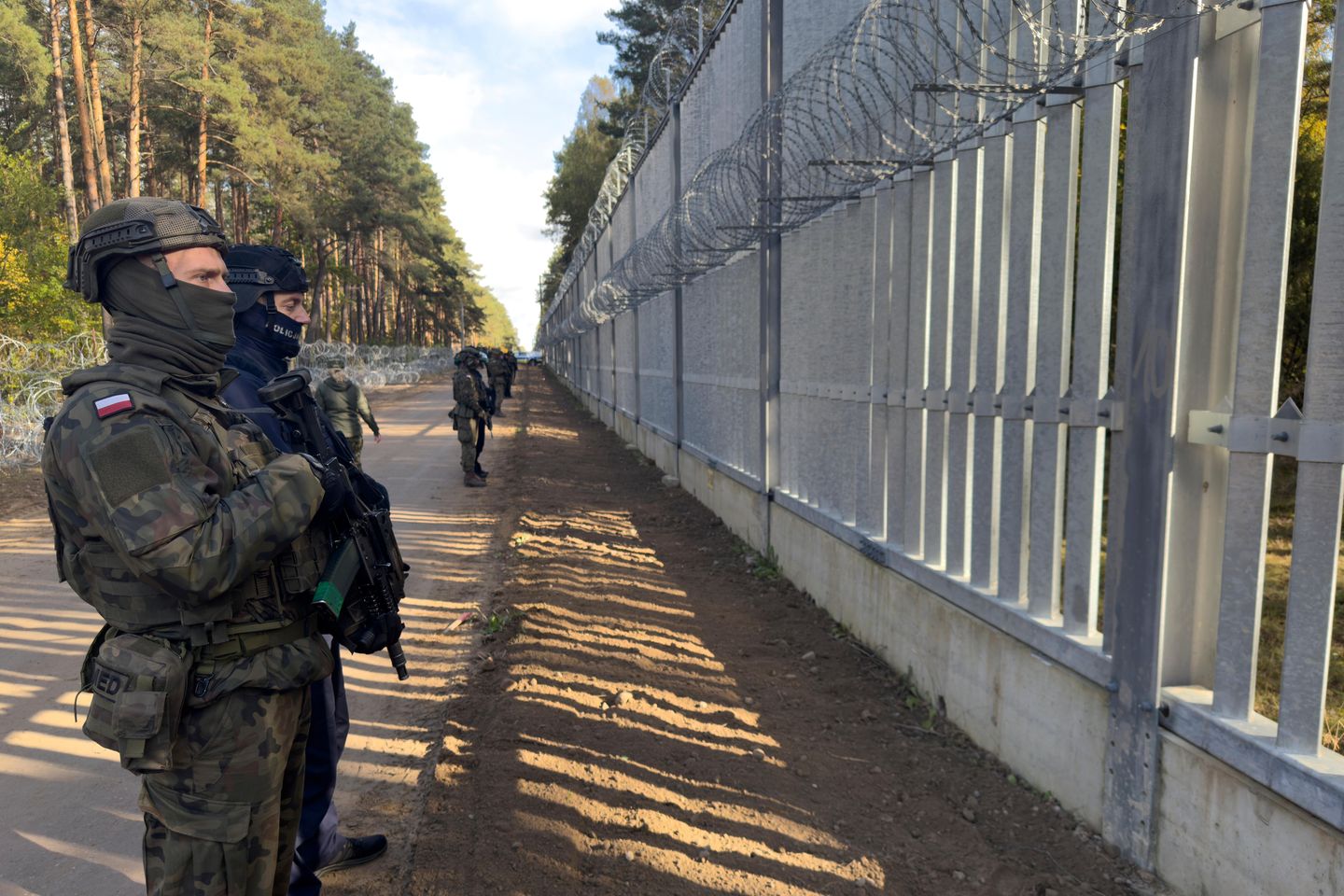
Polish border units say they are more than capable of dealing with the emerging threat. After the launch of Russia’s invasion of Ukraine, Poland began building a large, 128-mile-long wall. The wall is supported by 3,000 cameras, electrical monitoring systems and sensors.
European security officials suggest that the tunnels show a particularly high level of expertise that The Telegraph reported is linked to Hamas. According to Onet.pl, one of the most established news portals in Poland, the country’s Minister of Interior and Administration, Marcin Kierwiński, has said that while some of those involved in the construction were from Kurdistan and has thus far refused to comment on potential links to other Middle Eastern terror networks. In part this is because Poland holds only Belarus responsible for the infiltration tunnels.
“The Belarus regime has ties with despotic regimes and terrorist groups around the world, including Hamas and the Taliban,” said Pavel Slunkin, a former Foreign Ministry official in Belarus, told The Washington Times.
Mr. Slunkin, now a visiting fellow at the European Council on Foreign Relations, a think tank, said that he had heard rumours that illegal migrants had been there before the story broke. Slunkin said while it was possible that Middle Eastern terrorists were engaged in the construction of the tunnels, it was by no means a certainty.
“However, digging a tunnel under a border isn’t a technical miracle in the 21st century. The regime has enough capabilities and knowledge to do it on its own.”
The most extensive knowledge around tunnelling in the world right now is among Palestinian militants in Gaza. The so-called “Gaza Metro” includes at least 200 miles of tunnels, some reinforced with concrete, dug under the Gaza Strip to enable Hamas’s war on Israel. Elsewhere, criminal networks have used tunnels for drug smuggling and prison escapes. The U.S.-Mexican border is one global hotspot for such criminal activity.
“Building tunnels like this takes skill, said John Campbell, a former sapper with the Royal Engineers. “In Gaza, the guys who build tunnels have become experts at digging, mining, and shoring up the tunnels as well. The images I saw from Poland showed signs of similar work — without the concrete finishing because these were clearly meant as short-term use tunnels.”
During his deployment in Afghanistan, Mr. Campbell recalled British troops seeking specialist advice on subterranean warfare from Royal Engineers headquarters. The response was sobering: a scanned copy of the Royal Engineers’ Field Service Pocket Book, offering tips such as listening for digging sounds with buckets full of water. The manual was dated 1917.
“There is a lucrative market for a Hamas or Taliban tunnelling expert who is willing to work for criminal networks. While militant groups have made tunnelling into a specialised art, Western militaries have often forgotten it.”