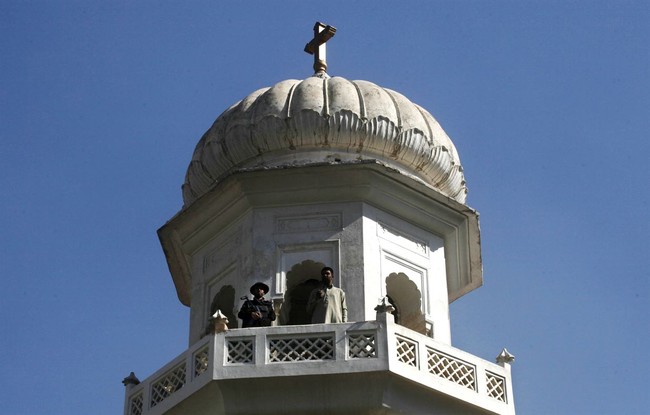
A Pakistani Christian could face the death penalty due to blasphemy allegations.Trial proceedings were completed for Ishtiaq Saleem, who was accused of downloading blasphemous material on social media, Alliance Defending Freedom International (ADF) said in a news release on 18 March. Saleem will receive a verdict after court proceedings conclude for his alleged accomplice, Muhammad Umair, ADF said.
Saleem, a 34-year-old sanitation worker, denied the charges. He has been imprisoned for three years during court proceedings and has been repeatedly denied bail, ADF said. The organization alleged his charges were fabricated and false.
According to the United States Commission on International Religious Freedom,
In November 2022, authorities in Islamabad arrested Saleem after he was accused of sharing content deemed blasphemous on social media. Authorities charged Saleem with “intending to outrage religious feelings,” “desecrating the Qur’an,” and “insulting the Prophet Muhammad,” “using derogatory remarks in respect of holy personages,” and “inciting interfaith hatred.”
Saleem’s father told Morning Star News that his son inadvertently downloaded sacrilegious images that someone else had shared in a social media group. Saleem did not even realize the images were on his phone when he was arrested, added his father.
Saleem’s charges were fabricated by the Blasphemy Business Group, according to ADF. The group has repeatedly invented charges in order to blackmail and entrap people, according to a report from Pakistan’s National Commission on Human Rights.
Pakistan’s blasphemy laws (Section 295-C of the Penal Code) mandate the death penalty for insulting Islam’s prophet Muhammad, frequently targeting Christians and other minorities, often due to personal disputes. Although the text mentions life imprisonment, the Federal Sharia Court ruled in 1991 that only the death penalty is consistent with Islamic law, effectively mandating it.
Pakistani courts have handed down several death sentences to Christians and other citizens. Furthermore, many in the country face mob violence or prolonged imprisonment when accused of blasphemy. Some have been lynched before their case trials begin.
In 2024, a court in Pakistan sentenced a 22-year-old student to death on charges of blasphemy over WhatsApp messages. The court in Punjab Province said he had shared blasphemous pictures and videos with the intention to outrage the religious feelings of Muslims. A 17-year-old was also sentenced to life imprisonment as part of the same case.
In the ruling, the judges said the 22-year-old was sentenced to death for preparing photos and videos that contained derogatory words about Islam’s prophet Muhammad and his wives. The younger defendant was given a life sentence for sharing the material.
Pakistan ranks number 8 in the World Watch List of Open Doors, which monitors global Christian persecution. As a minority in Pakistan, Christians are exposed to many challenges, from everyday discrimination to the threat of deadly violence.
On August 16, 2025, for instance, a Christian laborer in Sialkot district (Punjab) was stabbed to death after trying to rescue a Christian boy who was threatened by two Muslim men.
Christians have been a small minority in the Islamic Republic of Pakistan since independence in 1947. There are currently around 4,785,000 Christians in the country. Ninety-six percent of the population is Muslim, of which the majority follow the Sunni tradition. According to Pakistan’s constitution, the right to free speech is subject to the restrictions necessary to ensure “the glory of Islam.”
To this end, Pakistan’s blasphemy laws are increasingly used to intimidate the Christian community and other religious minorities (as well as ex-Muslims).
On July 19, 2025, a Christian man in Lahore was arrested and charged with blasphemy after complaining about being overcharged in a grocery shop. He was beaten by police who wanted his confession.
There are many similar cases in the country. Blasphemy allegations are often used as a pretext for settling scores, for the entrapment of Christians, or for economic reasons (including forced evictions). The penalties for those convicted are severe, including death. The mob violence these accusations can provoke has a wider impact, as illustrated by the 2023 Jaranwala attacks.
On August 16, 2023, in Jaranwala, Pakistan, a mob destroyed over 20 churches and dozens of Christian homes following false allegations that two Christian residents desecrated the Quran. The violence, triggered by rumors, led to widespread arson and looting, causing fear and displacement in the Christian community.
Two years later, the government remains unwilling to prosecute those involved.
According to Open Doors,
Christians are monitored by the Pakistani State and increasingly by non-state actors. In workplaces, the pressure against Christians is often so great that they have to change jobs multiple times to avoid being forced to convert to Islam. No matter their qualifications, Christians are often reduced to low-level jobs. Outside of public offices, businesses and farms run by Christians are boycotted and sometimes destroyed by Muslims.
Blasphemy laws make it dangerous to share one’s faith with Muslims. Even Facebook posts can be risky if the content is seen as challenging Islamic values. For example, in March 2025, a 24-year-old sweeper, Arsalan Gill, was taken into custody after returning home from work and charged with sharing blasphemous content on Facebook groups. It is dangerous for Pakistani Christians to keep Christian materials beyond their immediate personal use, as they could be suspected of evangelizing Muslims. Displaying Christian symbols or having a Christian name can trigger discrimination or vandalism of property.
On February 27, the European Centre for Law and Justice (ECLJ) submitted an official contribution to the United Nations special rapporteur on summary, extrajudicial, and arbitrary executions in Pakistan. The organization denounced the mandatory and automatic imposition of the death penalty for blasphemy against Islam in Pakistan. They note that it is incompatible with the prohibition of torture and cruel, inhuman, or degrading treatment or punishment, as well as with the protection of human dignity. Both are guaranteed under Articles 7 and 10 of the International Covenant on Civil and Political Rights (ICCPR).
“The mandatory and automatic nature of the death penalty for blasphemy against Islam in Pakistan is contrary to human dignity,” said the ECLJ. “Beyond this inherently unacceptable legislation, Pakistani Christians are arbitrarily placed on death row for blasphemy they did not commit.”
The ECLJ referred the matter to the United Nations special rapporteur on summary, extrajudicial or arbitrary executions, urging him to address these violations with the Pakistani authorities.
Some of the Pakistani blasphemy cases that the ECLJ presented in its report include:
Shahzad Masih was 16 years old when he was accused in July 2017 following a religious discussion with a coworker. The report of the senior police officer overseeing the investigation concluded that his remarks were not insulting to Islam. Despite this finding, charges were brought. The court refused to recognize him as a minor and sentenced him to death in November 2022. His appeal remains pending before the Lahore High Court after multiple postponements.
Brothers Qaisar and Amoon Ayub were arrested in 2014 after their names and contact information were found on a website publishing content deemed blasphemous. However, the investigation failed to establish that they were the authors of the site. Pakistani authorities even contacted WordPress to identify the creator but received no response. Despite the absence of direct evidence, the brothers were sentenced to death in 2018. Their appeal before the Supreme Court has been repeatedly delayed.
In another case, Ahsan Masih was arrested in August 2023 for allegedly sharing an image considered blasphemous on TikTok. The image was not found on his phone, yet he was nevertheless sentenced to death.
Intizar Masih, for his part, has been prosecuted since March 2023 alongside approximately twenty others for alleged blasphemous exchanges in a WhatsApp group. His trial is ongoing, and he also faces the death penalty.
These cases demonstrate that, beyond the inherently problematic nature of the law itself, many Christians are accused of blasphemy for acts they did not commit and are convicted following proceedings marred by serious irregularities. Even under a flawed legal framework, such convictions should not occur.
The ECLJ called on the United Nations “to urge Pakistan to amend its legislation so that individuals accused of blasphemy can no longer be sentenced to death, in order to uphold human dignity as well as freedom of expression, freedom of religion, and the guarantees of a fair trial.”
For Pakistan to cease murdering, imprisoning or beating up Christians and other citizens for blasphemy charges, Western nations should consider taking harsher measures such as preventing Pakistan from benefitting from the EU’s Generalized Scheme of Preferences (GSP+) and ending the U.S. military and economic aid to the country.
Editor’s note: Get exclusive content and support independent journalism with 60% off a PJ Media VIP membership. Use promo code FIGHT and join today.