CAIRO — Iran’s government is detaining family members and threatening to seize the property of Iranian opposition figures in exile, some tell The Associated Press, in the latest crackdown on dissenting voices as the war rages on.
Activists overseas play a key role in tracking the crackdown, which is complicated by the internet shutdown imposed earlier this year during massive nationwide protests against the Islamic theocracy. Watchdogs say security forces shot and killed thousands of people.
The war with the United States and Israel has intensified the authorities’ threats against anyone speaking to outside media or activists. Now that pressure appears to be expanding to intimidate activists in exile.
Iran ’took my mother away to make me be quiet’
This 2023 photo provided by Mehraveh …
more >
Intelligence agents in Tehran on March 15 detained the brother of Hossein Razzagh, a former political prisoner who fled last year to Europe, Razzagh told the AP.
“My own brother isn’t at all political and doesn’t do any kind of political activity. It’s to put me under pressure,” he said.
His brother, Ali, was taken from his home in Tehran and was able to phone his wife that night “for a few seconds” from a detention center run by Iran’s Intelligence Ministry, Razzagh said.
Since then, the family and his lawyer have been unable to contact him. But the intelligence ministry told them it was reviewing his contact with his brother, Razzagh said.
Another activist who fled, Behnam Chegini, said his 20-year-old niece was detained on March 10 for a week. The niece was taken from her parents’ house in the city of Arak soon after she returned from Tehran, where her university had closed because of the war.
She was later released on bail and put under a travel ban.
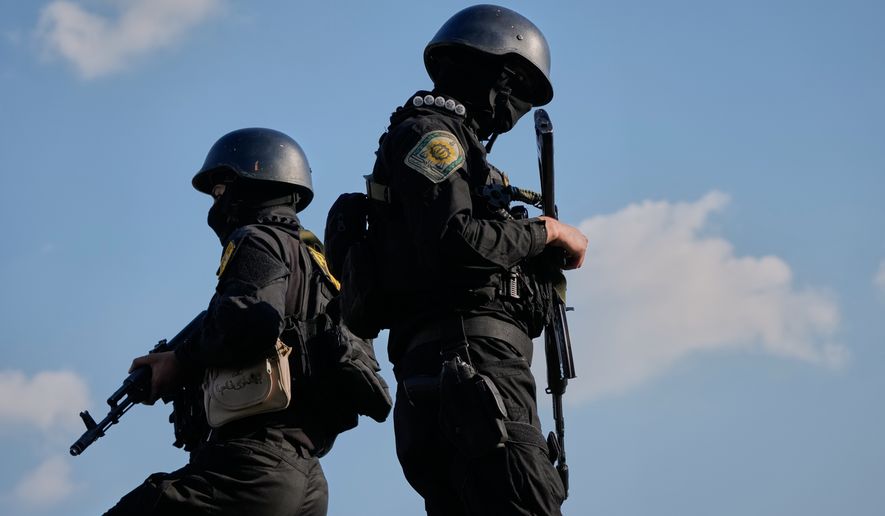
Iranian police special forces stand guard …
more >
Chegini, who is now based in France, said the detention was at least in part “because she is my niece and they know that.”
Sareh Sedighi, an activist who fled after her 2021 death sentence was overturned, said her mother was detained from her home last month in the western town of Urmia.
“The Islamic Republic took my mother away to make me be quiet,” she said. Her mother suffers from health problems and requires daily insulin doses, she added.
And Mahshid Nazemi, a former political prisoner and activist who now lives in France, said at least one friend was detained and questioned about contact with her.
Authorities target the property of outspoken exiles
Iran’s judiciary has begun seizing the property of public figures critical of the country’s rulers, under an anti-espionage law approved during last year’s 12-day war with Israel that punishes media and cultural activities deemed to support Iran’s enemies.
A judiciary spokesman on March 31 said on state TV that more than 200 indictments for confiscations have been or are being issued.
Borzou Arjmand, an Iranian actor living in California, found out from news reports that his assets in Iran had been confiscated. After his outspoken support for protests in 2022, Arjmand was unable to return to Iran. Since then, authorities have blocked his bank accounts.
Arjmand has expressed support on social media for Reza Pahlavi, the son of Iran’s last shah, who has organized an opposition movement abroad and supported U.S.-Israeli strikes.
Pressuring exiled figures is meant “so the Iranian people’s voice doesn’t reach the world,” Arjmand said.
At least three other figures living outside Iran – star soccer player Sardar Azmoun, musician Mohsen Yeghaneh and university professor Ali Sharifi Zarchi – have been on lists of confiscations, according to two semiofficial news agencies in Iran. Yeghaneh and Zarchi have expressed support for anti-government protesters on social media.
Rights groups say conditions are worsening
Iranian security and judicial officials have warned that any new anti-government protests will be met with lethal force.
State media regularly report arrests around the country, describing people as “mercenaries” or “agents” of Israel and the United States, “royalist thugs” or “traitorous elements.”
Reports have alleged that some sent information to “hostile networks.”
Iran Human Rights, a Norway-based group, has tracked several hundred detentions since the war began on Feb. 28, using its networks in the country and state media reports, said its director, Mahmood Amiry-Moghhaddam. He said the full number is likely far higher.
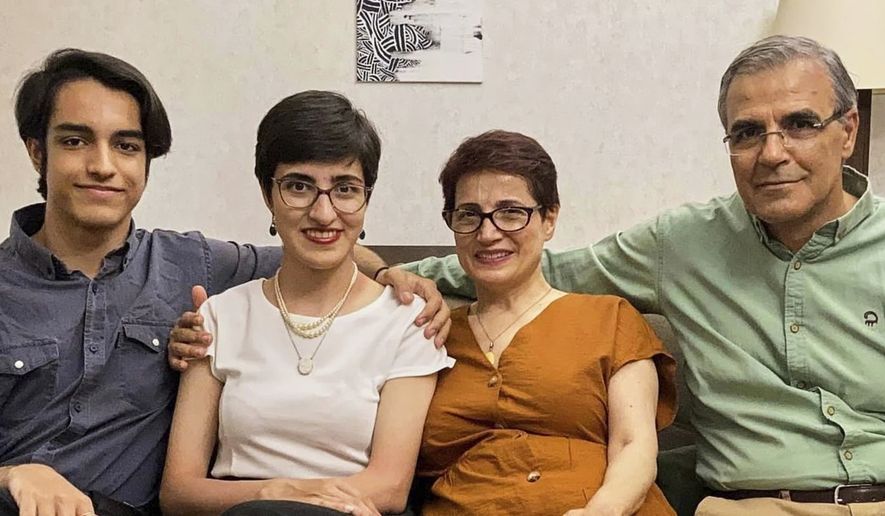
Among those detained is human rights lawyer Nasrin Sotoudeh, taken by intelligence agents from her house in Tehran, said her daughter Mehraveh Khandan, who lives in Amsterdam. The 64-year-old Sotoudeh had been out on bail for health reasons following an earlier detention.
Little is known about how trials are functioning, as Israeli airstrikes have targeted buildings connected to the judicial system. “It’s like they are half-closed. A lot of judges are staying home,” said Musa Barzin, a lawyer with Dadban, a group of rights lawyers based abroad.
Some report deteriorating conditions inside crowded prisons. Speaking from Tehran, the wife of a political prisoner held at Iran’s Evin Prison worried it could be struck as it was during last year’s war.
“Explosions and smoke can be heard and seen from everywhere in the city. Every time we hear a sound, we get scared,” she said, speaking on condition of anonymity for her family’s safety.
Iranian opposition tries to organize overseas
The situation has led to new attempts to organize the highly fragmented Iranian opposition abroad.
Shortly before the war, Razzagh and others began planning an opposition conference in London, the Iran Freedom Congress, to bring together pro-democracy groups. Razzagh represented a group of Iran-based opposition figures including Soutoudeh and imprisoned Nobel laureate Narges Mohammadi.
He called the conference a first step toward forming a coalition to push for a “political transition” in Iran.
For decades, Iran’s rulers have quashed organized political opposition. Some activists in the diaspora say the war is worsening that pressure.
“Israel and America are saying, well, if the Islamic Republic doesn’t kill you, let us bomb you. They’ve been taken hostage from both sides,” Nazemi said of Iranians back home.