
Deposed Venezuelan President Nicolás Maduro pleaded not guilty in a federal courtroom in New York City to charges alleging he had masterminded a narco-terrorism conspiracy before U.S. forces captured him in a daring weekend raid in the capital of his South American nation.
Mr. Maduro wore a blue prison uniform and a headset to listen to a translation of the proceedings, which included an outline of the charges against him. He was defiant in his remarks to the courtroom.
“I was captured,” Mr. Maduro told the judge. “I am a decent man, the president of my country.”
“I am innocent. I am not guilty of anything that is mentioned here,” he said.
Mr. Maduro and his wife and codefendant, Cilia Flores, wore headsets to understand the proceedings in the lower Manhattan courtroom.
Mr. Maduro faces a lengthy criminal process that could take more than a year and raises thorny legal questions, including whether the U.S. raid to capture him was legal and whether he is entitled to immunity because of his status as a head of state.
SEE ALSO: Maduro’s removal draws comparisons to Noriega, though stark challenges remain
“It’s my job to assure this is a fair trial,” said U.S. District Judge Alvin K. Hellerstein, a Clinton appointee. “That’s my job, and that’s what I intend.”
An indictment charges Mr. Maduro, his wife and other Venezuelan officials of a narco-terrorism conspiracy, cocaine importation conspiracy, possession of a machine gun and other destructive devices, and conspiracy to possess machine guns and other destructive devices.
Court papers say Mr. Maduro led a “corrupt illegitimate government” that abused its power to “transport thousands of tons of cocaine to the United States.” He used the proceeds from the illegal drug activity to enrich himself, his family and Venezuela’s political and military elite, the indictment says.
Mr. Maduro repeatedly said he remains the leader of his country and was learning his U.S. rights in real time.
“I did not know of these rights,” he said through his interpreter. “Your honor is informing me of them now.”
Ms. Flores also said she maintains her role back home.
SEE ALSO: Trump administration starts outlining post-Maduro strategy, keeping grip on Venezuelan oil
“I am first lady of the Republic of Venezuela,” she said.
Asked to enter a plea, she responded: “Not guilty. Completely innocent.”
Her attorney, Mark Donnelly, said Ms. Flores may have a fracture or severe bruising on her ribs and needs medical attention.
Mr. Maduro is represented by Barry J. Pollack, a Washington-based lawyer known for securing WikiLeaks founder Julian Assange’s release from prison and winning an acquittal for former Enron accountant Michael Krautz.
Mr. Pollack said he is not seeking bail for Mr. Maduro but might in the future. The lawyer said there were questions about the legality of Mr. Maduro’s “military abduction,” so he would file pretrial motions to address that issue.
Mr. Maduro’s next court appearance will be on March 17.
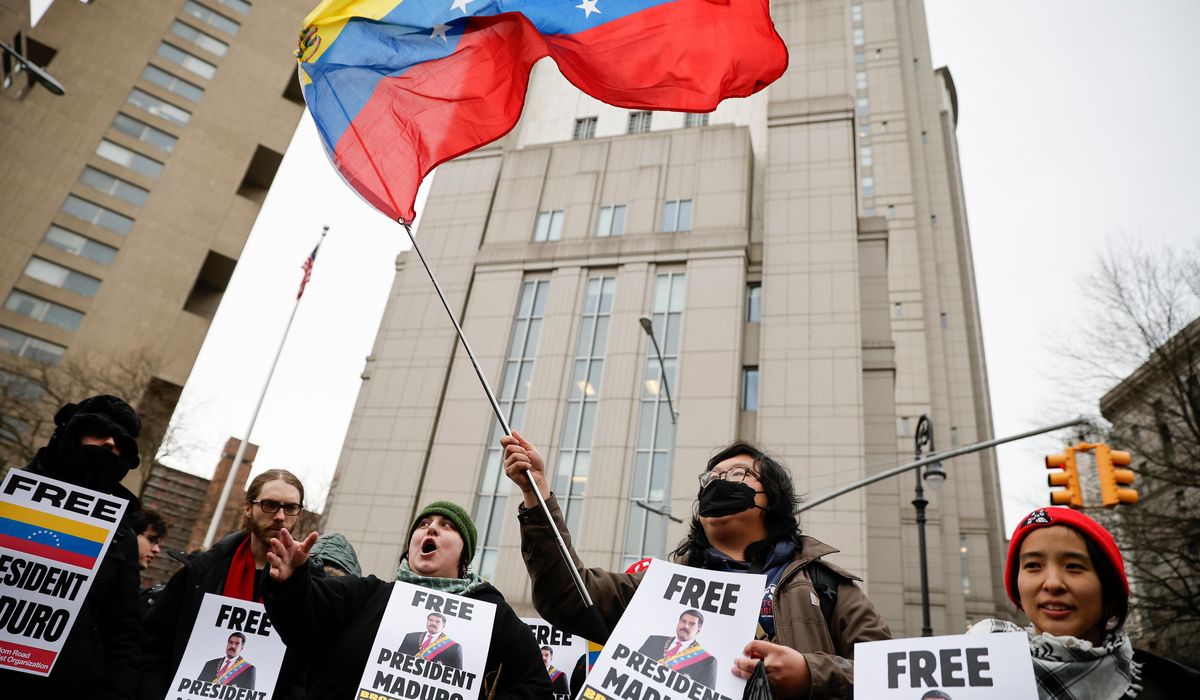
Videos circulating on social media showed protesters gathered outside the Manhattan courthouse to condemn the raid while anti-Maduro demonstrators scolded them and tussled over Venezuelan flags.
The Maduros were whisked from the presidential palace in Caracas to a federal jail in Brooklyn over the weekend after a stunning U.S. military raid.
Prosecutors said Mr. Maduro and his wife were taken into law enforcement custody at 11:30 a.m. Saturday. Their plane landed in New York at 4:31 p.m. Saturday.
The Trump administration said Mr. Maduro is an illegitimate leader who harmed Americans through illegal activity.
International leaders shed few tears for Mr. Maduro, citing his heavy hand in leading Venezuela. But some are fretting about the nature of his capture, whether President Trump will attempt to seize Greenland or upend other countries and whether the raid sets a poor precedent for aggressive nations like Russia and China.
U.N. Secretary-General Antonio Guterres said he is “deeply concerned that rules of international law have not been respected with regard to the 3 January military action.”
At home, Republican lawmakers largely cheered the decisive action to remove Mr. Maduro and force him to face U.S. justice, while Democrats said Mr. Trump should not have acted without consulting Congress for war authorization.
The raid capped months of pressure on Mr. Maduro, including Mr. Trump’s decision to authorize deadly air strikes on boats that allegedly carried drugs from Venezuela.
Some experts questioned whether the underpinning of the actions — drug trafficking — warranted the removal of a foreign leader.
“Maduro was a brutal thug who impoverished and terrorized the Venezuelan people, and he himself is charged with being a drug trafficker, but a new offensive in the lost drug war is not a good reason for the raid,” said Jeffrey A. Singer, a senior fellow at the libertarian Cato Institute, adding that Venezuela is not the major source of fentanyl that enters the U.S.
“Drug smugglers aren’t terrorists,” Mr. Singer said, “and suggesting that military action in Venezuela will ’save hundreds of thousands of lives’ is pure fantasy detached from any serious policy analysis.”
Mr. Trump says the U.S. will be “in charge” of Venezuela, an oil-rich nation, while it sets up a new government.
U.S. stocks rose on Monday in a sign that investors do not see inherent economic risks from the raid.
Oil stocks such as Chevron and ConocoPhillips rose after Mr. Trump said U.S. companies would play a role in rebuilding Venezuelan infrastructure.
• This article was based in part on wire service reports.