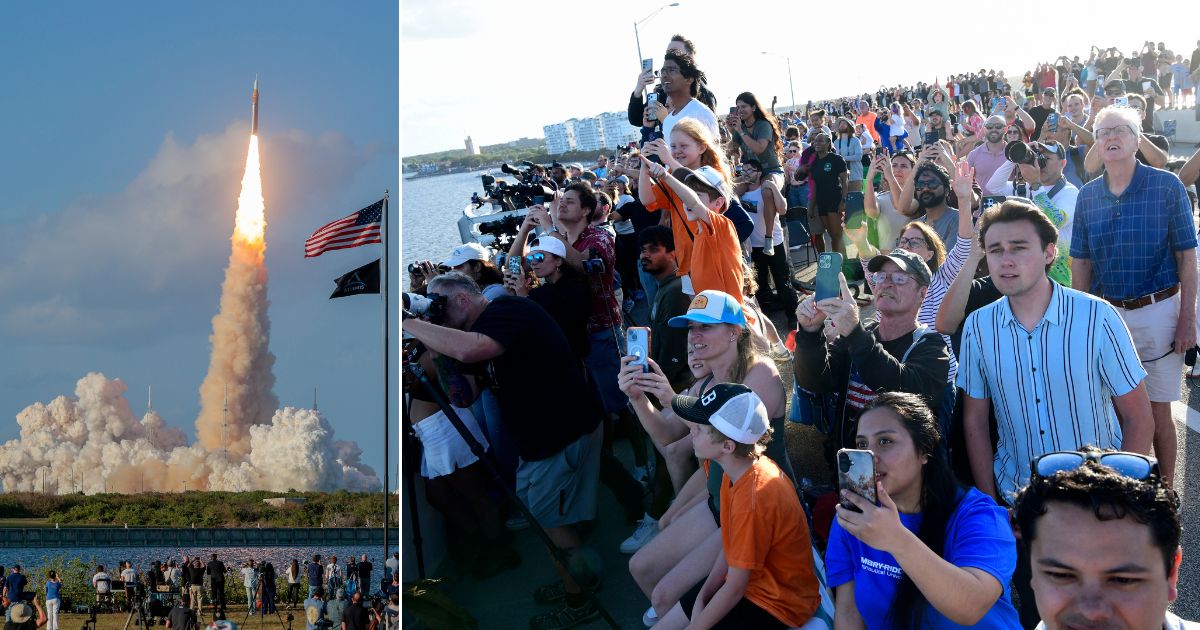
Wednesday night, I sat in a grocery store parking lot for half an hour watching the Artemis mission to the moon on my phone with the excitement of a 10-year-old kid.
A successful launch that, God willing, will see a crew of four astronauts return home after making a pass around the moon is something historic and fun.
NASA has not ventured outside of Earth’s orbit in my lifetime, which is a big deal if you ask a lot of people.
This animation shows NASA’s Artemis II mission path, a journey of nearly 685,000 miles. The crew will travel in a figure-eight trajectory, looping out from Earth, around the Moon, and back again.
Follow live updates: https://t.co/PikF0FNlO9 pic.twitter.com/tnrahDMaGu
— ABC News (@ABC) April 1, 2026
My excitement at the launch turned to a kind of shock when the YouTube stream I was watching suggested I read the comments as they were posted in real time.
I lost track of how many people called the launch an outright fake, despite the fact that it was seen by countless people.
The sound alone made a space geek out of me! 🚀
Here’s one unedited minute of the Artemis II launch from our setup on the press mound.
My first time covering a launch from Kennedy Space Center… and I’m not sure I could’ve picked a better one. Thanks to everyone who watched! pic.twitter.com/23Zar7dn8f
— Pete Muntean (@petemuntean) April 2, 2026
Passengers on a commercial flight captured the launch of Artemis II on camera
The plane happened to pass near the launch trajectory at the exact moment of liftoff, giving passengers a rare view of the rocket launch right from their windows.pic.twitter.com/8Bewtm8aFg
— Visegrád 24 (@visegrad24) April 2, 2026
Artificial intelligence was named a launch culprit. Aliens were invoked. The entire event was labeled a manufactured distraction from the planet’s magnetic field dying or from hidden germs in Antarctica.
A Hollywood studio was decided on by many people as the real stage of the mission, and that was stated as a fact more times and by more people than I could count.
I shrugged it off at first, but the feeling of being outright troubled did not go away as my evening progressed.
To be clear, I wasn’t troubled that people did not share my excitement about a lunar mission. It was that more and more people are treating even basic facts as negotiable or as if everything is objective.
Of course, the spread of this social disease is not limited to space launches.
If you remind people that Israel exists in a constant state of fighting for survival and that the founding of the country was shaped by the Holocaust, some people will simply deny the Holocaust ever happened.
People will tell you your own grandfather did not actually see a death camp in Germany in the spring of 1945, at least not in the way he recounted in his later years.
They might even connect you to Mossad for reminding them that many American soldiers saw the horrors of the Second World War.
In the past, I have told people I met Neil Armstrong before he died, and what a pleasure that was. My smile sometimes faded when I was informed that Armstrong was just an actor who never even left the Earth’s atmosphere.
This pattern of suspicious, goal-post-moving thought is not sustainable as it continues to spread.
To be clear, I trust the government very little. In my youth, I was called a right-wing extremist and a conspiracy theorist more times than I could ever count.
I understand as well as anyone the importance of scrutinizing what I am being told by authority.
Now I am called a sheep for saying I watched a spacecraft take off from Florida on Wednesday evening.
In the words of more than a few commenters, “space isn’t real.”
That is no longer a fringe opinion.
Michael Knowles with The Daily Wire addressed some of this during his Wednesday livestream of the Artemis launch.
He even walked into the background of his shot and interacted with the environment to show it was real, and not simulated.
A viewer demanded I touch the grass behind me to prove it wasn’t CGI on a green screen. pic.twitter.com/XRDJhluMBY
— Michael Knowles (@michaeljknowles) April 2, 2026
It didn’t matter to many who were watching, as doubters pivoted to claiming the grass was fake.
People are right to distrust authority. Years of media lies, government coverups, curated narratives, and failures in Washington have conditioned people to assume they are being misled at least part of the time.
At the same time, AI, deepfakes, and out-of-context videos have made nearly everything look or sound suspicious at first glance.
Once people feel lied to enough, they naturally default to doubt, and it doesn’t help that they are being taken advantage of by hucksters online.
Sadly, it appears the true function of social media after two decades is that it has replaced shared facts with personal realities.
So many people have formed hives wherein they build their own version of the world and defend it. But the result is a society that cannot even agree on basic facts, like whether Michael Knowles was in Florida on Wednesday, or whether the planet is spherical.
How long can we go on like this?
Our interconnected lives rely on at least some shared understanding of what is real, and that is disappearing quickly.
Once we completely strip a shared objective reality away, everything — and I mean everything — is in danger of crumbling.
The mainstreaming of questioning even something as simple as the clouds in the sky does not point to anything or anywhere good.
We can either strive for a world where fundamental realities matter, or we can accept that at this rate, nothing will matter at all, and confusion will rule.
The question is, where do we go from here? How do we get people in the same book, or even on the same page — one where everyone agrees the lines on the page are actually there?

Advertise with The Western Journal and reach millions of highly engaged readers, while supporting our work. Advertise Today.