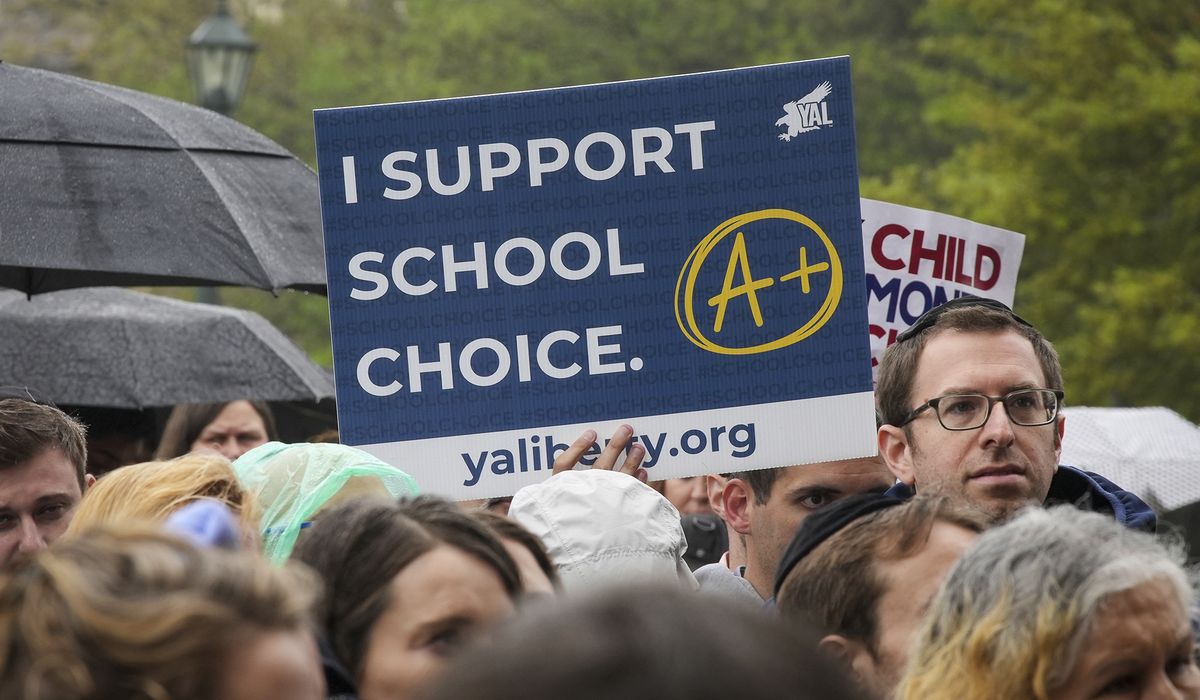
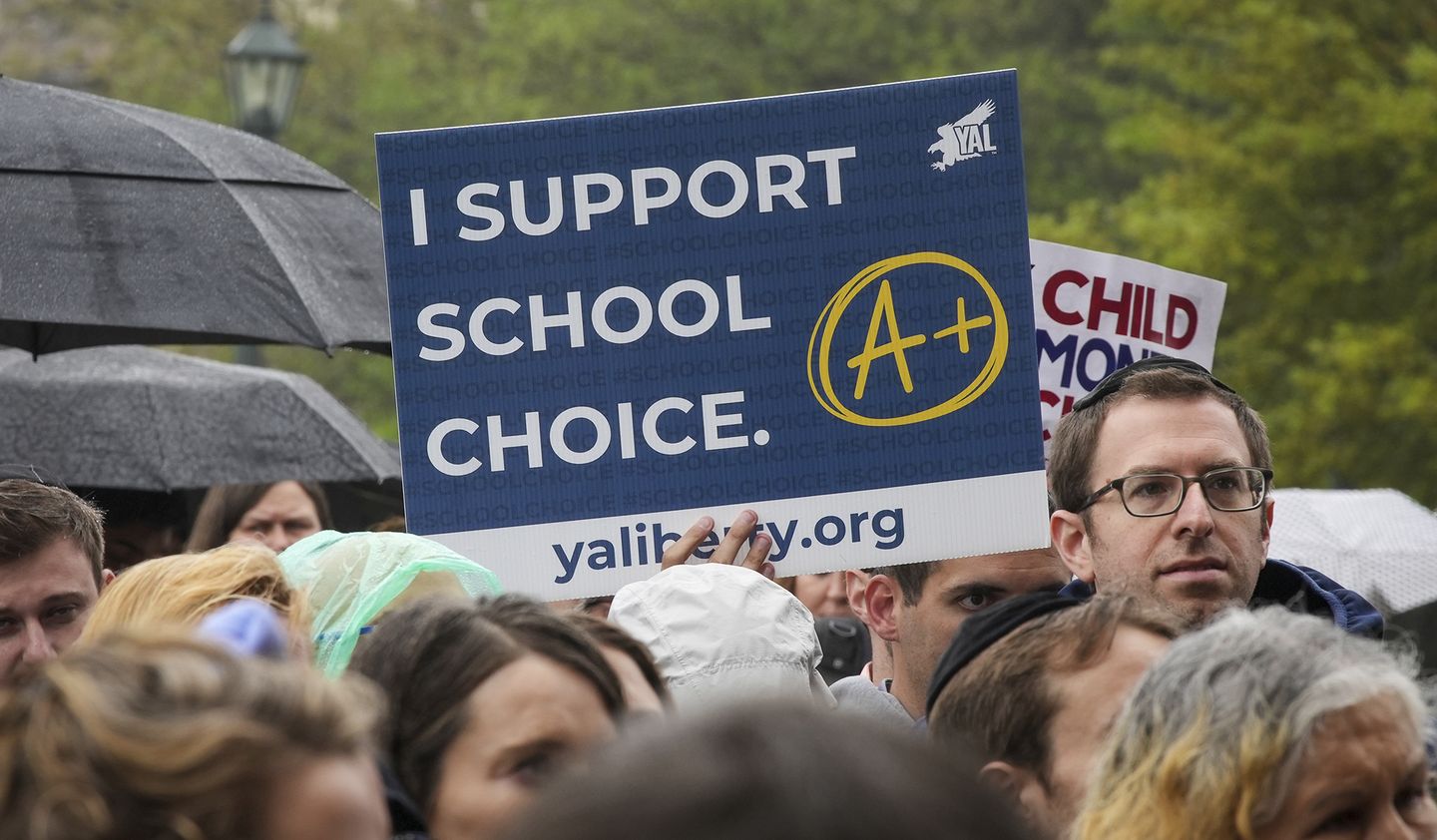
More states are expanding programs letting parents spend public money on private schools, buoyed by the Trump administration’s support.
FutureEd, a Georgetown University think tank, projects that universal school choice programs open to all families will be available this fall in 17 states, making roughly half of the nation’s pre-K to 12th-grade students eligible. That’s up from 10 states last year.
The most recent states hopping on the bandwagon include Tennessee and Texas, with the latter opening applications this month for what is expected to become the nation’s largest program. Wyoming will do the same this fall, expanding eligibility for an education savings account program from low-income students to all families.
Several education analysts interviewed by The Washington Times credited President Trump for making “universal school choice” a litmus test for Republican politicians in primaries. They said his pressure has helped overcome longtime GOP resistance in rural areas lacking private schools.
“That has had an especially significant impact in Tennessee and Texas, where Trump’s vocal support for school choice, and a handful of losses by anti-choice Republican legislators in primaries, led to seemingly miraculous ‘conversions’ of many Republican legislators to the school choice camp,” said Patrick J. Wolf, a University of Arkansas education reform professor who supports the trend.
Mr. Wolf reported that the number of students attending private schools with a state-sponsored voucher, tax-credit scholarship, or education savings account has jumped by 227%, from 660,000 students in the 2021-22 academic year to 1.5 million students this year.
States such as Indiana, Iowa, and Colorado have also opted into a GOP-sponsored federal credit that will allow individuals to deduct up to $1,700 per year in donations to state-approved nonprofits on their income tax returns starting next year.
Included in Mr. Trump’s Big Beautiful Bill, the federal tax credit will help fund nonprofits such as Arete Scholars, which distributes scholarships to 3,500 low-income children attending 350 private schools in Georgia and Louisiana. It builds on similar state tax credits in 21 states, including Florida and Arizona.
“What we’re seeing nationally isn’t a partisan wave,” said Arthur Dupre, Arete’s president. “It’s a parent-driven movement. Families want agency.”
Universal private school choice programs are funded with state taxpayer dollars, typically through dedicated appropriations or allocated portions of existing per-pupil funding.
Democrats and teachers’ union leaders have slammed the programs for helping wealthy families and siphoning money away from struggling public schools. They have also accused some states of encouraging unsustainable funding levels and allowing families to spend the money fraudulently.
Hezekiah Herrera, a teachers’ union leader at Chula Vista Elementary School District near California’s southern border, noted that 90% of U.S. children attend public schools, including most low-income and foreign-speaking families.
“Choice and equity are not interchangeable concepts,” Mr. Herrera said. “Equity requires genuine investment in high-quality public schools in every zip code, not the creation of a separate system of schools funded with tax dollars [and] subject to differing accountability requirements.”
In an emailed statement, the U.S. Department of Education touted the Trump administration’s new federal tax credit and $500 million in federal grants to expand public charter schools.
“School choice fosters a spirit of healthy competition, inspiring all institutions – including traditional public schools – to enhance their academic offerings, refine their operations, and meet the unique needs of the students they serve,” said Savannah Newhouse, an Education Department spokeswoman.
“As we return education to the states, it is heartening to see local leaders embrace the responsibility of ensuring that every child, regardless of zip code or income, is afforded opportunities to pursue success,” she added.
State programs
Arizona became the first state to enact universal school choice in 2022. Seven more states followed in 2023, including Arkansas and Utah.
The Goldwater Institute, a conservative Phoenix think tank, estimates that Arizona’s creation of universal education savings accounts from the state’s general fund has reduced per-pupil education spending by drawing students from higher-cost public schools to lower-cost scholarship awards.
Public school students in the state receive over $10,000 per child, compared with $7,500 per recipient of education savings account funds.
“Growth in the program is a positive outcome for students and taxpayers alike,” said Matt Beienburg, Goldwater’s director of education policy. “Demand for the ESA program will certainly continue, even as parents face headwinds from teachers’ unions and other activist groups.”
The Arizona Department of Education estimates that the number of participants has grown from 12,000 students in 2022 to 101,000 children who spent $872 million in the 2025 fiscal year. That’s 1 in 10 of the state’s students using the program, including roughly 40,000 who left public schools.
Last month, Democratic Gov. Katie Hobbs proposed limiting participation to disabled children and military families. She dubbed universal eligibility an “entitlement program” that wastes tax dollars, “with no accountability.”
Republican-led states have been more bullish on universal school choice. They include governors supporting the expansion of fast-growing programs in Alabama, Oklahoma, Tennessee, Texas, and West Virginia.
In Texas, most participating students will be eligible to receive $10,470 a year starting this fall, and students with disabilities can receive up to $30,000. Homeschooling families are eligible to apply for $2,000 a year.
According to Texas officials, 42,000 people applied for the program when it opened on Feb. 4 with a March 17 deadline to submit paperwork. The number grew to 111,000 on Feb. 18.
In West Virginia on Tuesday, Republican Gov. Patrick Morrisey praised the expansion of a 2021 private scholarship program to all students this year as a “real opportunity” for families.
“I will continue to defend this program and ensure that every family in our state has the freedom to choose the best educational option for their children,” Mr. Morrisey said.
Future trends
At the University of Arkansas, Mr. Wolf estimates that states are spending $11.1 billion to support private schooling and homeschooling for 1.5 million students nationwide this year.
That’s $7,462 per student receiving funds from private school choice programs, compared to an average of $20,000 per student spent in public schools nationally.
“It is dramatically cheaper for states to educate those students through a universal private school choice program than through the public schools,” Mr. Wolf said.
The American Federation for Children, a school-choice advocacy group, predicts the number of students participating in state school-choice programs will surpass 2 million nationwide in the near future.
The group attributes this growing interest to more parents seeking alternative schooling options after pandemic lockdowns at public campuses.
“We can’t afford not to sustain it,” said Ryan Cantrell, the federation’s chief state strategy officer. “The education status quo is clearly not sustainable.”
Other states that have adopted universal school choice programs since 2022 include Florida and Idaho.
The American Legislative Exchange Council, a network of conservative state lawmakers that supports the programs, touted studies showing academic improvement for students participating in them.
“Education funding should never be tied to a single system of education,” said Andrew Handel, an education and workforce development expert at the council. “Instead, it should be tied to the student and spent where that student is going to achieve the highest outcomes.”