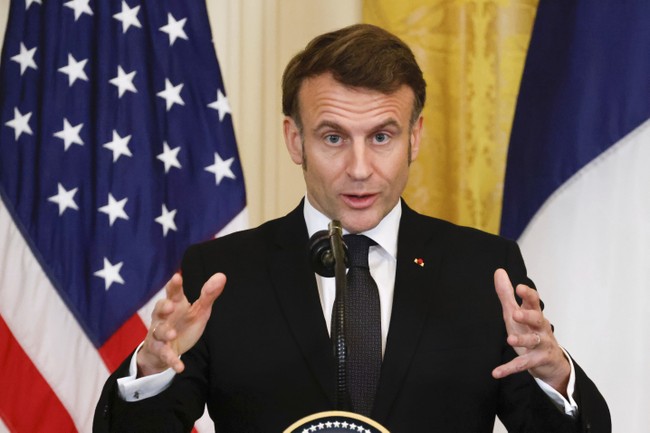
French President Emmanuel Macron recently spoke in South Korea during a meeting with South Korean President Lee Jae-myung at the Blue House.
Macron told business leaders that France offers more predictability than the United States, describing American policy as unpredictable and urging middle powers to build a third-way coalition separate from both the United States and Chinese influence.
Those powers include France, South Korea, Japan, and others. In Macron’s view, they should stand apart and chart their own course.
NOTED. 👀
“France’s Macron Criticizes Trump and Calls on Allies to Unite Against US” – Bloomberg https://t.co/RtNWDr8gDP
— Jason Miller (@JasonMiller) April 4, 2026
That line didn’t come out of nowhere. Charles de Gaulle set the tone decades ago, leading the Free French forces in World War II, but he clashed with President Franklin D. Roosevelt throughout the war. FDR never fully trusted de Gaulle, and preferred other French leaders. De Gaulle took the slight personally, even as American forces helped to liberate France in 1945, demanding to be the first ally to enter Paris. He also demanded equal standing at Allied meetings, and carried that resentment forward long after the war ended.
Once in power, de Gaulle acted on it, pulling France out of NATO’s integrated military command in 1966 and forcing NATO headquarters off French soil. He built an independent nuclear force and criticized U.S. involvement in Vietnam, a conflict that followed France’s own failure in Indochina after Dien Bien Phu in 1954.
The United States stepped into a region France couldn’t hold, yet the resentment over lost influence never quite faded. That mix of pride and grievance became part of the French political DNA.
French attitudes toward the United States often trace back to that tension. American forces helped save France in two world wars, with thousands of American lives lost on French soil. You’d expect that history to produce a lasting sense of partnership.
But no.
Instead, parts of the French political class treat the alliance as something to push against, as if independence requires constant public distance from the very power that helped secure it.
Macron follows that script almost line for line, and his remarks in Seoul came as France and South Korea discussed cooperation tied to the Strait of Hormuz, where Iran has kept disrupting that critical shipping route. He’s called a military effort to reopen the strait unrealistic, even as a French-owned CMA CGM container ship passed through the straits on April 3, one of the first transits since Operation Epic Fury began.
The timing says plenty; Macron points to American unpredictability while benefiting from the broader security environment American power helps maintain. He pitches France as a stable alternative for investment, telling Korean executives they can avoid U.S. tariffs and Chinese pressure by turning to Paris instead.
NOTED. 👀
“France’s Macron Criticizes Trump and Calls on Allies to Unite Against US” – Bloomberg https://t.co/RtNWDr8gDP
— Jason Miller (@JasonMiller) April 4, 2026
It’s a neat sales pitch, at least until you look at the foundation it rests on.
Macron acts and sounds like a bloody fool when he publicly takes shots at the United States, forgetting that American defense spending and nuclear deterrence let his country feel a measure of safety.
That protection doesn’t disappear just because Macron wants to sound independent in front of a room full of executives. He knows where his security comes from, and he also knows South Korea depends heavily on U.S. military strength to counter threats from North Korea and China.
Standing in Seoul and lecturing about American reliability takes a certain kind of nerve.
Not to mention French arrogance.
The pattern stretches across generations: De Gaulle pushed back against American influence to restore French prestige. Macron elaborates on a third way to elevate France on the global stage. Both approaches lean primarily on symbolism, while quietly relying on the same American power they criticize in public.
It’s not a new strategy; it’s a recycled one with better lighting and a different audience.
French voters and European partners see what’s happening; Macron faces domestic pressure and economic strain, and the international stage offers a chance to project strength.
It’s a bold statement using strong rhetoric, but it carries a cost. Allies don’t ignore public criticism, especially when it comes from a partner nation that still depends on the alliance structure for its security.
Macron delivers his remarks with confidence, pointing to international law and trade stability, as if those exist in a vacuum.
They don’t; they exist inside a framework shaped by American military and economic power. Strip that away, and the picture rapidly changes. The independence he promotes relies on a system he didn’t build and can’t replace.
France doesn’t become stronger by pretending it stands alone; it weakens its position by creating doubt where cooperation should exist. Macron can keep talking about a third path, but he hasn’t shown what replaces the one that already works. Until then, the message lands as posturing rather than strategy.
The history is there for anybody willing to look. The United States stepped in when France needed help more than once, a reality that doesn’t vanish because it makes some leaders uncomfortable. Macron can dress up his argument any way he wants, but the results look the same.
France reaches for independence while standing on a foundation built by someone else.
When you strip away the speeches and look at results, the story changes fast. PJ Media VIP keeps that focus front and center. Use promo code FIGHT for 60% off and see the difference.