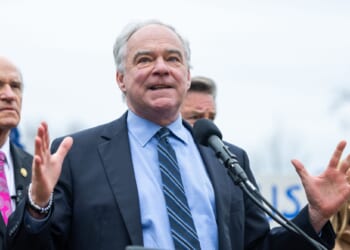
Back when Attorney General Keith Ellison was a mere Congressman instead of the Attorney General of my state, he passed only one bill during his 12 years in that
Of all the bills he sponsored, he was able to successfully pass only one. It must have been really important to him to put it all on the line to convince his colleagues to go along with him, right? After all, it wasn’t to rename a post office or anything. It was to actually change a policy intended to prevent money laundering.
He had to be pretty passionate and persuasive.
Keith Ellison served as a congressman for more than a decade and the only bill he sponsored and was signed into law was Money Remittances Improvement Act of 2014.
His only concern was about getting money to Somalia pic.twitter.com/fadZAKHUa7
— easttowestt 🌍 🇮🇱🇹🇼 (@westtoeastt) January 20, 2026
It turns out that this bill was the Money Remittances Improvement Act, which created the conditions through which those hundreds of millions or likely billions of dollars were fraudulently acquired and sent off to fund the Somali civil war and to enrich members of Somali clans associated with those who settled here in Minnesota.
Holy f’n hell.
Keith Ellison sponsored the Money Remittances Improvement Act of 2014 while in Congress, signed into law by Obama.
The lawsuit eased regs and put most of the oversight into state hands. We see how that worked out.
His concern was getting $$$ to Somalia. https://t.co/QNZvG2G4y6
— CrimeWatchMpls (@CrimeWatchMpls) January 20, 2026
Any financial bill is complicated, but the most relevant portion of the bill in this case is to transfer the authority to monitor money transfers to foreign countries to the states, which are in turn supposed to ensure that federal regulations are strictly adhered to.
Here’s Perplexity.ai’s description of the bill:
The Money Remittances Improvement Act of 2014 is a federal law that streamlines how U.S. regulators oversee certain money-transfer and remittance businesses, mainly by allowing federal authorities to rely on state examinations of those institutions instead of always doing their own separate federal exams.
Purpose and context
The law’s core purpose is to reduce duplicative regulation and compliance burdens for nonbank financial institutions such as money services businesses (MSBs) that handle remittances, while maintaining federal oversight of anti–money laundering and related reporting requirements.
It was motivated in part by concerns that heavy, overlapping regulation and bank de-risking were making it harder and more expensive for immigrant and diaspora communities to send money to family members abroad, even though remittances are a major financial lifeline to developing countries.
Main provisions
The Act amends the Bank Secrecy Act framework (including 31 U.S.C. 5318(a)) to authorize the Secretary of the Treasury to rely on examinations conducted by a state supervisory agency for a “category of financial institution,” if either that category is required to comply with the relevant federal anti–money laundering/reporting requirements, or the state agency already examines that category for compliance with those federal requirements.
It similarly amends earlier federal law on reporting requirements for financial institutions (12 U.S.C. 1958) so that the Secretary may rely on state exams for compliance with that statute and with section 21 of the Federal Deposit Insurance Act, again where state supervisors already ensure compliance with those federal standards.
Regulatory effects
In practice, this allows the Financial Crimes Enforcement Network (FinCEN) and Treasury to use state exam findings for MSBs and other affected institutions instead of performing fully separate federal on-site examinations for the same issues, reducing duplicative audits and compliance costs.
The Act also requires the Secretary of the Treasury to consult with state supervisory agencies when issuing rules to implement this new reliance on state examinations, reinforcing a coordinated federal–state oversight approach.
Hmmm. You do see the problem here, right? Instead of the federal government monitoring the activity, the responsibility is transferred to the states. In turn, the federal government is forced to rely on the competence and integrity of state officials to conduct financial regulation of businesses that are ideally suited to shipping large amounts of money out of the country to…God knows who.
I don’t know about you, but I suspect the competence of state officials to do so, even if they were fully committed to ensuring that everything is on the up and up.
But what if they aren’t on the up and up. Especially when the man who pushed through this bill becomes Attorney General in a state where massive fraud begain to take place when he and Tim Walz become Attorney General and Governor of the state?
It’s almost as if the system were intentionally designed not to aid in the small remittances of people working in menial jobs as refugees to send money to their families back home, but rather to enable the shipment of hundreds of millions or billions of ill-gotten gains abroad.
Naah. Couldn’t be.
Such corruption is impossible in America, right? A no man with the patriotism and integrity that would vault him to the exalted heights of Congressman, Deputy Chair of the Democratic National Committee, and then Attorney General would ever participate in a scheme to defraud the state and federal governments, right?
 One would have to be very cynical to believe such a thing.
Editor’s note: If we thought our job in pushing back against the Academia/media/Democrat censorship complex was over with the election, think again. This is going to be a long fight. If you want to join the conversation in the comments — and support independent platforms — why not join our VIP Membership program? Choose VIP to support Hot Air and access our premium content, VIP Gold to extend your access to all Townhall Media platforms and participate in this show, or VIP Platinum to get access to even more content and discounts on merchandise. Use the promo code FIGHT to join or to upgrade your existing membership level today, and get 60% off!