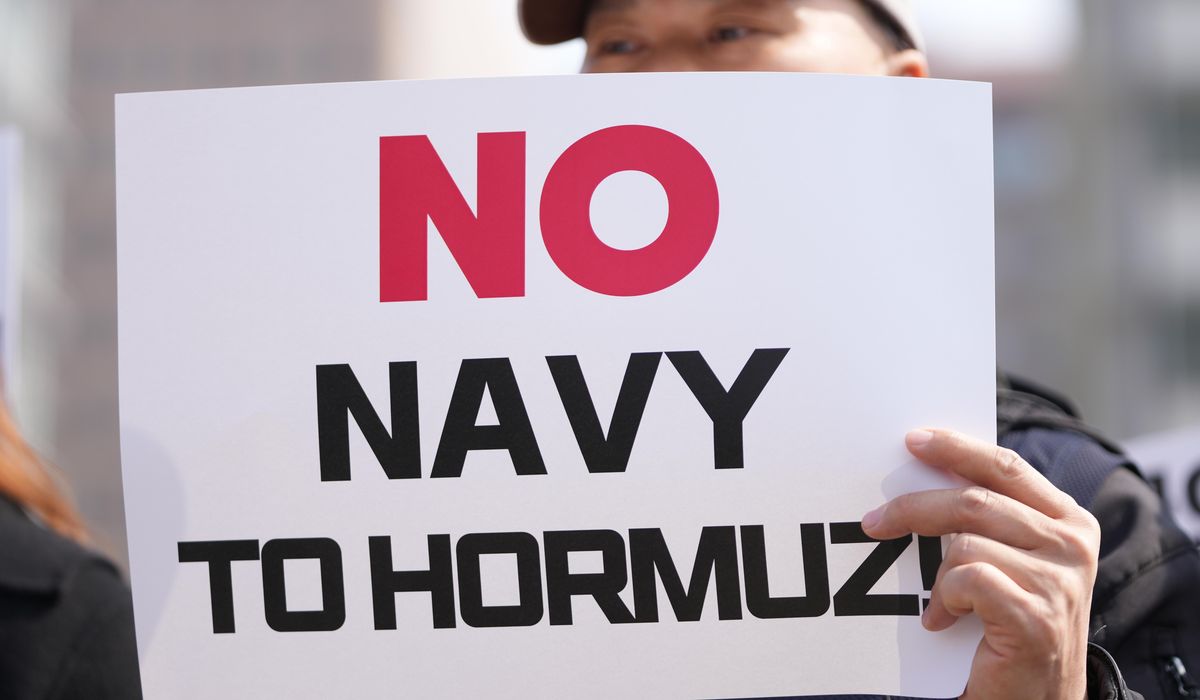
SEOUL, South Korea — South Korea and Japan on Monday downplayed the possibility of sending warships to secure tanker transit through the Strait of Hormuz, defying U.S. President Trump’s call for global powers to join the effort.
Mr. Trump sent a Truth Social tweet on Saturday and followed up Monday with related comments pressuring countries to send warships to a warzone where Iranian resistance to the ongoing Israeli-U.S. aerial barrage remains resolute.
Tehran, though militarily far weaker than the coalition it is battling, has responded asymmetrically, placing tanker-borne oil — and the global economy — in its crosshairs.
In a message tweeted on Truth Social late Saturday, Mr. Trump wrote: “Hopefully China, France, Japan, South Korea, the UK, and others, that are affected by this artificial constraint, will send Ships to the area so that the Hormuz Strait will no longer be a threat by a Nation that has been totally decapitated.”
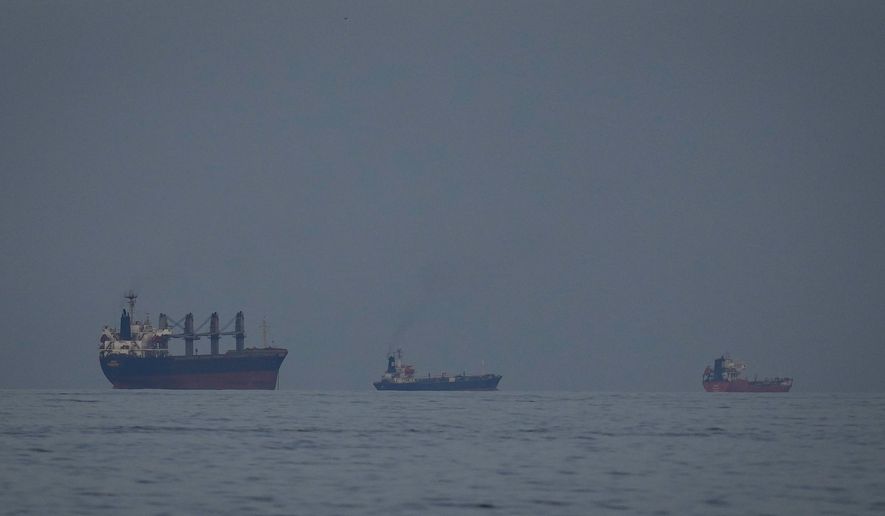
Oil tankers and ships line up …
more >
It was unclear if the message represented Mr. Trump’s shoot-from-the-hip communications style, or an actual plea for naval assistance. But he doubled down on Monday.
“I’m demanding that these countries come in and protect their own territory, because it is their territory,” Mr. Trump told U.S. media on Air Force One. “It’s the place from which they get their energy. And they should come and they should help us protect it.”
SEE ALSO: World leaders cool on Trump’s demand for an international coalition to reopen Strait of Hormuz
Oil represents some 30-33% of global energy requirements. About 20% of global oil supplies exit the Persian Gulf, home to not only Iranian terminals, but also the Gulf states’ energy infrastructures.
The Gulf’s entry-exit point, the 21-mile wide Strait of Hormuz is a hugely strategic chokepoint that grants Iran — which dominates its northern and eastern littoral — the leverage to disrupt the global economy.
In oil-thirsty Indo-Pacific on Monday, officialdom indicated that Washington had made no official request. Responses to Mr. Trump’s widely publicized comments were — at best — prudent.
“No decision has been made whatsoever regarding the dispatch of escort vessels,” Japanese Prime Minister Sanae Takaichi told an Upper House Budget Committee meeting on Monday, per Japanese media. “We are currently examining what Japan can do independently and what is possible within the legal framework.”
She is expected to discuss the matter further during a summit with Mr. Trump in Washington on March 19.
Defense Minister Shinjiro Koizumi, also speaking in the House, said his government has no plan “as of now” to deploy assets to the strait.
With the Middle East conflict and its economic fallout fraying nerves in government offices, business boardrooms and family homes worldwide, Ms. Takaichi took to her personal X account late on Monday evening to reassure Japan.
“With crude oil tankers effectively unable to pass through the Strait of Hormuz, crude oil imports to our country are expected to decrease significantly from around March 20 later this month,” she tweeted. “However, our country has approximately eight months’ worth of petroleum reserves held by both the public and private sectors combined, so there will be no immediate disruption to the stable supply of energy domestically.”
In Seoul, South Korean presidential spokesperson Lee Kyu-yeon briefed with care.
“This is an issue that should be decided after sufficient discussions between South Korea and the U.S. and with adequate time for deliberation, and I understand that the two sides remain in close communication,” he said in Seoul on Monday, according to local media.
“We intend to handle this issue very carefully,” he continued, adding that Seoul is trying to gauge “the exact intention” behind Mr. Trump’s comments.
While regional allies expressed discretion, Chinese officialdom was silent.
China, widely seen as a major competitor or “pacing threat” to the U.S., is no American ally, making Mr. Trump’s request to the country, which he is planning to travel to for a state visit in April, highly unusual.
Beijing Foreign Ministry Spokesperson Lin Jian, during a Monday briefing, declined to answer reporters’ questions
Non-official commentary from inside the country ranged from dismissive to derisive.
According to Singapore-based specialist media ThinkChina, military commentator Song Zhongping said China would not want to join any Iran-facing naval coalition as that would “not align with China’s political objectives.”
ThinkChina also quoted a person “with links to official media” who wrote, on Chinese social media service WeChat, “The whole world is stunned, and even Iran seems not to know whether to laugh or cry … The U.S. is actually begging China to help clean up the mess.”
Though Australia was not referenced by Mr. Trump, Canberra — a staunch U.S. ally in recent conflicts — also made its position clear.
Asked in a Monday radio interview whether Australia would get involved, Minister for Infrastructure, Transport, Regional Development and Local Government Catherine King responded, “We won’t be sending a ship to the Strait of Hormuz. “
She continued, “We know how incredibly important that is, but that’s not something that we’ve been asked or that we’re contributing to.”
Despite decades-long efforts by governments to diversify their energy mixes and their energy sources, Asia’s manufacturing economies are key customers of Gulf supply. According to Bloomberg, China’s dependency on Gulf oil is 38% of the region’s output, India’s is 15%, South Korea’s is 12% and Japan’s 11%.
While the U.S. is the world’s largest single supplier of oil, data makes clear that multiple countries that are central to global supply chains are dependent on the Middle East.
That means Iran can leverage its coastal geography to deploy guerrilla-style seaborne threats that affect global energy economics.
Frustration may be setting in in the White House at Tehran’s asymmetric responses to overwhelming force.
Despite the successful decapitation of the Iranian regime’s leadership early in the Israeli-U.S. campaign, and the decimation of its military, Tehran is proving resilient.
In the aerial domain, it is spreading chaos around the region with drone and missile strikes, pressuring stocks of anti-drone munitions. In the economic domain, it has plugged the strait, trapping tanker fleets in the Persian Gulf.
Though Tehran’s navy has been decimated, it may retain fast-boat assets, and certainly deploys missiles, aerial drones, underwater drones and sea mines.
Those arms make a tanker run through the strait immensely hazardous.
Of the region’s major oil exporters, only Saudi Arabia is non-reliant on Strait transits: It maintains a trans-desert pipeline that delivers oil to a terminal on its Red Sea coast.