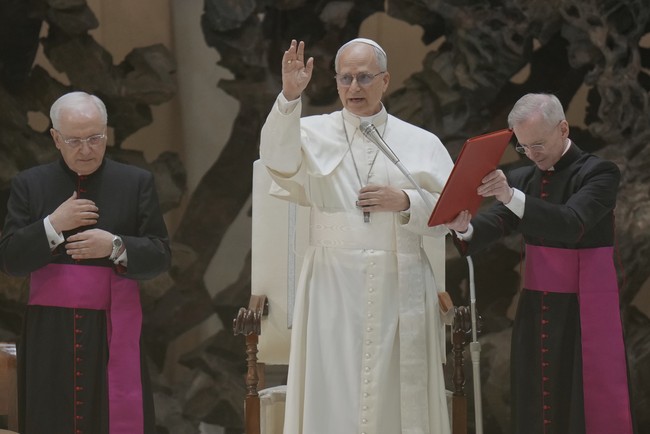
No intended disrespect to my Catholic friends but this statement on X this morning from Pope Leo XIV sounds a lot like a Bernie Sanders campaign speech.
Hundreds of millions of people throughout the world are immersed in extreme poverty. Yet, disproportionate wealth remains in the hands of a few. It is an unjust scenario, in the face of which we cannot fail to question ourselves and commit to change things. There is no lack of…
— Pope Leo XIV (@Pontifex) April 10, 2026
I certainly understand that the church has a mission to care about the poor and that the New Testament is full of warnings about rich people being separated from God’s Kingdom because they love their wealth more than God. So I’m not suggesting the topic should be off limits. The Pope’s concern about the “hundreds of millions” of people in poverty seems appropriate.
And yet, by the second line he’s really taken a turn. “Yet, disproportionate wealth remains in the hands of a few?” Who is he talking about? Who are the few? Is he talking about third-world dictators who steal from their country’s wealth and live like kings or is he talking about “the billionaires” the way that Bernie Sanders does? It sort of sounds like the latter, mostly because of the 2nd half of his statement which we’ll get to in a moment.
What does he mean when he says their wealth is “disproportionate”. Is he just saying some people have too much? Okay, but how do you know that?
We have a free market capitalist system that assigns value to things based on what a company produces that people want to buy and what people who buy shares in the company think that could be worth down the line. Every quarter we get reports about how the company is doing and what its goals are. People are free to buy and sell stock and to buy or not buy the products. The stock market is a constantly changing database which keeps track of those decisions and estimates of value. Some stocks soar and some slump and disappear entirely.
Is that the “unjust scenario” the Pope is talking about? And if so, at what point exactly does the injustice creep in? To use a familiar example, if a hundred million people decide to order things on Amazon because it’s cheaper or more convenient to do so, what’s unjust about attributing tremendous value to Amazon? And since Jeff Bezos owns about 8% of the company, he is tremendously, disproportionately wealthy compared to all the people who don’t own 8% of Amazon. But how is that unjust?
I think what I really object to is the word “remains” in the sentence “disproportionate wealth remains…” There was no Amazon 40 years ago and Jeff Bezos was not disproportionately wealthy. In 1980, he was working as a cook at McDonalds. His wealth isn’t something that was handed to him or that he stole from people. He built it by making something people liked and chose, of their own free will, to use.
Again, is that an unjust scenario? What did Bezos do, broadly speaking, that makes his wealth shameful and unjust? Would it be better if Amazon didn’t exist? Not to put too fine a point on it, but it seems likely the Pope himself has used it before. Would he denounce it now?
The latter half of the statement reads:
There is no lack of resources at the root of disparities, but the need to address solvable problems related to a more equitable distribution of wealth, to be achieved with moral sense and honesty.
This is really what makes me think this is meant as a critique of capitalism. There is no lack of resources at the root of disparities? That’s certainly false. There is almost always a lack of resources which is why we have trade and markets and ultimately money itself. We needed a system of exchange for scarce resources.
If you want a plate of strawberries in the summer, that will cost you several dollars. If you want the same plate of strawberries in January, that will cost you more. Why? Because January isn’t strawberry season. The availability of strawberries is constrained by the weather. Of course it’s always warm enough for strawberries somewhere, so you can still get them in January, but they probably have to be shipped from farther away and that makes the price go up. The resources for growing strawberries are large but not infinite, especially in the winter.
This is what we call supply and demand. It’s true of every possible thing you can name. For instance, you would think the supply of toilet paper would be pretty constant. It’s not that complicated a product. But then some lunatic burns down the TP warehouse and it’s a safe bet we might have a shortage of TP for a while. And the price will probably go up until the supply is sorted again. You can still get it but you may have to choose between TP and strawberries.
What the Pope is saying absolutely flies in the face of reality. Of course there is a lack of resources at the root of disparities. Even in the summer, strawberries are expensive. We can grow millions of them every year but not enough for everyone to have an unlimited daily supply. And the same is true of every other type of meat and produce. It’s the market that makes it possible to meet the demand despite finite resources.
What about housing resources? I can tell you that in California there is in fact a lack of resources (homes and apartments) which leads to high prices and great disparities in how people live. There are people a few miles from me living in $10 million mansions and there are people just as close living in trailer parks (fewer of the former and more of the latter). Neither group are where they are because they did anything illegal or immoral. The people in the $10 million houses offered a product or service that other people wanted and they got rich. Some people spent years of their lives becoming doctors or licensed contractors and others work retail jobs. That doesn’t make one group better people than the other, it just makes some of them more successful. And because the number of houses in California are very finite relative to the number of people who need homes, you have to be pretty successful to own one.
So when I hear talk about “a more equitable distribution of wealth” that assumes the current distribution is not only unequal but somehow unjust and, as the statement hints, maybe even immoral. But what alternative is the Pope proposing?
Seizing money from the people who succeeded and handing it over to the people who did not might be more equitable but it would not be just or moral. This would in fact be theft, no different than robbing someone’s home. This is in fact the solution many people would prefer.
The communists call it expropriation. Hugo Chavez used to have a TV show where he would walk down the street and point to businesses that looked like they were doing well and say “expropriate.” And that was it. Your property was not property of the government, for the good of the poor of course. He was just a thief empowered by the state to do his thieving on television.
Maybe I’m misreading what the Pope meant. I’m not trying to be uncharitable, but I’m also not alone in hearing a lot of Bernie Sanders socialism radiating like a stench from this statement. Maybe some further clarification would be nice.
Editor’s Note: Do you enjoy Hot Air’s conservative reporting that takes on the radical left and woke media? Support our work so that we can continue to bring you the truth.
Join Hot Air VIP and use promo code FIGHT to receive 60% off your membership.