NEWS AND ANALYSIS:
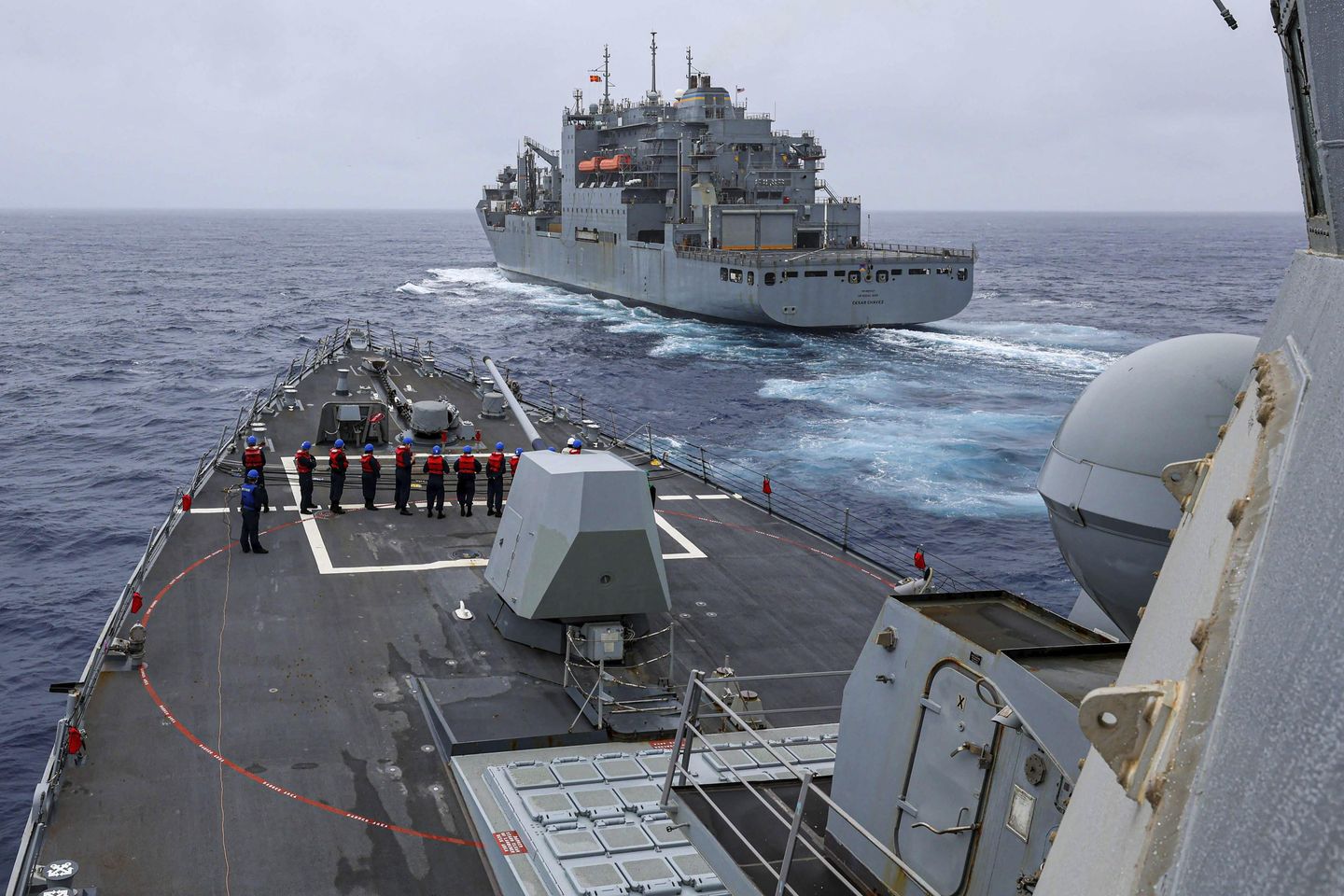
The Navy deployed an oceanographic survey ship, along with a guided missile destroyer, that sailed through the Taiwan Strait last week gathering key data for future underwater drone operations.
The passage of the Pathfinder-class survey ship USNS Mary Sears and missile destroyer USS John Finn were the Navy’s first transit of the tense waterway in 2026.
The two ships made a routine transit of the 100-mile-wide waterway on Jan. 16 and 17, Commander Matthew Comer, a spokesman for the Seventh Fleet, said in a statement.
Cmdr. Comer said the action was conducted through space that allows high-seas freedom of navigation and overflight under international law.
“The ships transited through a corridor in the Strait that is beyond the territorial sea of any coastal state,” he said. “The transit through the Taiwan Strait demonstrates the United States’ commitment to upholding freedom of navigation for all nations as a principle.”
Navigational rights and freedoms in the strait should not be limited and the U.S. rejects “any assertion of sovereignty or jurisdiction that is inconsistent with freedoms of navigation, overflight, and other lawful uses of the sea and air,” Cmdr. Comer said.
The dispatch of the survey ship with the destroyer appears to be a new policy of the U.S. government. The last survey ship to pass through the strait was the Bowditch that sailed there together with a guided missile destroyer in February.
The survey ships will provide Navy war planners with vital data for U.S. submarine operations, helping to prepare for future uncrewed underwater vehicle operations, according to naval warfare experts.
Drones, both aerial and underwater, are a key element of Indo-Pacific Command efforts to dissuade China from attacking Taiwan. Drones are expected to be used against any potential invading Chinese force in future conflicts.
The survey ships are equipped with numerous sensors that collect data to be used for “battlespace awareness” and maintaining tactical advantages underwater.
Operations are often disguised as environmental monitoring or commercial shipping support. But the spy ships’ main military objective is providing data for undersea warfare, according to Navy sources.
Military data includes sea floor mapping and production of high-resolution 3D maps, information critical for both safe submarine and offensive and defensive UUV operations.
Additional information gathered by the ships can include water measurements such as temperature, salinity and pressure.
The information is useful in the tracking of Chinese submarines based on how sound travels through water.
The surveys seek to identify “shadow zones” or “ducts” that can be used to detect hidden Chinese submarines or for use by U.S. submarines to hide from Chinese attack subs.
The Navy survey ships also measure ambient noise and test how the Taiwan Strait floor reflects or absorbs sound. The data helps fine tune Navy sonar systems.
Another key role in electronic information gathering for survey ships is the collection of geophysical and magnetic data that is used to refine inertial navigation for submarines and precision-guided missiles.
The data can provide precise positioning without relying on satellite GPS signals that are vulnerable to jamming.
Survey ships also monitor marine life and water chemistry, which is used to measure biological growth or water turbidity that could impact sensitive underwater sensors or the range of unmanned vehicles.
The ships also gather key data in shallower waters that can identify underwater hazards, wreckage or sediment types useful for conducting mine countermeasures operations and amphibious landings.
The Navy conducted three warship passages in the Taiwan Strait last year, compared to nearly monthly passages in previous years.
Beijing’s new sub has missiles capable of hitting U.S. from Chinese waters
Chinese state media recently disclosed the first images of a new ballistic missile submarine, the Tang-class Type 096 boomer that will carry long-range missiles capable of striking U.S. targets from protected waters close to China’s shores.
China Central Television, the official broadcaster, on Jan. 3 provided a close look at the new missile submarines that reportedly will have a displacement of 12,000 tons and 24 vertical launch missile tubes for the new 6,000-mile range JL-3 submarine-launched ballistic missile.
Naval experts say the submarine represents a major leap forward in Chinese underwater nuclear power. The vessels feature stealthier features and a quieter engine.
As with other major Chinese weapons systems, U.S. intelligence suspects the new Type 096 was built with the help of technology stolen through China’s massive cyberespionage and traditional spying programs.
State media reports from Jan. 14 disclosed the details on the Type 096, which has been reported by the Pentagon as under development for the past several years.
The submarine appears to be Beijing’s effort to field a missile submarine comparable to U.S. Ohio-class boomers and Russia’s new Borei-class missile submarine.
The Type 096 reportedly uses special equipment such as hull isolation gear and a nuclear propulsion system that seeks to reduce detectable noise during patrols.
The publication India Defence Review stated that the submarine’s acoustic signature is between 95 decibels and 100 decibels and is much quieter than earlier People’s Liberation Army missile subs viewed as too loud for credible open-ocean patrols.
Its armament is also significantly more powerful with between 16 and 24 multiple-warhead JL-3 missiles. The missile is believed to be capable of firing between 6 and 10 independently targetable reentry vehicles, or MIRV, warheads.
The range would allow the Type 096 to attack targets in the continental U.S. from patrol zones in the South China Sea or Bohai Gulf without having to sail in contested maritime choke points.
The capability gives the submarine a shorter launch window and increases its ability to survive attack by U.S. attack submarines during a conflict.
According to a report from Britain’s Royal United Services Institute, a defense think tank, the earlier JL-2 SLBM lacked the range to strike the U.S. mainland from protected waters, limiting its potential targets to attacks on Hawaii and Alaska.
The report said the Type 096 is built with an ice-rate hull and could be used for future operations in Arctic waters.
Chinese academics revealed that China has sought access to Russian bases in the Arctic.
“Given that a northern ballistic trajectory to the U.S. is efficient and would not require transiting choke points such as the Bashi channel, it might also be the case that the Type 096 will be deployed in an area where the Euro-Atlantic and Indo-Pacific overlap,” the report said.
Despite the improvements, the Type 096 was built with unusual features of earlier subs, such as a hump for its launch tubes, that will impede some aspects of its performance, the report said.
China’s military also is working on artificial intelligence-based undersea warfare that could reduce the survivability of enemy submarines, the report said.
China may use Type 096 patrols close to the U.S. Pacific Coast, which would reduce missile defense warning time.
“The implicit threat posed by one or more Tang submarines in the Pacific may well prove useful Chinese leverage in encouraging the U.S. not to become involved in Taiwan reunification issues,” the report said.
DIA reveals Iran to field 60 ICBMs
A Defense Intelligence Agency report made public in support of President Trump’s Golden Dome missile defense system reveals that Iran could field up to 60 intercontinental ballistic missiles by 2035.
The report, a single-page graphic, stated that Iran currently has no deployed ICBMs but by 2035 will field 60 long-range missiles — more than North Korea is expected to have during the same time frame.
The DIA estimates that North Korea has 10 or fewer ICBMs in its current missile arsenal and will have up to 50 by 2035.
“Missile threats to the U.S. homeland will expand in scale and sophistication in the coming decade,” DIA said. “North Korea has successfully tested ballistic missiles with sufficient range to reach the entire Homeland, and Iran has space launch vehicles it could use to develop a militarily viable ICBM by 2035 should Tehran decide to pursue the capability.”
The report was issued in May — before the U.S. and Israeli struck Iran’s nuclear facilities.
Iran currently boasts of having the largest and most diverse missile systems in the Middle East, including seven types of short-range ballistic missiles and eight medium-range missile types.
“The majority of systems presented here have nuclear-capable variants,” the DIA said.
The DIA report included a map that showed a potential Iranian ICBM attack on the U.S.
Behnam Ben Taleblu, an Iran expert with the Foundation for Defense of Democracies, said the Iranian missile arsenal is increasing in size and capability.
“Improvements in ballistic missile precision, range, mobility, warhead design and survivability (including the creation of underground missile depots) imply an increasingly lethal long-range strike capability in the hands of the world’s foremost state sponsor of terrorism,” he said.
Ex-British intel chief opposes Chinese mega embassy
The former head of the British MI-6 foreign intelligence service, Richard Dearlove, said recently he opposes plans to allow the Chinese government to set up a large embassy that critics say poses a major espionage threat.
Mr. Dearlove, once known by the code name “M,” told the British outlet LBC that the Chinese embassy is “completely inappropriate.”
The government approved the new embassy despite warnings from intelligence agencies that the facility poses risks to national security.
“We’re giving the Chinese, on a plate, a much better opportunity to organize espionage, not just in the U.K.,” he said.
“I’m not going to go into detail, but the complications of having a massive Chinese embassy and members of that embassy traveling into Europe … third country activity from a base where China are represented in spades is a real problem as well.”
Providing Beijing with a prominent location across from the Tower of London and from an adversary nation, is a mistake, he said.
Underground cables transiting near the embassy, which is said to be built with 208 secret rooms and hidden underground chambers, in addition to above-ground structures could be compromised, he said.
“What we have to realize,” he said, “is that the Chinese are a big problem already, so why make them this concession when we’re already worrying about the threat to national security?”
Mr. Dearlove was MI-6 chief from 1999 to 2004.
Approval of the new embassy comes as Prime Minister Keir Starmer plans to visit China within a few weeks.
In Washington, Rep. John Moolenaar, chairman of the House Select Committee on the Chinese Communist Party said: “The U.K.’s decision defies common sense. It is effectively rewarding China for spying on Parliament, interfering in the U.K.’s elections, and fueling Russia’s war in Ukraine. China is also suspected of cutting undersea cables, so letting it build on the land above critical infrastructure is a serious security risk. The only safeguard against the mega-embassy is to prohibit its construction.”
• Contact Bill Gertz on X @BillGertz.