What makes a man truly great? As President Donald Trump celebrates the ouster of dictators in Iran and Venezuela, and jokes about running for a third term in 2028, I can’t help but think of the two great men whose lives pivoted on one date—the Ides of March.
“The Ides of March” has a powerful, ominous, almost alien feel, but it’s just a fancy Latin term for March 15, the day in 44 B.C. when members of the Roman Senate stabbed Julius Caesar, who had just been appointed dictator for life.
Today, “dictator” means a person with near absolute power, and it’s often synonymous with “tyrant.” The ancient Roman Republic, however, established it as an actual position—a person invested with supreme authority during severe crises, but only for a maximum of six months. The most famous example, Lucius Quinctius Cincinnatus, took up the mantle in the 400s B.C., assuming absolute power to resolve a crisis but then immediately returning to his farm after saving Rome.
Caesar had achieved great successes for Rome, but accepting this title threatened to make him something Rome had intentionally rejected for centuries—a monarch.
In one of history’s greatest ironies, the senators killed Caesar to restore the Roman Republic, but they ended up bringing about its ultimate demise, as a bloody civil war saw the emergence of the first emperor, Caesar’s nephew Augustus.
Redeeming the Ides of March
Another Ides of March brought about a similarly ironic fate in 1783.
George Washington led the Continental Army in the Revolutionary War, and while the British had already surrendered at Yorktown in 1781, they had yet to sign the Treaty of Paris acknowledging America’s independence in September 1783.
The army, camped near Newburgh, New York, and still active because America was still at war, harbored grievances against the Continental Congress, because Congress hadn’t paid them.
An anonymous soldier circulated two inflammatory letters, suggesting the Army do more than just ask nicely for more money. The first letter urged Army leaders to “suspect the man who would advise to more moderation and longer forbearance.” The second suggested that Washington supported an aggressive plan to move against Congress.
It seemed the Continental Army might take up arms against America’s fledgling government. Some analysts have suggested the Army might have tried to make Washington a king.
Whatever the true goals of this Newburgh Conspiracy, Washington took a firm stance against it.
“This dreadful alternative, of either deserting our country in the extremest hour of her distress, or turning our Army against it … has something so shocking in it, that humanity revolts at the idea,” Washington wrote in his manuscript of the address. Any man suggesting it must be “an insidious foe” against the Army and his country, the commander-in-chief said.
He urged the Army to trust Congress, and not to “tarnish the reputation of an Army which is celebrated through all Europe for its fortitude and patriotism.”
Captain Samuel Shaw recalled that Washington read a letter from Congress, expressing admiration for the Army. While reading, Washington “made a short pause, took out his spectacles, and begged the indulgence of his audience while he put them on, observing at the same time that he had grown gray in their service, and now found himself growing blind.”
Shaw noted that this remark “forced its way to the heart, and you might see sensibility moisten every eye.”
Washington had talked the Army off a cliff and had seemingly rejected the possibility of becoming a military dictator.
While Washington admirably led men in battle—and, what may be even more difficult, in occasionally ignominious retreat—and later shepherded the fledgling republic through its tumultuous early years under the new Constitution, he consistently rejected long-term power.
Lewis Nicola, writing to Washington in May 1782, expressed what he claimed were sentiments shared by the Army, that the commander-in-chief may want to consider taking charge of the American government as something like a king.
Washington responded that “no occurrence in the course of the war has given me more painful sensations than your information of there being such ideas existing in the Army.”
He added that, “if I am not deceived in the knowledge of myself, you could not have found a person to whom your schemes are more disagreeable.”
The American Cincinnatus
When Washington resigned his military commission in December 1783 following the Treaty of Paris, King George III reportedly responded to the news by saying, “If he did, he would be the greatest man in the world.”
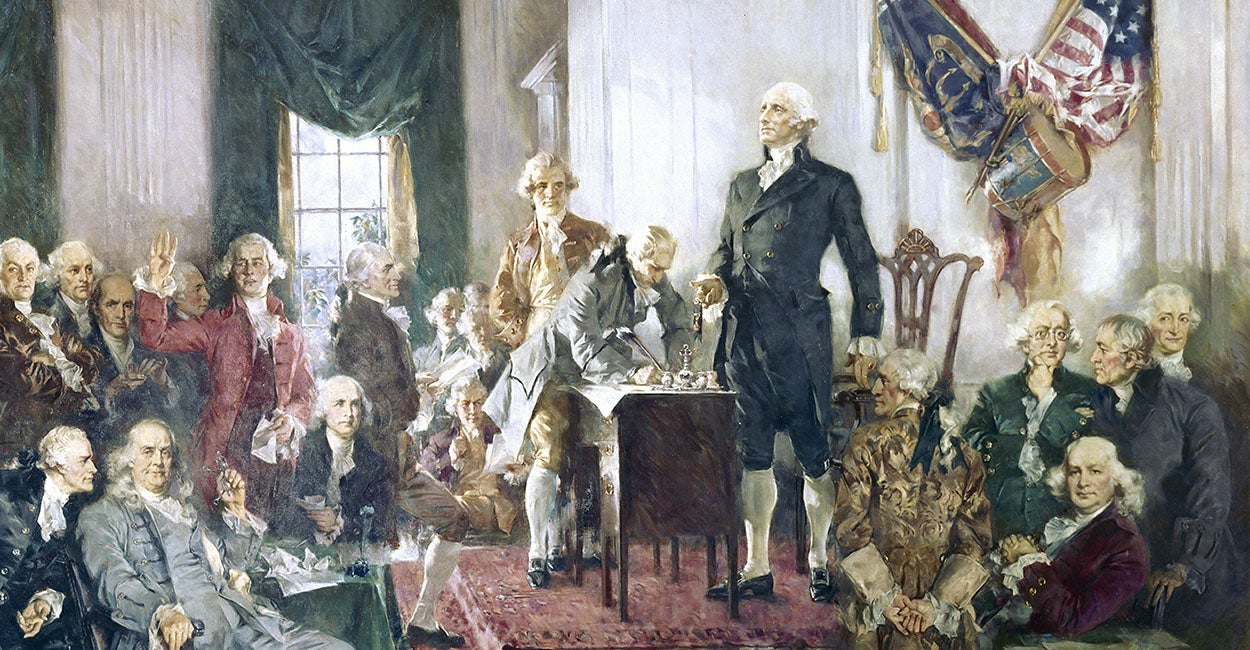
Washington did not step aside from public life. He presided over the Constitutional Convention and served as America’s first president, holding together in one government two fiercely competing factions: the Federalists (led by Alexander Hamilton and John Adams) and Republicans (led by Thomas Jefferson). Yet Washington also established a key precedent by stepping aside from the presidency after two terms—a precedent only one president, whose name is rightly synonymous with government overreach, ever dared to defy.
The Ides of March revealed George Washington’s true character—establishing him as the American Cincinnatus.
Washington’s noble speech prevented America’s experiment in ordered liberty from being smothered in the cradle.
As Trump topples modern-day dictators and defends our mighty experiment in liberty, he should also heed Washington’s example. The true measure of a man’s greatness isn’t just what he achieves with power, but his ability to give up power for a more noble cause.