Congressional Republicans are scrambling to avoid a midterm trouncing over health care, as the one Democrats delivered in 2018 after Republicans tried and failed to replace Obamacare.
Democrats campaigned heavily against Republican attempts to gut the law during President Trump’s first term, focusing on popular provisions such as the requirement that insurers cover preexisting conditions. They won control of the House in 2018 with a net gain of 41 seats.
Now, in Mr. Trump’s second term, Democrats are ramping up their health care messaging again. Their pandemic expansion of Obamacare premium subsidies expires Dec. 31, and Republicans are rejecting a clean extension.
It’s part of a broader Democratic effort to compel Republicans to address voters’ concerns about the high cost of living.
“They’re on the run,” said House Minority Leader Hakeem Jeffries, New York Democrat. “It’s why they’ve been defeated electorally across the country up and down the ballot. And it’s why I’m confident we’re going to take back control of the House of Representatives next year.”
Republicans are promising to deliver alternative solutions for lowering health care costs, but they have no unity on how to defuse Democrats’ attacks.
Republicans are divided between pursuing a party-line health care overhaul and seeking a bipartisan compromise.
Ironically, neither side will get its way until after House Democrats have a vote on their proposed clean three-year extension of the expanded Affordable Care Act tax credits.
Four Republicans — Reps. Brian Fitzpatrick, Robert Bresnahan and Ryan Mackenzie of Pennsylvania and Rep. Michael Lawler of New York — signed the Democrats’ discharge petition to force a vote on the bill, which will be held when Congress returns the week of Jan. 5.
Mr. Jeffries and most other House Democrats declined to back two discharge petitions on bipartisan bills that would have extended and tweaked the enhanced subsidies.
“It is purely politics on his behalf,” Mr. Mackenzie said.
Some Republicans are conflicted about whether to support the clean three-year extension, given that the Senate has rejected an identical bill.
“I want to not just have a vote for the sake of having a vote, or to say I voted for something. I want to actually solve the problem,” said Rep. Kevin Kiley, California Republican.
If Congress does not renew the enhanced ACA tax credits, the 22 million people on subsidized Obamacare plans will have to pay more than double, on average, for their premiums next year. Many are expected to drop coverage.
A CBS News poll conducted Dec. 17-19 found that 68% of Americans want Congress to continue the enhanced tax credits, while 32% want them to expire.
“I think we made it pretty clear that if you do nothing, you’re going to get your ass kicked in a year,” said Rep. Don Bacon, Nebraska Republican, who predicted that Democrats will use the issue as a “sledgehammer.”
Mr. Bacon is one of three House Republicans representing districts that Mr. Trump lost in 2024. He is not seeking reelection in 2026.
The other two, Mr. Fitzpatrick and Mr. Lawler, are running. They have been part of a group of swing-district Republicans pushing to temporarily extend the enhanced Obamacare subsidies, with an income cap and fraud guardrails, as a bridge to larger changes.
“What’s clear is for the Republicans, they have to do something,” said Rep. Josh Gottheimer, a New Jersey Democrat who led one of the bipartisan discharge petitions. “They can’t just ignore the reality that people’s health insurance premiums are going to be way up.”
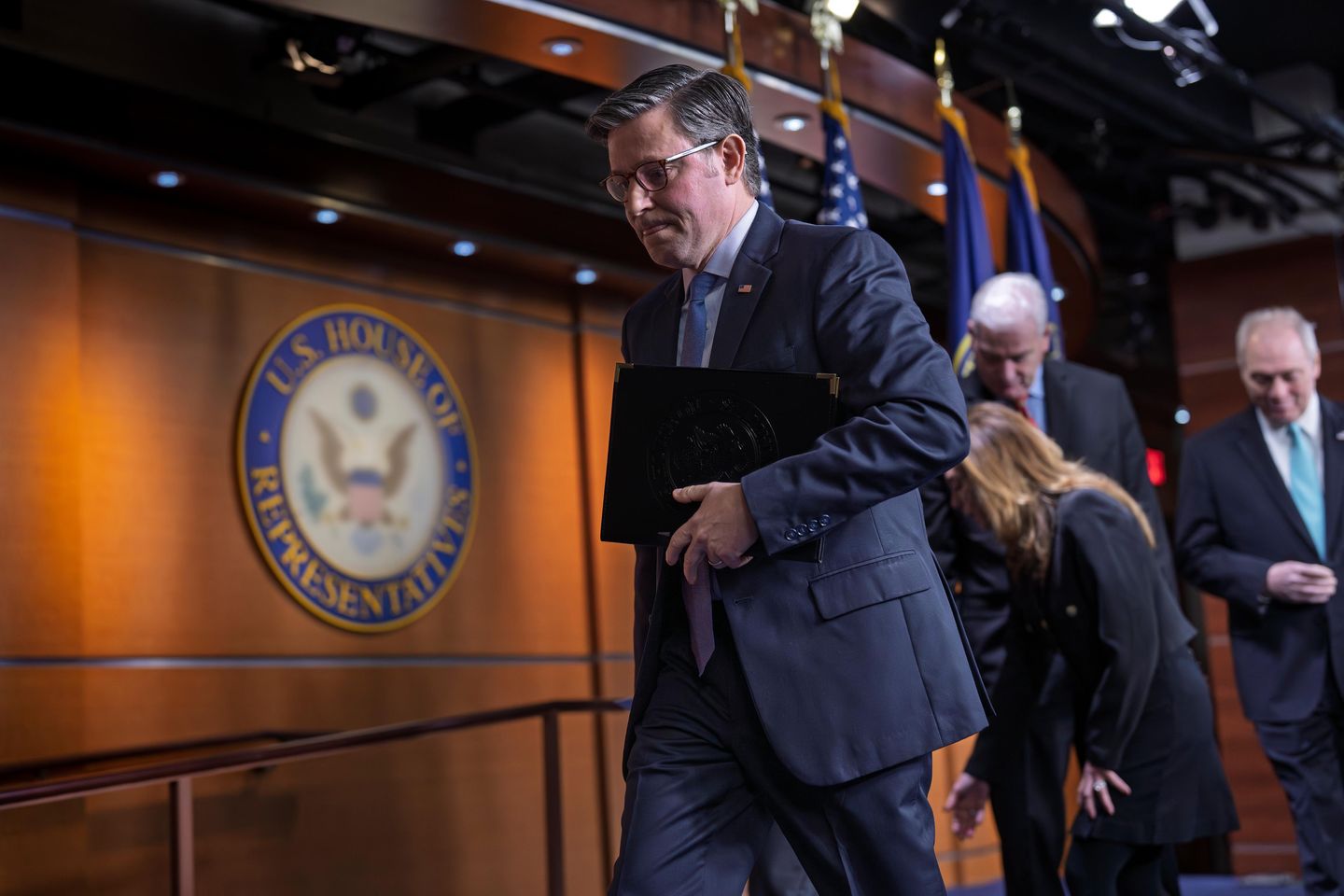
House Speaker Mike Johnson, Louisiana Republican, declined to hold a vote on any of the bipartisan proposals. He said the subsidies are not a “panacea to bring down health care costs.”
He said he is not worried that the decision will hurt Republican incumbents in the midterms.
“We want to reduce costs for all Americans, not a tiny subset of them,” he said, noting that the swing-district Republicans are working around the clock to do so. “They’re performing very well for their constituents, and we’re excited to keep doing that.”
House Republicans passed a bill last week with several provisions aimed at giving consumers more options when shopping for health insurance.
That package came together “in short order” because of Republican groundwork on health care during Mr. Trump’s first term, said Rep. Warren Davidson, Ohio Republican.
“We already have more momentum than we had in 2017,” he said, explaining why he is not worried about a repeat of that failure and midterm shellacking.
Rep. Chip Roy, Texas Republican, said he supports the policies Republicans have passed, but “it’s milquetoast” compared with Obamacare.
The Congressional Budget Office estimates that the measure would save taxpayers nearly $36 billion over the next 10 years and reduce gross premiums by an average of 11% through 2035. Still, roughly 100,000 people would drop health insurance coverage over that period, CBO said.
Mr. Roy said Republicans need to enact a “transformative change” like Democrats did in 2010, but instead offer consumers more freedom to choose what they want out of their health coverage with “tax treatment that’s equal to corporations” that provide employer-sponsored plans.
If Republicans can do that, “we will coast to victory next fall,” he said.
Mr. Johnson and a majority of his conference seem content to pursue another party-line budget reconciliation bill early in the new year as they shoot for a larger health care overhaul.
The swing-district Republicans prefer a bipartisan bill. They say they want to avoid repeating the Democrats’ mistake of enacting and expanding the Affordable Care Act on a partisan basis.
“When parties change in power, all of a sudden, the other party has a difference in opinion,” Mr. Mackenzie said. “That’s not durable for the long term.”
Senate Majority Leader John Thune, South Dakota Republican, has fewer vulnerable incumbents than Mr. Johnson but still favors a bipartisan solution.
Sens. Susan M. Collins of Maine and Jon Husted of Ohio are the only two Republicans running for reelection considered in danger of losing to a Democrat. Like their vulnerable House counterparts, they are pushing for a temporary extension of the subsidies with changes to protect against waste and fraud.
Mr. Thune said he sees “a potential path” to a bipartisan deal along those lines, “but it’ll be a heavy lift.”
If it doesn’t come together, he said, Republicans may move on their own because it’s better to get a result than to have to draw contrasts over unrealized ideas on the campaign trail.
“I’m a big believer that you can’t beat something with nothing,” Mr. Thune said. “You have to have an alternative.”
Deal or no deal, Democrats will hammer Republicans on health care in the midterm campaigns.
“There are some perceptions that don’t change,” said Rep. Richard Neal of Massachusetts, the top Democrat on the Ways and Means Committee. “No matter what happens here, you’re going to have a large number of Republicans who are going to oppose any agreement.”
Sen. Brian Schatz, Hawaii Democrat, said he wants a deal and getting one would not significantly change the political picture.
“When we were able to prevent the Obamacare repeal, we still ran against the attempt to repeal Obamacare and did just fine,” he said. “So I think we can get our outcome and our politics aligned, but the first thing is that 24 million people need our help.”
Although Republicans may not be in complete agreement on the path forward, Democrats “have their own civil war going on as well,” said Sen. Roger Marshall, Kansas Republican.
“I think there’s 15 or 20 Democrat senators that would like to solve this, and I think the Democratic Party would like not to solve it,” he said. “That’s the dilemma. And we just saw this just play out on the government shutdown. We thought there might be 15 that would walk across and vote yes, but it was eight of them.”
Sen. Tim Kaine, Virginia Democrat and one of the eight, is still pushing for a bipartisan deal on the Obamacare subsidies.
He said Democrats are preparing for their next fight against Republican cuts to Medicaid funding, set to take effect at the start of 2027. He said three health clinics and an obstetrician-gynecologist ward at a hospital in Virginia have announced closures because of it.
“We hopefully win the ACA tax credit issue,” Mr. Kaine said, “Then, we’re going to turn to the Medicaid issue because people are going to start to see a lot of closures of medical providers all over this country.”