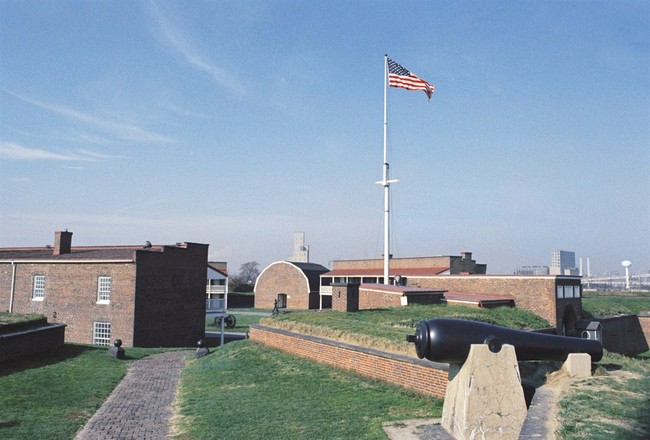
In September 1814, Frances Scott Key stood on a British ship while working to secure a prisoner exchange. He was successful in his negotiations, but he wasn’t allowed to leave the ship. The British admiral informed him about an upcoming attack that would level Fort McHenry.
The following video isn’t new; it’s been online for eight years, but I found it to be a moving account of that important night. Full disclosure: I couldn’t find a transcript of the video, but I used an AI tool to transcribe it.
The British admiral told Key that hundreds of warships would soon arrive to begin the attack. Key went below and told the men in cages about the coming attack, and that if the Americans behind the ramparts don’t lower the flag, it would be destroyed along with the fort.
Key went back on deck and began describing the events as they unfolded to the men below, who kept repeating the same question: “Is the flag still there?”
Remaining on deck, Key stood and watched rockets tear across the sky over Fort McHenry, not knowing whether the American flag still stood.
He waited through smoke, fire, and darkness until dawn broke over Baltimore Harbor.
When the light cut through the haze, the flag remained, creating a sight that the United States is more than a poem. It reminded the country who Americans are when the test comes.
Operation Epic Fury shows that the same spirit still lives.
President Donald Trump directed U.S. forces to begin Operation Epic Fury because of two events: the gathering of Iranian leaders in a single room, and to prevent an Iranian-planned missile attack on military targets across the Middle East.
Related: The Reason Trump Struck Iran That the Left Doesn’t Want You to Know
The combined American and Israeli forces executed precise strikes against military infrastructure used to threaten U.S. personnel and allies. This operation continues as commanders assess damage and respond to the retaliation attempt.
Combat carries real cost: Three U.S. servicemen have been killed, and several others seriously wounded during the operation. Their names haven’t been publicly released yet. The losses confirm that Epic Fury isn’t symbolic or abstract; American troops are under enemy fire in active combat.
If you’ve been following PJ Media, you know that the fight includes missiles and drone exchanges, air defense responses, and sustained pressure on hostile military networks. American pilots, sailors, soldiers, and Marines operate in contested airspace and dangerous waters, knowing that they’re being directly targeted.
That reality brings us back to Key.
He watched British warships unleash firepower against the fort guarding Baltimore in a bombardment that lasted over 24 hours. The British demanded surrender—lower the flag, and the attack would stop; keep it raised, and the shelling would continue.
The defenders chose to keep it raised.
Key later wrote of “rockets red glare” and “bombs bursting in air,” words that weren’t poetic inventions; they were battlefield descriptions. He wrote because he saw the flag still standing when daylight arrived.
Epic Fury forces Americans to ask the same question Key faced: What does the courage of our current forces tell us about what America is still capable of?
It tells us that service members still volunteer to stand in harm’s way, that when hostile regimes test American resolve, the response doesn’t come from words alone. It comes from disciplined action carried out by our men and women who accept risk as part of their duty. It tells us that our flag isn’t an ornament: It represents people defending it.
When the British targeted Fort McHenry, they believed an overwhelming force would end resistance.
They misjudged the Americans’ resolve.
Today, when hostile actors launch drones and missiles, they make a similar calculation, assuming fatigue, hesitation, or retreat. Operation Epic Fury answers that calculation.
American forces operate with advanced aircraft, precision-guided munitions, and integrated defense systems. Technology alone doesn’t hold the line; training, discipline, and courage do. Those qualities can’t be manufactured in a crisis; they’re built over years of preparation and shaped by a culture that honors service.
Key didn’t write about comfort; he wrote about survival under fire, about endurance when defeat seemed possible, about a nation that refused to lower its standards. He said there was a heavy mist hanging over the land, but the Rampart was tall enough that the flag stood completely nondescript in shreds. The flag, pulled itself, was at a crazy angle, but it was still at the top (emphasis mine).
Francis Scott Key immediately wanted to go to Fort Henry to see what had happened, and what he found was that the flag had been pulled down and had suffered repeated, direct hits; when hit, it had fallen, but the men were bothered. Who knew what it meant for that flag to be on the ground?
Although knowing that all of the British guns were trained on it, they walked over and held it up humanely until they died, their bodies were removed, and others took their place. Francis Scott Key said that what held the flagpole in place at that unusual angle were Patriots’ bodies.
Over two centuries later, American forces still stand watch under a different sky. Missiles still streak through darkness, explosions still shake the horizon, and somewhere, in command centers and on flight decks, our service members wait for dawn knowing that what they protect still matters.
The question remains simple and serious: Does that Star-Spangled Banner yet wave?
As long as Americans continue stepping forward to defend it, the answer remains.
Yes.
If you value clear-eyed reporting on American strength, leadership, and the courage of those who serve, consider becoming a PJ Media VIP member today. Right now, you can save 60% off with promo code FIGHT.