“Road to Damascus” moments are rare in these times. Social media strongly discourages changing one’s mind about anything; otherwise, you risk being branded a hypocrite or worse.
That’s why it was refreshing to read a climate activist’s revelations about the absolute necessity for fossil fuels.
Lucy Biggers spent 10 years as a self-described “climate journalist and influencer.” “I believed I was on the right side of history, fighting against the climate crisis, and for a more just and equitable world,” she writes in The Free Press.
“Now as I watch Cuba suffer from its lack of Venezuelan oil, and see the panic over the Strait of Hormuz, I’m reminded of the importance of oil and why, despite spending trillions of dollars in an attempt to transition to renewables, oil, coal, and natural gas still produce 86 percent of the energy consumed around the world,” Biggers writes.
Perhaps the Cuban catastrophe and the threat to the Strait have clarified her thinking about fossil fuels. In much the same way, many liberals in the 1970s saw the radicalism that was taking over the left and gravitated toward conservatism.
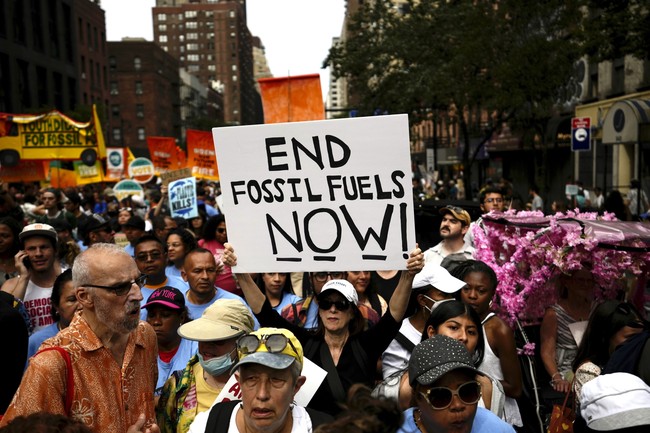
Among the climate activists, there’s a deep belief in a kind of net-zero utopia. A vision where we can rapidly eliminate fossil fuels without serious trade-offs. In this worldview, the moral clarity of the goal far outweighs the inconvenience of reality. That was the world I lived in for six years.
I got pulled in around 2016, watching social media footage of Native American tribes protesting the Dakota Access oil pipeline. I had seen documentaries like An Inconvenient Truth, Before the Flood, and Gasland, and I believed fossil fuel companies were villains destroying the planet. The climate movement gave me a sense of purpose and a way to feel virtuous.
But over time, I started to question it. In the first year of the pandemic, with our freedom of movement heavily curtailed, small businesses shuttered, and children attending school on Zoom, global carbon emissions fell by only about 5.8 percent. Given that, what would net-zero require of us?
Many liberals my age in the 1970s became disillusioned with the left’s refusal to see where their policies would lead the United States, and despite opposition to the lies told by the government about the Vietnam War, they began to rethink their politics. Their journey from left to right was chronicled in David Horowitz’s Destructive Generation: Second Thoughts about the 60s.
Today’s climate activists are just as close-minded, just as impervious to logic and reason as their grandparents were in the 1970s.
Biggers “covered pipeline protests, pushed the Green New Deal, and repeated slogans like “Just stop oil” and “Keep it in the ground,” she writes in The Free Press. “I believed I was on the right side of history, fighting against the climate crisis, and for a more just and equitable world.”
In fact, she and her fellow climate radicals were refusing to face the simple reality that any Econ 101 student could have pointed out to her.
Critics will say if we just transitioned to renewables we could get off fossil fuels. But physics begs to differ. Solar and wind production just aren’t as energy-dense or reliable as oil and gas. They’re intermittent, meaning the sun does not always shine and the wind does not always blow. This means our energy systems have to build out twice as much to get less reliable energy. In Europe, which has most zealously chased the net-zero mirage, energy prices have gone up and their manufacturing economy has suffered. Batteries are also not a practical solution. They have serious downsides, including a supply chain reliant on China, environmentally destructive mining, and an expensive price tag. Germany has invested tens of billions of euros to build out its battery capacity to 24–25.5 gigawatt hours. Sounds impressive, but that amount of storage could not even meet an hour of the country’s energy demand.
“Instead of a utopia, you get what’s happening in Cuba: a country in which many neighborhoods have power for only a few hours a day, the people are desperate, and daily life has ground to a halt,” she writes.
“It turns out you can’t ‘just stop oil’ without consequences,” she concludes.
The fact is, Gen Z and Gen X don’t do consequences. That’s why they can sublimely advocate for the end of fossil fuels and still imagine a “utopia” and see themselves saving the Earth from climate change.
Recommended: Some Democrats Believe That Their Best Hope For 2028 is a Straight, White, Christian Man
PJ Media will give you all the information you need to understand the decisions that will be made this year. Insightful commentary and straight-on, no-BS news reporting have been our hallmarks since 2005.
Get 60% off your new VIP membership by using the code FIGHT. You won’t regret it.