“What Level of Iranian Degradation Is Sufficient to Produce a Settlement That Does Not Simply Reconstitute the Threat Within a Generation?” asks the Middle East Forum.
There is a leftist line of attack that the U.S. doesn’t have a stated “endgame” in Iran, and Trump’s opponents are using that as “proof” that the war is already a failure. Destroying Iran’s ability to “reconstitute” its nuclear and missile program, as well as preventing Tehran from supporting its proxies, would achieve all of the goals that Trump stated when the war began. If that would be an “endgame,” so be it.
But the Islamic Republic is still standing. Bloodied but unbowed, if the regime survives (despite losing a large number of key leaders), it will claim “victory” based on the simple idea that, despite the Islamic Revolutionary Guard Corps (IRGC) being firmly in control of the security apparatus of the state and the clerics now just figureheads, the form of the Iranian regime remains intact.
“The Islamic Republic of Iran entered 2026 with four hundred and forty kilograms of uranium enriched to sixty percent purity, a ballistic missile arsenal numbering in the thousands, an active proxy network running from Lebanon through Iraq to Yemen, and a fresh record of massacring its own citizens by the thousands,” writes Hussein Aboubakr Mansour in the Middle East Forum.
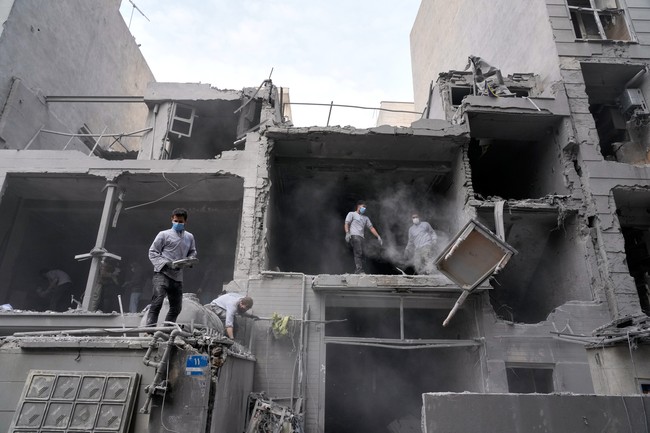
The success of Israel and the United States military in systematically destroying most of that infrastructure is unprecedented. In less than a month, Iran’s ability to do anything with that 440 kilograms of enriched uranium to make a bomb has been eliminated, 90% of its ballistic missile arsenal has been destroyed, along with much of the industrial capacity to make additional missiles, and in the last two years, Israel has massively weakened Hamas and Hezbollah.
It’s not enough.
“The United States finds itself in a position that has historically accompanied military success without political resolution: it has destroyed the adversary’s capacity to project power without yet determining the terms on which that adversary will accept a new arrangement,” writes Mansour. That arrangement, if Iran gets its way, would be a general settlement of the conflict, and not just a ceasefire.
The Islamic Republic has not collapsed. A statement attributed to Mojtaba Khamenei, read on state television, vowed that the Strait of Hormuz would remain closed. The regime’s survival instinct is still operating at full intensity. Iranian Foreign Minister Araghchi told Al Jazeera that Tehran is not seeking a ceasefire but seeking to end the war, a distinction that is not merely semantic from the Iranian side. A ceasefire implies a pause in hostilities that the other party might resume at will; an end to the war implies a political settlement in which the Islamic Republic retains some recognizable claim to sovereignty and survival. The gap between those two is the terrain on which the uncertainty stands.
“Unless the U.S. and Israel can decisively break this stalemate, the battle of the last month is likely to be recorded as a limited but notable achievement for the Iranian side,” writes MEF’s Jonathan Spyer. The spin from the left and others, including Western Europe, is that Trump’s primary goal in going to war against Iran was regime change. Failing to achieve that would demonstrate a total failure, even if Iran is prostrate and its ability to strike its neighbors had been eliminated.
Even if most people aren’t buying that nonsense, the survival of the regime would strengthen it in the eyes of its citizens and give heart to the IRGC and other fanatical regime supporters.
The statements of the president and the prime minister, along with similar remarks by senior officeholders including Secretary of State Marco Rubio, place emphasis on the physical damage inflicted on the Iranian regime as an indicator of success.
This is to some extent justified. It is undoubtedly the case that Iran’s capacities in every area, including that of missile production and deployment, have been massively damaged over the last month.
More broadly, Iran’s Hamas clients have been decimated by two years of war with Israel. Its proxy Hizballah movement in Lebanon has lost its historic leadership and was revealed to be thoroughly penetrated by Israeli intelligence. The Houthis in Yemen waged an effective campaign against shipping on the Red Sea-Gulf of Aden route but signed a ceasefire (with the US, not Israel) after massive damage at the hands of US and Israeli air power. The Iran-aligned Assad regime has gone, replaced by a sectarian, Sunni Islamist government.
But it is also a fact that for all this, the Iranian regime is intact, and determined to continue on its chosen path.
Trump and Israeli Prime Minister Benjamin Netanyahu don’t need the regime to fall for the world to judge their efforts a success. But they do need tangible accomplishments such as capturing or destroying that highly enriched uranium, destroying Iran’s ability to make and launch ballistic missiles, and making it more difficult for Iranian proxies to receive material support.
All of those goals are within reach. Whether Trump and Netanyahu want to do what’s necessary to achieve them remains to be seen.
PJ Media will give you all the information you need to understand the decisions that will be made this year. Insightful commentary and straight-on, no-BS news reporting have been our hallmarks since 2005.
Get 60% off your new VIP membership by using the code FIGHT. You won’t regret it.