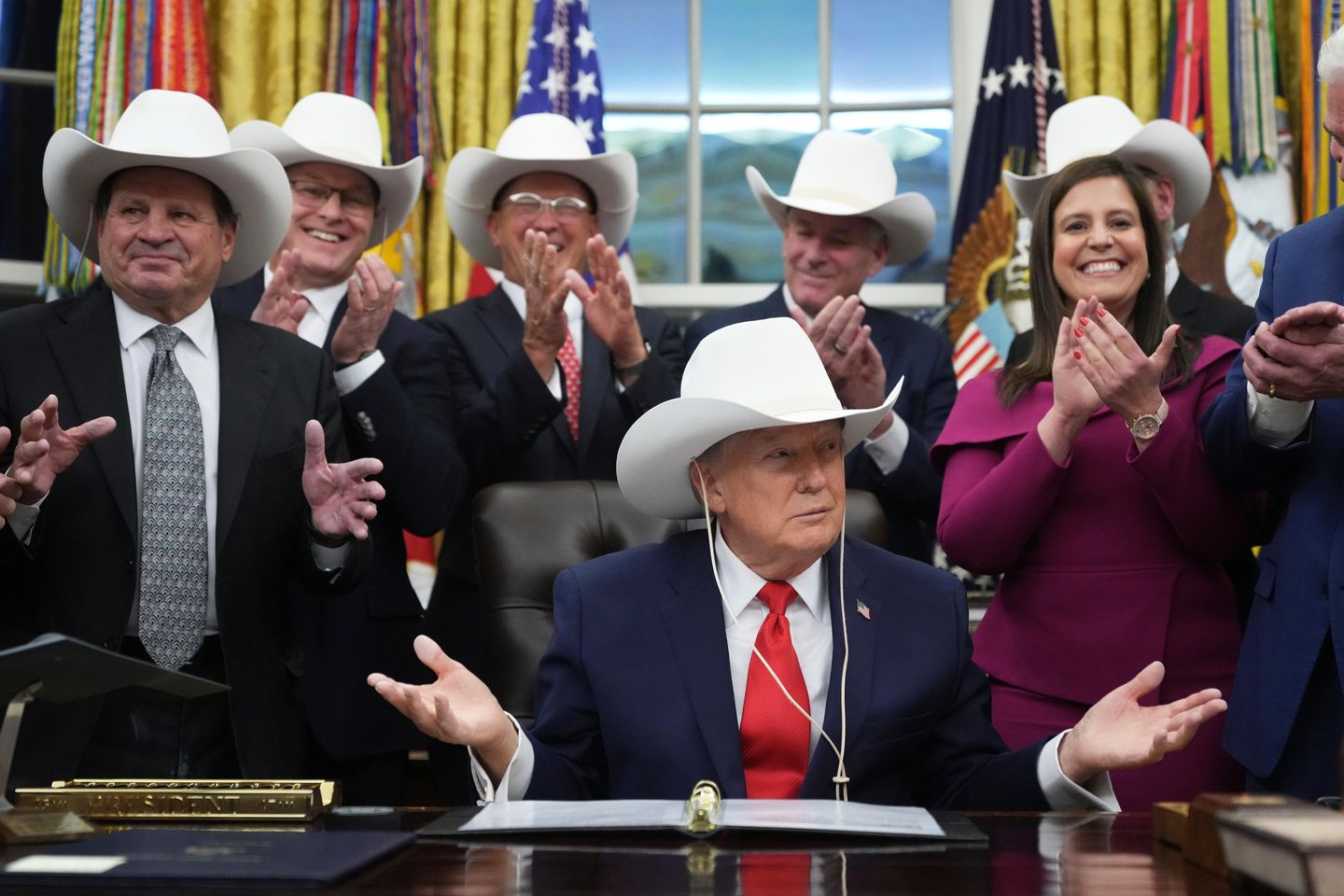
Thousands gathered in Pennsylvania in mid-December to hear President Trump talk about the economy. The very partisan pro-Trump crowd applauded, cheered and shouted support at the president.
But they also did something that surprised his critics — they laughed. A lot.
Mr. Trump’s speech was interrupted six times by laughter from the crowd, according to a review by The Washington Times.
The president riffed on his opponents, drawing guffaws from the crowd. He impersonated former President Biden — “It’s great to be back in this state — uh, where are we?”
He mocked Democrats’ cost-of-living message: “Democrats talking about affordability is like Bonnie and Clyde talking about public safety.”
But the president’s favorite target was actually himself, peppering his speech with self-deprecating remarks. He joked about the assassination attempt last year in Butler, Pennsylvania, saying if he turned his head in a different direction, he’d have “a little differently shaped ear.”
Mr. Trump made fun of his freewheeling speaking style, telling the crowd, “If I read what’s on the teleprompter, you’d be all falling asleep right now.” He even added comical sound effects to his rhetorical style dubbed “the weave.”
The president’s unscripted quips become an essential part of his communication with the public and perhaps his most debated personality trait. Supporters eat up his schtick, enjoying the departure from canned, over-prepared political speeches.
His critics, meanwhile, have deemed his remarks offensive and downright cruel.
Those who work inside the White House say Mr. Trump’s sense of humor isn’t just for the crowds, but he’s frequently making jokes when the cameras are off.
“There has never been a president who communicates more effectively and connects better with the American people than President Trump. A signature part of President Trump’s core appeal is his authenticity, personal charm, and great sense of humor. President Trump is a legendary figure, and there will never be another president like him,” White House spokeswoman Taylor Rogers told The Times.
White House insiders shared with The Times some of their favorite Trump one-liners over the past month.
Mr. Trump recently attended a White House Christmas party with tech billionaire Michael Dell. During his remarks, Mr. Trump talked about how both he and Mr. Dell started with $1,000, and each kept making more money. He then joked that he realized he couldn’t keep up with Mr. Dell, so he decided to run for president instead.
Staffers also enjoyed the zingers Mr. Trump directed at Illinois Gov. J.B. Pritzker at this year’s turkey pardon.
Mr. Trump began his speech by calling his frequent political foe “a big, flat slob.” Later, Mr. Trump said his speechwriters wrote some jokes about Mr. Pritzker’s weight, but he wasn’t going to use them.
“I don’t talk about people being fat. I refuse to talk about the fact that he’s a fat slob. I don’t mention it,” Mr. Trump said to uproarious laughter from the crowd.
Lawmakers who’ve spent time with the president say he’s cracked them up during private moments.
Rep. Byron Donalds, Florida Republican, said his favorite moment came just before Mr. Trump rode a trash truck to one of his campaign rallies after Mr. Biden referred to his supporters as “garbage.” Mr. Trump delivered the speech wearing a sanitation worker vest, telling Mr. Donalds he was wearing it because “it slims me down.”
“He’s got a great sense of humor. He’s very misunderstood, which is why people have their opinions based on what they watch on TV or clips, but people who spend time with him leave liking him,” Mr. Donalds said.
Rep. Richard Hudson, North Carolina Republican, said his favorite Trump line came during his Joint Address to Congress in March, when he roasted Mr. Biden for urging Congress to pass new border security legislation.
“It turned out that all we really needed was a new president,” Mr. Trump said.
“He’s hysterically funny. The funniest times I get to spend with him are when we are all relaxed,” Mr. Hudson said. “When I think of him, what I think of is his compassion and his humor.”
Even Mr. Trump’s harshest critics have acknowledged that he can be funny.
“If you take away the hateful poison of what he says, the actual comedic timing is very, very good. It’s very good. If I can take away, like how much I dislike him and what he stands for and what he’s saying — if I was a supporter, I would be like, ‘This is the funniest guy in the world,’” comedian Brett Gelman told Larry King in 2019.
Other critics accuse Mr. Trump of using humor to cover up his policies, saying the president is relying on jokes to normalize policies they say are authoritarian threats to democracy.
“This comic-authoritarian politics has some advantages over the older dictatorial style. It allows a threat to democracy to appear as, at worst, a tasteless prank,” Irish author Fintan O’Toole wrote in The New York Times. “Trump’s audiences, in other words, are not passive. This comedy is a joint enterprise of performer and listener. It gives those listeners the opportunity for consent and collusion.”
Mr. Trump’s comic timing is not something that has come by accident but from years of being on film, television and stage.
Before he entered the political sphere, the multibillionaire businessman was wanted by powerful entertainment executives to appear in their fast-food commercials, blockbuster movies, hit TV shows, radio programs and sports arenas.
In 2011, he proved that not only could he dish it out, but he could take it as comedians Whitney Cummings, Seth McFarlane and Jeff Ross mocked him during a Comedy Central roast. He laughed along as the comedians roasted his presidential ambitions four years before he declared his candidacy and ended the roast making a profane joke comparing his hair to “wet raccoon.”
He hosted “Saturday Night Live” multiple times, particularly on Nov. 7, 2015, during his presidential campaign, which drew massive ratings. When he hosted on April 3, 2004, he appeared in a sketch wearing a bright yellow suit, shirt and tie extolling his newest venture known as “Trump’s House of Wings,” while the theme of “Jump For My Love” played in the background.
Long before Mr. Trump served up burgers and french fries at the McDonald’s drive-thru in Bucks County, Pennsylvania, toward the end of the presidential campaign, he talked to one of the fast-food giant’s biggest icons, Grimace, in a 1999 TV ad about the company’s $1 hamburger and McChicken sandwich. He asked Grimace how he pulled off making such a deal.
When the smiling, large purple McDonald’s mascot remained mute, Mr. Trump said, “You’re a man of few words. I like that.” He later said, “Purple, very powerful.”
Pizza Hut had Mr. Trump doing ads for the company as well. In 1995, he and his then-wife Ivana promoted the chain’s stuffed pizza crust, while they wore formal wear. “We eat our pizza the wrong way,” she said. “Crust first,” Mr. Trump responded.
Earlier in the decade, Mr. Trump did a seven-second cameo in the “Home Alone” sequel where Macaulay Culkin bumps into the billionaire in one of his New York hotels. That famous cameo was later edited out in subsequent TV airings when Mr. Trump was in the White House.
By the early 2000s, the future president was taking on World Wrestling Entertainment boss Vince McMahon and others in the wrestling ring, where he showed off his physical comedy.