Don’t miss the full story from our staff writers, whose reportage is the basis of this article.
The U.S.-Israel military offensive against Iran has ignited a fierce debate on Capitol Hill over war powers and congressional authority, while simultaneously intensifying the standoff over funding for the Department of Homeland Security.
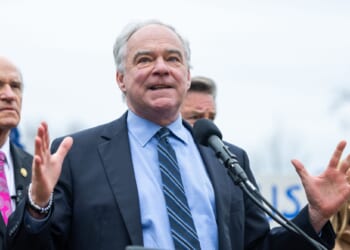
Democrats are pushing for a war-powers vote, contending that President Trump overstepped his authority by launching the military operation without congressional approval. Sen. Tim Kaine of Virginia, a senior member of the Senate Armed Services and Foreign Relations committees, has scheduled a war-powers vote this week, arguing that the Constitution supersedes the War Powers Resolution of 1973 and that Trump failed to notify most lawmakers before acting. “This is an illegal war,” Kaine said on “Fox News Sunday,” citing the Constitution’s requirement that Congress declare war.
Most Republicans are standing behind the president, pointing to the 1973 War Powers Resolution, which they say grants Trump up to 60 days to act before requiring congressional authorization. Sen. Dave McCormick of Pennsylvania, a Foreign Relations Committee member and combat veteran, dismissed Democratic criticism as partisan hypocrisy, noting that similar military actions were taken under Democratic administrations without the same objections. “For 50 years, Democratic presidents and Republican presidents have been making this claim,” he said.
Democratic Sen. John Fetterman of Pennsylvania broke with his party to side with Republicans, arguing that Iran posed a serious and immediate threat and that Trump was on firm legal ground. “I don’t understand why we can’t just say, ’Thank God,’” Fetterman said on CNN’s “State of the Union.” The most prominent Republican dissenters are Sen. Rand Paul and Rep. Thomas Massie, both libertarian-leaning Kentucky Republicans, who have also called the strike unconstitutional.
The Iran offensive has also sharpened the fight over DHS funding, which lapsed on Feb. 14. The shutdown was triggered by Democratic opposition to aggressive ICE enforcement tactics, including the deaths of two U.S. citizen protesters in Minnesota who were attempting to interfere with an ICE operation. Democrats are demanding concessions on immigration enforcement before agreeing to fund the department.
Republicans argue the Iran strike makes restoring DHS funding more urgent, warning that the shutdown leaves the country exposed to potential counterattacks. They note that the shutdown primarily affects non-immigration DHS agencies with national security responsibilities, including the Coast Guard, TSA, Secret Service, FEMA, and cybersecurity offices. Democrats remain unmoved, with Sen. Chris Murphy accusing Republicans of using the Iran conflict to deflect from what he described as unlawful ICE conduct.
Read more: Iran strike ignites Capitol Hill battle over war powers, Homeland Security funding
This article is written with the assistance of generative artificial intelligence based solely on Washington Times original reporting and wire services. For more information, please read our AI policy or contact Steve Fink, Director of Artificial Intelligence, at sfink@washingtontimes.com
The Washington Times AI Ethics Newsroom Committee can be reached at aispotlight@washingtontimes.com.