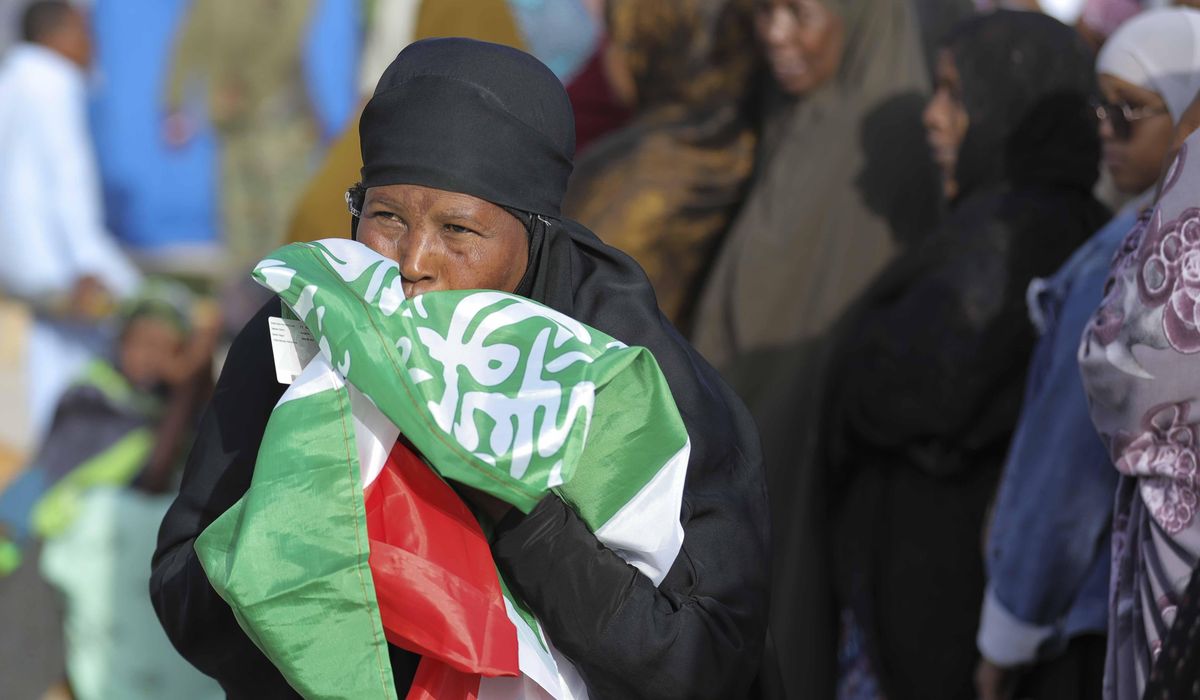

More than three decades after declaring independence from Somalia, the breakaway region of Somaliland last week exchanged diplomatic greetings with Israel, the first country to recognize the autonomous territory as a sovereign state.
The move drew swift rebukes from several countries and international organizations such as the African Union. Even the United States is wary, with President Trump saying only that he would “study” the issue before deciding if the White House would follow Israel in recognizing Somaliland.
A major concern is Mogadishu’s role as one of America’s most important strategic partners in Africa.
U.S. special operators work closely with Somalia’s Denab Brigade to battle the Islamic State and al-Shabab forces in the Horn of Africa. On Saturday, U.S. Africa Command confirmed that it launched Christmas Day airstrikes targeting ISIS fighters about 60 miles southeast of Bosaso, a city in Somalia’s northeastern Bari province.
The agreement to exchange ambassadors was signed by Israeli Prime Minister Benjamin Netanyahu and Somaliland President Abdirahman Mohamed Abdullahi. The recognition comes with Somaliland’s agreement to sign on to the Abraham Accords.
Mr. Netanyahu invited the Somaliland president to pay an official visit to Israel. He said Jerusalem plans to immediately expand its relations with its newest diplomatic partner through cooperation in the fields of technology, health and agriculture.
“The President thanked me for this historic declaration and expressed appreciation for my achievements in fighting terrorism and advancing regional peace,” Mr. Netanyahu said on X.
Somaliland first gained independence and international recognition in 1960, before voluntarily joining with Somalia later that year. It has functioned as a stable, self-governing and democratic nation since moving to reclaim its independence in 1991, advocates say.
The province is located in the northwest of Somalia, bordering Ethiopia, Djibouti and the Gulf of Aden. Although Somaliland functions as a de facto sovereign nation with its own government, military and currency, it isn’t internationally recognized and still considered by most countries as a region of Somalia.
The chairman of the African Union Commission, formerly known as the Organization of African Unity, has noted “with deep concern” the recent diplomatic move by Israel and Somaliland. Mahmoud Ali Yousouf, the foreign minister of Djibouti who leads the organization, called for the respect for the “intangibility” of international borders inherited at independence.
Mr. Yousouf said he rejects any initiative aimed at recognizing Somaliland as an independent entity. It remains an “integral part” of the Republic of Somalia, he said.
“Any attempt to undermine the unity, sovereignty, and territorial integrity of Somalia runs counter to the fundamental principles of the African Union and risks setting a dangerous precedent with far-reaching implications for peace and stability across the continent,” Mr. Yousouf said in a statement.
The European Union criticized Israel’s recognition of Somaliland, with EU officials saying all parties should respect the unity, sovereignty, and territorial integrity of Somalia.
“This is key for the peace and capability of the entire Horn of Africa region,” EU officials said in a statement. “The EU encourages meaningful dialogues between Somaliland and the Federal Government of Somalia to resolve longstanding differences.”
Egypt, Jordan, Turkey and Algeria were among more than a dozen mostly-Muslim countries that condemned Israel’s decision to exchange ambassadors with Somaliland.
“The recognition of parts of a state constitutes a serious precedent, threatens international peace and security, and violates the cardinal principle of international law and the U.N. charter,” their joint letter stated.
The diplomatic marriage between Israel and Somaliland has also drawn praise in some quarters.
Joshua Meservey, a senior fellow at the Hudson Institute think tank, said Israel may have been the first nation to recognize Somaliland, but it almost certainly won’t be the last.
“Recognizing [Somaliland’s] independence is recognizing a simple reality, including that it isn’t worthwhile to sacrifice relations with [them] in hopes Mogadishu will emerge from its dysfunction,” Mr. Meservey said on X.
Mark Dubowitz, the CEO of the Foundation for the Defense of Democracies think tank, said a glance at a map of the Middle East can illustrate why it makes sense to recognize Somaliland.
“Somaliland sits on the Gulf of Aden, next to the Bab el-Mandeb — a choke point for global trade and energy. Across the water are Iran-backed Houthis firing on Israel and shipping,” Mr. Dubowitz said on X. “Somaliland offers stability, ports, intelligence access, and a non-Iranian platform on the Red Sea. Similar reason why the U.S. has a military base in Djibouti.”
Somaliland also has powerful advocates on Capitol Hill, including Sen. Ted Cruz, Texas Republican, who sent the White House a letter in August urging the Trump administration to formally recognize it as an independent state with sovereignty within its 1960 borders.
“Somaliland has emerged as a critical security and diplomatic partner for the United States, helping America advance our national security interests in the Horn of Africa and beyond,” Mr. Cruz said in a letter to Mr. Trump. “Somaliland faces mounting pressure from adversaries, due in no small part to its role as a partner for the United States and its allies.”
“Despite the threats, Somaliland remains committed to forging closer ties with the U.S. and is actively engaged in enhancing military cooperation, counterterrorism efforts, and economy and trade partnerships,” Mr. Cruz said in the letter. “To do so to the greatest effect and the greatest benefit to American national security interests, it requires the status of a state.”