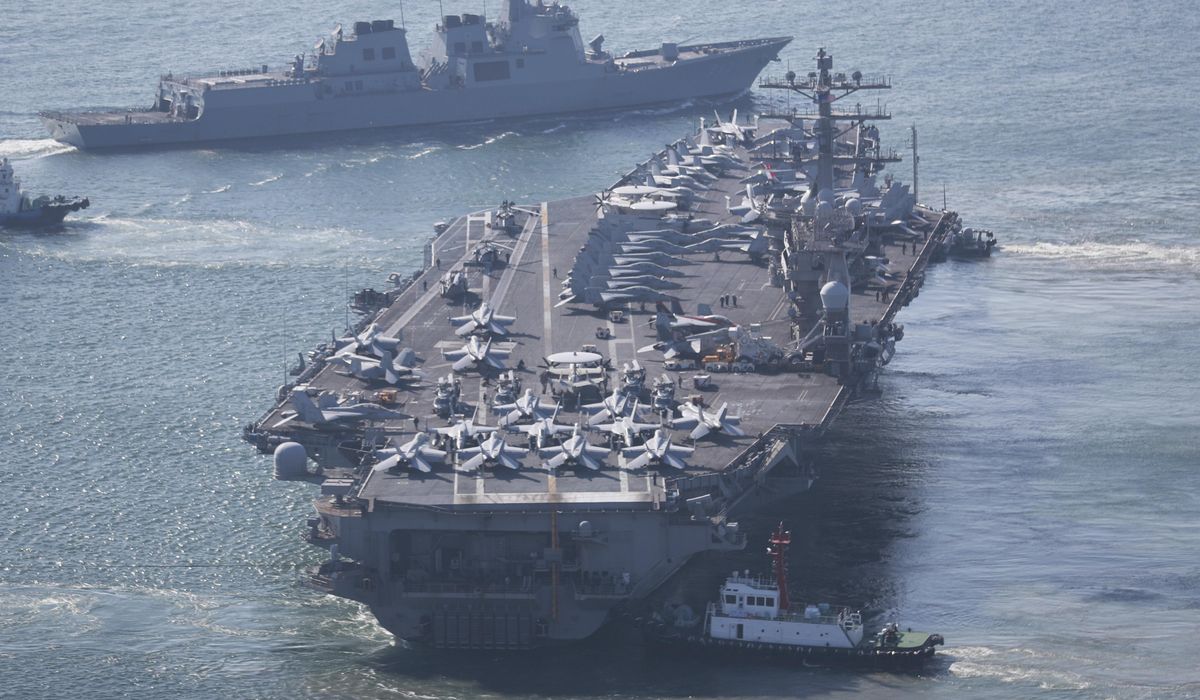
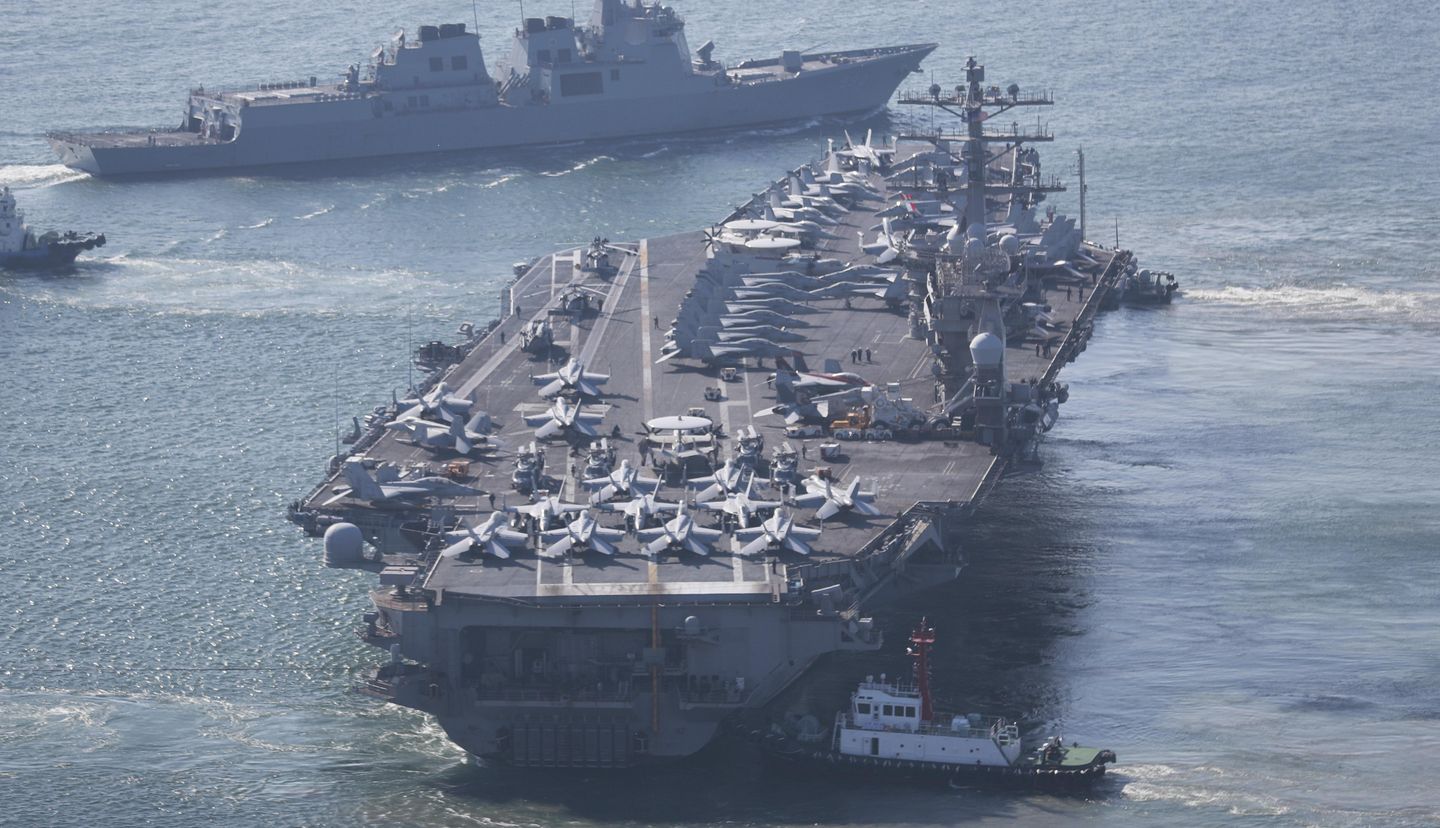
Hundreds of sailors manned the rails on a wet, blustery day in mid-December as the USS Nimitz steamed into Puget Sound and returned to its home port at Naval Base Kitsap, about 20 miles west of Seattle.
The Nimitz had just wrapped up a nine-month deployment, operating in the Indo-Pacific region and in the Persian Gulf, where it launched air strikes against Islamic State targets in Somalia. It also supported freedom of navigation efforts in the Arabian Sea, completing four transits through the tense Strait of Hormuz.
It would be the last deployment for America’s oldest operational aircraft carrier.
“We have traveled more than two-thirds of this planet during this nine-month deployment, and I cannot overstate the positive impact the Nimitz Strike Group has made as part of our mission to maintain peace through strength by sustaining credible deterrence alongside our allies and partners,” Rear Adm. Fred Goldhammer, commander of Carrier Strike Group 11, said in a statement.
Named for Fleet Adm. Chester Nimitz, who led the U.S. Pacific Fleet during World War II, the carrier has taken part in nearly every major U.S. conflict and operation for more than 50 years.
Nimitz aircrews provided fighter cover and launched airstrikes during Operation Desert Storm and Southern Watch in the 1990s, and the more recent Operation Iraqi Freedom and Operation Enduring Freedom in Afghanistan.
“These men and women, these world-class warfighters, truly exemplified our Navy’s warrior ethos through their honor, integrity, resilience, and relentless commitment to the mission and to each other,” Capt. Joseph Furco, the ship’s commanding officer, said after the Nimitz returned to its final homeport.
“I am deeply proud of this crew for proving, over nine months of sustained operations at sea, that they are well-trained, fit to fight, and ready to win,” he added.
The Nimitz was commissioned in May 1975 by President Gerald Ford. Along with its sister Nimitz-class carriers, it was the backbone for U.S. power projection for decades during the Cold War and its aftermath.
The nuclear-powered Nimitz was both a mobile airbase for sustained global operations and a symbol of national resolve.
Retired Rear Adm. Mark Montgomery, a senior fellow with the Foundation for Defense of Democracies think tank, served aboard the Nimitz as the ship’s reactor officer from 2004 to 2007.
“Nimitz was the first in a class of supercarriers. Its construction was started just after the Tet Offensive in Vietnam, and it has excelled for 50 years,” Rear Adm. Montgomery told The Washington Times. “The ship is a physical manifestation of America’s global reach and power.”
Rear Adm. Montgomery also serves as senior director of FDD’s Center on Cyber and Technology Innovation. He believes that supercarriers like the Nimitz will continue to play an important role in deterring adversaries like China in the short term and for decades to come.
“This would be less risky if the Navy would commit to longer-range attack aircraft and preferably some unmanned versions,” he added.
Nimitz-class aircraft carriers are powered by two A4W nuclear reactors that generate steam to drive four turbines that will provide virtually unlimited range and endurance for more than 20 years without refueling.
The Nimitz was America’s second nuclear-powered carrier, after the USS Enterprise. The construction of the 10 Nimitz-class ships over the decades marked the Navy’s transition from conventionally-powered carriers, which need friendly countries’ ports to refuel and operate overseas, to nuclear-powered ones, which essentially don’t.
Rear Adm. Montgomery was the senior reactor operator aboard the Nimitz during the ship’s 2005 deployment to Iraq that was featured in the PBS documentary series “Carrier.”
“The personnel in the Reactor Department were all professionals. But in particular, the department heads, the limited duty officers, and the senior enlisted were all workhorses who were very committed to the mission,” he said. “I was very fortunate to have such superb shipmates.”
During the ship’s final operational deployment, Nimitz sailors completed more than 8,500 sorties and 17,000 flight hours while sailing more than 82,000 combined nautical miles.
“Being on a combat deployment where you are the only carrier available for persistent air operations means you can’t go ‘off-line’ for maintenance issues and you can’t have personnel hiccups,” Rear Adm. Montgomery said. “It’s a demanding, high-stress environment within a nuclear engineering enterprise that is already highly demanding and stressful.”
But the ship’s final mission wasn’t without mishaps.
On Oct. 6, 2025, an F/A-18F Super Hornet and an MH-60R Seahawk helicopter went into the South China Sea within 30 minutes of each other. Both crews were safely recovered.
President Trump later suggested that contaminated fuel may have been responsible for the crashes, although the Navy’s investigation is reportedly still ongoing.
The ship also became a Hollywood star.
In 2005, PBS released a 10-part documentary series called “Carrier,” which followed the Nimitz on a six-month deployment to the Middle East.
The USS Nimitz also had a starring role as itself in “The Final Countdown,” a 1980 Kirk Douglas movie in which the modern carrier travels through time to Dec. 6, 1941, the day before the Japanese attack on Pearl Harbor.
The Navy cooperated with both films’ production and allowed the filmmakers on the ship to shoot.
Dave Wood, vice president of the USS Nimitz Association, was aboard the carrier while the Hollywood crew was filming the sci-fi movie.
A large chunk of it is set in the carrier’s sick bay, where Mr. Wood was working, which gave him ample opportunity to spot the movie stars pretending to be naval officers.
“Just experiencing that was phenomenal. We got a lot of interaction with the [movie] crew,” he said.
Mr. Wood’s bunk was near the carrier’s steam catapult, which is used to launch the aircraft off the deck.
“The noise was immense during flight operations, which can happen 24 hours a day,” he said.
Following its return from the last operational deployment, the Nimitz is now undergoing maintenance at Naval Base Kitsap before the final transport to Norfolk, Virginia.
There, the ship’s nuclear reactor will be defueled and the formal inactivation will begin.
The USS Nimitz is unlikely to become a floating museum, as have scores of other retired Navy ships, including such World War II-era carriers as USS Yorktown and the USS Midway.
Those carriers were conventionally powered but removing the complex nuclear reactors, to avoid radiation risks, while keeping the rest of the Nimitz reasonably intact, would be a logistical headache and tremendously costly.
“It’s sad, but it’s one of those things. We knew it was going to happen, but we just didn’t know ‘when,’ Mr. Wood said.