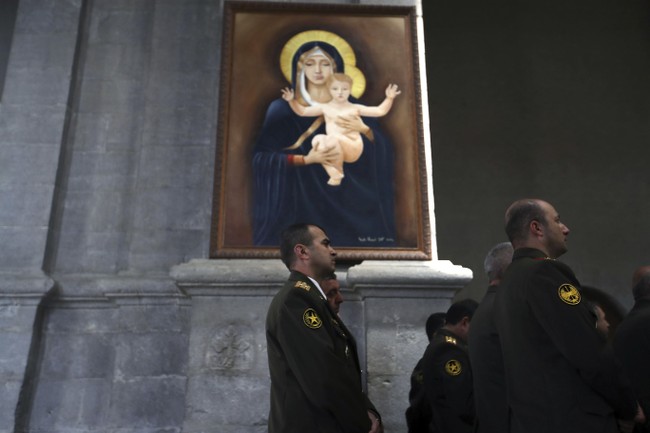
Armenia is historically recognized as the first nation to adopt Christianity as its official state religion, traditionally dated to 301 AD. However, a part of the ancient Armenian Christian heritage is currently facing extinction in the South Caucasus.
Approximately 150,000 indigenous Armenians—the creators and bearers of an ancient civilization—were forcibly displaced from their ancestral homeland of Artsakh/Nagorno-Karabakh following the 44-day war in 2020, a subsequent 10-month blockade, and a renewed military offensive by Azerbaijan.
The Armenian cultural heritage which they were forced to abandon has been extensively documented. It was built by the Armenian inhabitants’ own hands—and passed on through millennia.
In recent years, many of these sites have been distorted or repurposed, while others face imminent threats to their existence, as part of Azerbaijan’s—and its ally Turkey’s—goal of Turkification and Islamization of the wider region.
The organization “Spiritual Artsakh” announced on February 11 the release of The Tangible Cultural Monuments of the Republic of Artsakh, a comprehensive, two-volume ethnographic publication detailing endangered, millennia-old, Armenian religious and cultural heritage sites across Nagorno-Karabakh/Artsakh.
The 1,088-page publication authenticates 5,658 diverse monuments in 308 indigenous Armenian settlements across eight regions of Artsakh. These monuments are at risk following the large-scale and complete displacement of the Armenian population from Artsakh in 2023. The publication is available for free download in both English and Armenian.
The publication offers a comprehensive inventory of cultural heritage monuments, including monasteries, churches, khachkars (cross-stones), and cemeteries. It authenticates each site by detailing its location, type, period, function, architectural style, artistry, historical context, and current state of preservation.
While raising global awareness of the urgency to protect these cultural monuments, this evidence-based repository supports academic research on Artsakh’s long-standing historical, ethnographic, cultural, and religious Armenian traditions.
In 2021, during an interview standing near the church in the village of Tsakuri in Hadrut (which was broadcast and widely circulated online), President of Azerbaijan Ilham Aliyev personally ordered the scrapping of all Armenian inscriptions on Armenian churches. Therefore, it is quite obvious that a pronounced policy of destruction and desecration of Armenian cultural heritage is currently being implemented by a state actor at scale.
To date, Azerbaijan’s destruction of historical monuments and various structures of Armenian origin in Artsakh has been numerous. At present, the free entry of journalists and experts into the territory of Artsakh is generally prohibited.
According to satellite imagery and information received through various channels, some settlements have been completely razed to the ground. This includes all of the monuments, including graves, in the villages of Karin Tak, Mokhrenis, and Sghnakh.
The 19th-century district of Stepanakert, built in the Armenian architectural style, was completely destroyed, as were the buildings of the National Assembly, the government, the Ministry of Defense, the Ministry of Foreign Affairs, the Union of Freedom Fighters, and several other buildings built in Stepanakert during the independence years. Throughout Artsakh, monuments and memorial complexes dedicated to the Artsakh Liberation War have been completely destroyed.
Armenian churches have also been targeted. The Ghazanchetsots Amenaprkich Cathedral in Shushi was bombed during the war, and immediately after the war. The famous Hovhannes Mkrtich (St. John the Baptist church) or Kanach Zham (Green Church) in Shushi, as well as those in Berdzor, Mekhakavan, and several other churches, have been completely razed to the ground.
Ali Mozaffari, an Iranian academic of Azerbaijani descent who is a senior research fellow at Australia’s Deakin University, says the latest apparent drive to wipe out physical traces of Armenian heritage in Nagorno-Karabakh is an issue that may extend beyond a conflict between Azerbaijan and Armenia. “There is a strong push, led by Turkey, for realizing the idea of a unified and connected Turkic World, and extending eastward to the Chinese border,” Mozaffari told RFE/RL. “Heritage is very important to justifying this geostrategic vision,” he said.
Lori Khatchadourian, an associate professor at Cornell University and the co-founder of Caucasus Heritage Watch, pointed to the precedent of the virtually complete erasure of Armenian heritage in the Azerbaijani-controlled exclave of Nakhijevan as an example of what may lie ahead in Nagorno-Karabakh.
“One of the important lessons learned from the Nakhijevan case is that total cultural erasure takes time,” Khatchadourian told RFE/RL. “The demolition of the Armenian cultural landscape in that region unfolded over a decade, beginning in 1997 and continuing until at least 2009, and possibly as late as 2011.”
The Tangible Cultural Monuments of the Republic of Artsakh is co-authored by several notable Artsakh historians, including Dr. Vahram Balayan, Melanya Balayan, Lernik Hovhannisyan, and Slava Sargsyan.
The co-authors of the book said:
Our book’s comprehensive documentation of Nagorno-Karabakh/Artsakh’s endangered, millennia-old, Armenian religious and cultural heritage sites is part of our collective civilization’s rich history, not only that of Armenians.
Every ancient cultural heritage site deserves recognition and preservation, regardless of religion or culture. Each site documented around the world, and those in our book, authenticates and validates the existence of a nation and its cultural heritage. It highlights and proves where they lived, thrived, and how they contributed to our world.
Also, many of the sites documented in our book are of great significance as early and first Christian sites, since Armenia was the first nation to adopt Christianity as its national religion.
“Amidst the current situation in Artsakh, we hope our research will prevent the further destruction or desecration of the settlements, monasteries, churches, khachkars (cross-stones), and cemeteries. Our evidence-based repository confirms, beyond doubt, the existence of these sites and their exact locations. Current and future world historians, archaeologists, sociologists, and academic researchers can use our two-volume book to gain a comprehensive understanding of Artsakh’s long-standing historical, ethnographic, cultural, and religious Armenian traditions–even if someday these are destroyed.
Parallels are striking between the destruction of the Armenian cultural heritage in Artsakh and the destruction of the cultural of other communities in the Middle East and North Africa region (such as Greeks, Yazidis, Jews, the Druze, the Copts, Mandaeans, Samaritans, Maronites, Assyrians, Baha’i, and others). This type of cultural erasure is the systematic removal or suppression of a group’s cultural identity, practices, religious beliefs, language, heritage, and history, often employed by Islamic supremacists in the region. Targeted destruction of monuments, places of worship, cemeteries, and schools, amongst others, serves to break the transmission of culture between generations and erase evidence of historical rights to land or sovereignty.
The authors of the book noted:
We know that evidence and actual historical references to cultural sites survive by the mere fact of documentation. This invaluable gift provides future generations with undeniable proof of what existed even if it no longer exists today or may in coming years. Even if ruling powers destroy cultural heritage sites, the documented evidence of what once existed cannot be erased and far surpasses that of those in power.
“We hope that our book will remain as a permanent, valued proof and evidence of Artsakh’s rich Armenian cultural sites. Our undertaking to document 5,658 diverse monuments includes many religious edifices that have already been destroyed, while others fell into disrepair or disappeared altogether during the Soviet era in Azerbaijan.
In compiling the enduring testimonies of our history, culture, and the spiritual and material heritage of our lost homeland, we hope to create a lasting record, even with the forced expulsion of the entire indigenous Artsakh Armenian population from our ancestral lands. As authors who were born, lived, and spent our lives in Artsakh, we have a duty as historians to preserve and safeguard the rich cultural tapestry of our ancestors so that it is never forgotten, especially amidst current attempts of on-going state-sponsored erasure.
Editor’s Note: Support and follow PJ Media’s coverage of Islamic terror and other key news in this midterm election year. Join PJ Media VIP and use promo code FIGHT to get 60% off your membership.