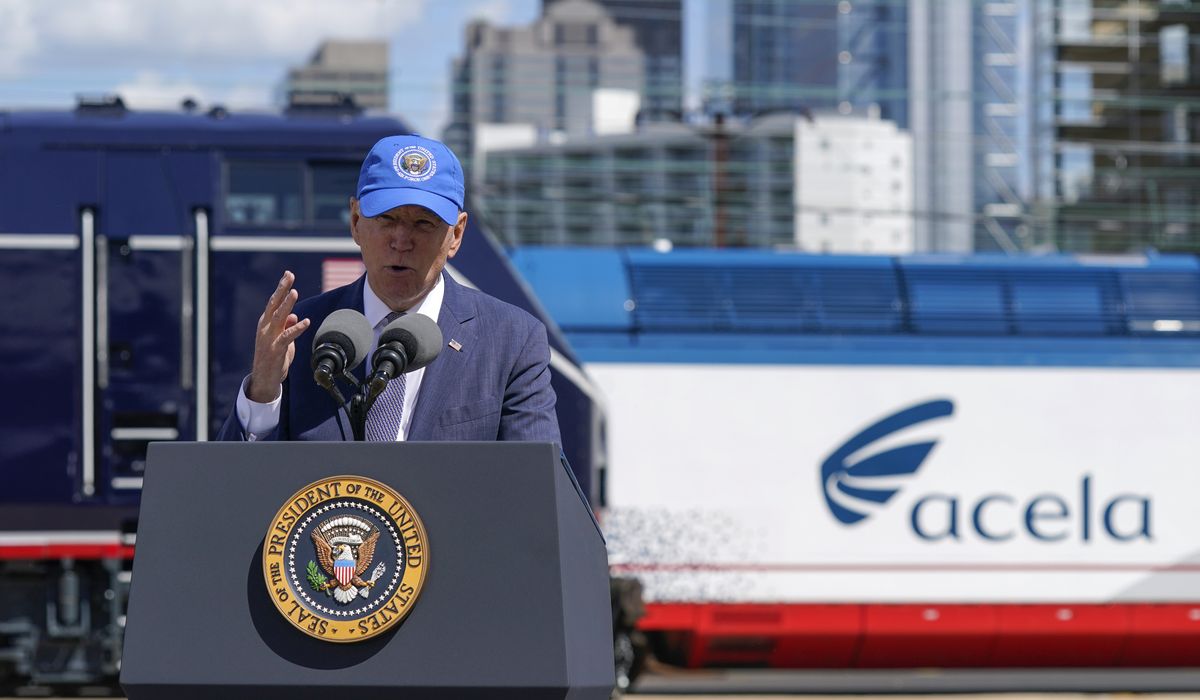
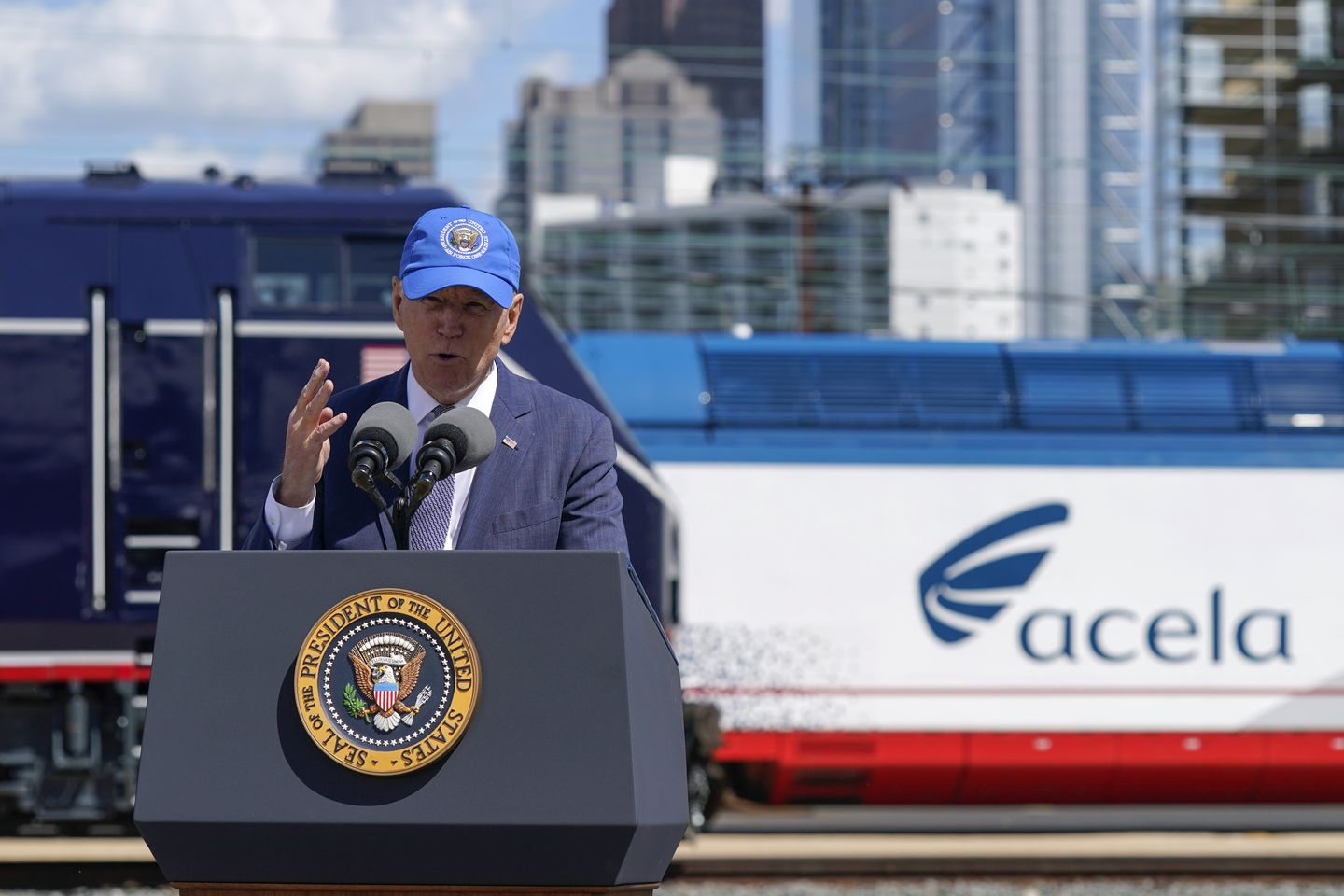
When Amtrak’s new NextGen Acela trains rolled into a station in August, they were gleaming pieces of modern machinery — the only problem is that they were years overdue and were clocked slightly slower than the old trains.
The NextGen Acela trains were supposed to have been delivered in 2021 but didn’t arrive until this summer, costing taxpayers nearly $300 million in lost revenue and unexpected maintenance in keeping the old trains running an extra four years, according to a new audit by the Senate Commerce Committee.
Worse yet, the trains make the trip from Washington to Boston in a little over 7 hours, or slower than older models that came in at about 6 hours and 50 minutes, the committee said, citing Amtrak’s timetables and a study by The Wall Street Journal.
It’s another blow to the legacy of former President Joseph R. Biden, or “Amtrak Joe,” as he styled himself because of his erstwhile daily commute from Delaware to the District of Columbia when he was a senator.
Mr. Biden’s face graced Amtrak’s 2010 glossy report promising a vision for the future of high-speed rail and speeds of 220 mph.
The problem, according to the Senate report, is that the new trains still run on tracks and infrastructure that can’t deliver the promised speeds. It would take a $120 billion investment for trains to hit maximum speeds in the Northeast corridor, the committee said.
Sen. Ted Cruz, Texas Republican and committee chairman, said it was a cautionary tale of how the Obama-Biden administration oversold and underdelivered on a massive infrastructure project.
Their miscalculation was to have taxpayers pony up for top-level speed and then hope the track infrastructure would follow. It hasn’t — yet.
“Against the advice of experts and manufacturers, the administration awarded an over-budget, high-speed train contract without a workable plan for deployment. We cannot continue to frivolously use millions of taxpayer dollars without producing an improved passenger rail system,” Mr. Cruz said.
A major reason for the delay in deployment was that the project was initially tied to high-speed rail in California. The vision was to use the same trains for both lines.
That deterred the number of vendors who bid to deliver the new train and proved to be a pipe dream anyway. Amtrak ditched the joint venture idea several years later.
A lot of that came down to tilting. Some potential bidders figured that speeding through curves in the Northeast corridor was a crucial way of reducing travel times — and the way to achieve that was through tilting the train.
But tilting wasn’t an issue in the California project.
In 2014 Amtrak abandoned the idea of buying a single train to work on both lines.
Amtrak called the new trains “a huge success” with strong ridership.
Amtrak, a public-private partnership that relies on taxpayer subsidies but operates as an independent business, blamed the delays on its commitment to safety, saying it was adhering to new federal standards and needed new designs and more testing.
“Amtrak will never compromise safety, and we remain strongly committed to Buy America Standards to help grow our national economy. We look forward to the continued success of Amtrak’s NextGen Acela, which will serve millions of additional riders in the coming years,” the passenger train firm said.
Amtrak said trip speeds are dependent on the rails and overhead wires that deliver power. It promised more improvements in those areas.
Alstom SA, the multinational firm that won the NextGen Acela contract, responded to an inquiry by deferring to Amtrak’s response.
High-speed rail has been an elusive goal for America.
Some envision the bullet trains of Europe and Japan crossing the nation, enticing Americans out of their cars, trucks and SUVs and onto the rails with speed, comfort and convenience.
So far, the Acela is the best the U.S. has to offer. Its top speed of 160 mph along some sections is still significantly slower than the 190 mph regularly achieved by Italy’s Frecciarossa or the 200 mph for Japan’s Shinkansen.
California has dreamed of high-speed rail to connect the Los Angeles area with San Francisco.
It seems an obvious fit. The train trip now takes about 10 hours, and it can be driven in under 7 hours. A high-speed train like Japan’s Shinkansen could cut the trip to three hours.
California and the federal government had dumped money into the project, but the Trump administration has signaled the spigot is being turned off.
That came after another damning report in February by the project’s inspector general saying the project’s timelines may not be “realistic and achievable.”
The new Senate report acknowledged the attraction of high-speed rail, but said taxpayers deserve not to have their leaders blinded by those dreams.
Committee investigators said it makes no sense to buy trains with flashy top speeds and then hope — often in vain — that the tracks they run on will improve enough to let them get near those speeds.
They urged planners to focus less on the top speed a train might achieve and instead look at the realistic trip times to see whether a route can compete with planes or cars.
“At this stage, NextGen Acela is not a ’remarkable success story’ but rather a cautionary tale for Amtrak and other advocates for high-speed rail,” the report concluded.