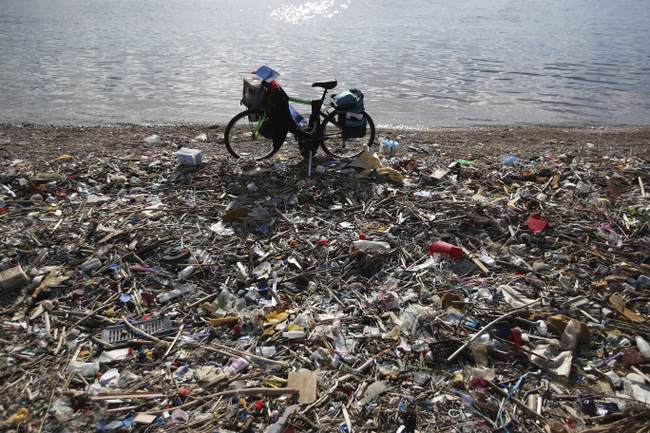
Planet Earth is drowning in plastic waste. Around 11 million metric tons (24 billion pounds) of plastic enter the ocean yearly, equivalent to thousands of garbage trucks daily.
This is one of several patches of plastic waste that dot our oceans, threatening water life and human existence.
These shocking images of the ocean plastic crisis were captured by our cleanup crews just days ago off the west coast of Haiti.
Did you know that huge patches of plastic pollution like this are created by the stirring of ocean currents?
pic.twitter.com/CsYl6Cef3m— 4ocean (@4ocean) October 4, 2020
These are tiny compared to the Great Pacific Garbage Patch (GPGP). Located in the North Pacific Ocean between Hawaii and California, it is estimated to cover roughly 1.6 million square kilometers—an area about three times the size of France or twice the size of Texas. It’s not a solid “island” of trash that you can walk on. Instead, it is a massive, dispersed vortex of marine debris held together by the North Pacific Subtropical currents.
An estimated 75-199 million tons already exist in the ocean, with plastic found from the poles to the seafloor. What’s more, plastic production is increasing, with plans for significant expansion, which would worsen the crisis.
This is an existential threat to the human race that we are refusing to deal with.
One of the side issues raised by all this plastic waste is human ingestion of “microplastics.” These are “synthetic solid particles or polymeric matrices, with regular or irregular shape and with size ranging from 1 μm [micron] to 5 mm, of either primary or secondary manufacturing origin, which are insoluble in water,” according to the European science journal Springer Nature.
Are they a huge problem? They certainly are ubiquitous. As of 2026, the scientific consensus suggests that the average adult ingests between 74,000 and 121,000 microplastic particles every year from food and water alone. If you include the particles we inhale from the air, that number can rise to over 211,000 particles annually.
What does that mean for our health? Ingesting that many microplastic particles could be linked to cancer, heart attacks, reproductive problems, and a host of other harms.
Or perhaps not.
The field of study is relatively new and has become “the next big thing” in science. That’s not necessarily bad. It’s a subject that, if not ignored, was certainly understudied for decades. It has also become the cause du jour of the environmental movement, with all the political baggage that entails.
The problem is very real and very critical, but the effect on the human body of microplastics is a relatively new field of study, and scientists disagree on how dangerous the problem might be.
Studies claiming to have revealed micro and nanoplastics in the brain, testes, placentas, arteries and elsewhere were reported by media across the world, including the Guardian. There is no doubt that plastic pollution of the natural world is ubiquitous, and present in the food and drink we consume and the air we breathe. But the health damage potentially caused by microplastics and the chemicals they contain is unclear, and an explosion of research has taken off in this area in recent years.
However, micro- and nanoplastic particles are tiny and at the limit of today’s analytical techniques, especially in human tissue. There is no suggestion of malpractice, but researchers told the Guardian of their concern that the race to publish results, in some cases by groups with limited analytical expertise, has led to rushed results and routine scientific checks sometimes being overlooked.
The Guardian has identified seven studies that have been challenged by researchers publishing criticism in the respective journals, while a recent analysis listed 18 studies that it said had not considered that some human tissue can produce measurements easily confused with the signal given by common plastics.
One such study was published in February last year. Appearing in Nature Medicine, it claimed “there was a rising trend in micro- and nanoplastics (MNPs) in brain tissue from dozens of postmortems carried out between 1997 and 2024,” according to The Guardian.
However, another group of scientists challenged those findings: “The study, as reported, appears to face methodological challenges, such as limited contamination controls and lack of validation steps, which may affect the reliability of the reported concentrations.”
One of the scientists challenging the study was more blunt. “The brain microplastic paper is a joke,” said Dr Dušan Materić, at the Helmholtz Centre for Environmental Research in Germany. “Fat is known to make false-positives for polyethylene. The brain has [approximately] 60% fat.”
Dr. Materić suggested that rising obesity levels over the same period of time may be responsible for the false readings.
“That paper is really bad, and it is very explainable why it is wrong,” Dr. Materić added. He believes that “more than half of the very high impact papers” raise serious doubts about the research.
But the brain study is far from alone in having been challenged. One, which reported that patients with MNPs detected in carotid artery plaques had a higher risk of heart attacks and strokes than patients with no MNPs detected, was subsequently criticised for not testing blank samples taken in the operating room. Blank samples are a way of measuring how much background contamination may be present.
Another study reported MNPs in human testes, “highlighting the pervasive presence of microplastics in the male reproductive system”. But other scientists took a different view: “It is our opinion that the analytical approach used is not robust enough to support these claims.”
There’s nothing unusual about this at all. This is the “sausage-making” part of science. Ideas and theories are constantly questioned and challenged by other scientists; new data is added to the mix, changing minds or hardening positions until a rough consensus is achieved.
It’s not pretty. It’s not neat. While there is universal agreement that something must be done about plastic waste in the environment, there is no consensus yet on how all this waste affects the human body.
At the moment, there isn’t anything we could do about it anyway. The body flushes some of the particles, but most remain in our blood, our organs, and our brain. Given that most plastic ever manufactured is still around, it may be a while before we can find a way to flush these toxins from our systems.
The new year promises to be one of the most pivotal in recent history. Midterm elections will determine if we continue to move forward or slide back into lawfare, impeachments, and the toleration of fraud.
PJ Media will give you all the information you need to understand the decisions that will be made this year. Insightful commentary and straight-on, no-BS news reporting have been our hallmarks since 2005.
Get 60% off your new VIP membership by using the code FIGHT. You won’t regret it.