The Pentagon has started selecting U.S. defense manufacturers for the military’s $1 billion Drone Dominance Initiative.
At least six manufacturers have been informed by Pentagon officials over the past week that their platforms have been chosen to advance to the next round of the initiative.
The program, which has been designed to rapidly expand domestic small drone production, will move approved applicants to an initial testing stage called “Gauntlet I” over the coming weeks and months.
The Drone Dominance Initiative (DDI) has thus far been a stage for competing bids from industry suppliers to offer small, lethal and expendable drones manufactured through U.S.-based supply chains.
The stipulation that supply chains do not include products from China has raised challenges for some companies, according to industry sources.
The small uncrewed aerial systems (sUAS) are meant to act as “capable attack drones,” according to Defense Secretary Pete Hegseth, who has said the military will field “tens of thousands” of these drones to the services during 2026.
While the Pentagon has yet to publicly announce which companies have been chosen for the next stage of the DDI, Threat Status at The Washington Times has spoken with multiple industry players who say they’ve been alerted about drones that made the cut.
“We have quite a few that are up for phase one,” Amol Parikh, the co-CEO of Doodle Labs, told Threat Status.
His company is a supplier of the radio modules used in at least seven of the entrants. “We’re rooting for every one of them, but there’s some that definitely…already have the supply chain behind them that can do it,” Mr. Parikh said.
Vector Defense, Red Cat, Anduril, Teledyne FLIR and Performance Drone Works are all expected to be selected, according to industry sources familiar with the program and social media posts by some of the companies.
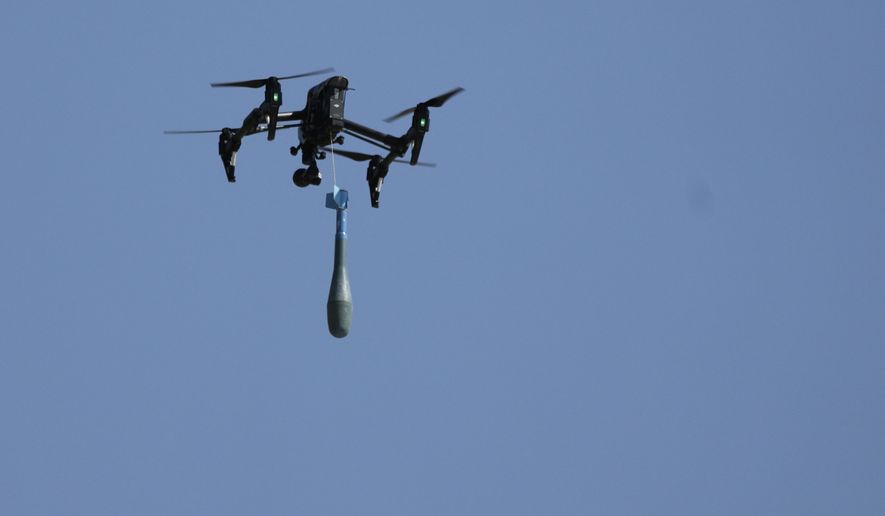
A drone carries a mortar shell …
more >
Pentagon officials have said they would approve at least 25 companies for the DDI testing phase, Gauntlet I. An official announcement is expected in the coming days, according to defense officials.
The official X account of the Pentagon’s under secretary for research and engineering included a post on Monday featuring a photo of a drone swarm with the words “Archipelago in the sky,” saying that it will be “scaling mass attritable drones” for the force, but has not made an official announcement on selections for DDI.
Anticipation has filtered down to retail investors who have scoured the internet for signs of which companies may have been selected.
More than two dozen companies are competing for a portion of the military’s order of 30,000 sUAS after completing testing in February.
Doodle Labs is part of a growing class of companies adapting cutting-edge civilian technology for military applications — often called dual-use technologies — even going so far as to shift the majority of their business to defense. The company provides communications for defense manufacturers Teledyne FLIR, DraganFly Incorporated, Performance Drone Works, Anduril Industries and Red Cat Holdings Incorporated.
The new approach represents a departure from the historically difficult defense purchasing process, marking a move toward modern manufacturing methods to keep pace with commercial technology and rapidly field new systems.
“Drone Dominance is one of those step changes in terms of how they approached putting this program out, and just how they’re really stressing the system — by design — to force it to make this massive step up and evolution,” said Mr. Parikh, the company’s co-CEO.
The production of sUAS stems from an industry that “was literally in garages like five years ago” but has now moved into “very, very real, large-scale production,” Mr. Parikh said.
Non-traditional defense businesses are embracing the Pentagon’s new direction, bringing a culture of agile development and commercial-market competitiveness that the department says is vital for maintaining a technological edge in rapidly evolving sUAS.
The shift represents a broader transformation in defense contracting. Companies that might have struggled to navigate Pentagon bureaucracy a decade ago are now accelerating the adoption of cutting-edge civilian technology for military applications and in some cases building the majority of their business into defense work.
It’s an evolution that Doodle Labs doesn’t plan to miss out on.
“Through the conversation, you get the sense that they’re betting the farm on the FPV, like drone dominance type of thing. That was one of the first signals of like, ‘Oh, this is a big deal,’” said Mr. Parikh.
Rather than relying solely on established prime contractors with long development cycles, the Pentagon is turning to startups and venture-backed companies specializing in uncrewed systems, artificial intelligence, software development and rapid prototyping.
Initially, Doodle Labs developed products for communications in commercial environments, products they still supply. But, in 2020, Doodle received funding from the U.S. Army and the Defense Innovation Unit — a critical part of leadership for the DDI — for the company’s Mesh Rider Radio system.
Mr. Parikh told Threat Status that a bulk of Doodle’s work is now focused on defense. The change accelerated when the company’s radios were brought into Ukraine with a local drone manufacturer there in 2023. Doodle didn’t have an anti-jamming solution at the time — it wasn’t a problem small drones had needed to focus on.
“We first went there in 2023, our radios, they worked for a bit until they didn’t against jammers,” Mr. Parikh said. That battlefield experience drove the company to develop capabilities now being integrated into DDI submissions.
A similar shift has filtered out to the manufacturers of the drones themselves. Red Cat, one of the companies competing in the DDI, sees the initiative as significantly reshaping the landscape of defense contracting, creating unprecedented opportunities for companies that are historically outside the traditional military-industrial complex.
“We’re excited that the government is moving towards this rapid prototyping, sort of accelerator-style production model,” said Brendan Stewart, the senior vice president of government affairs for Red Cat. “That really works better for sUAS, which are much more similar to the consumer electronics manufacturing philosophy than they are to traditional manned aviation or building ships and tanks.”
The push to rapidly deploy and scale drone technology has lowered the barrier to entry, meaning “a lot of folks who you would not traditionally expect to be in defense contracting now sort of have a seat at the table,” Mr. Stewart told Threat Status.
“You are seeing some of the more traditional primes in the room, and you’re also seeing folks like us,” he said.
Red Cat was a startup that is now publicly traded and worth over $2 billion. They have previously worked on the U.S. Army’s Short-Range Reconnaissance sUAS program. Mr. Stewart said the company is excited for the changes afoot under the DDI.
The shift is also buoying an American supply chain that has relied on China and other countries for much of its manufacturing.
The Pentagon is requiring all of the drones to be built from components made in the United States. Mr. Stewart said he’s seeing more companies develop key production capabilities, specifically the manufacture of brushless motors and lithium batteries made domestically.
“I’m really excited about the way that drone dominance was structured for that reason,” Mr. Stewart said. “Because it’s opening the aperture a little bit, and it’s forcing companies like some of the traditional primes to be a little bit more competitive, and frankly a little bit more innovative.”