The Trump administration’s military strikes against terror groups in Nigeria last December were crucial in the fight for international religious freedom and could boost global security, a State Department adviser says.
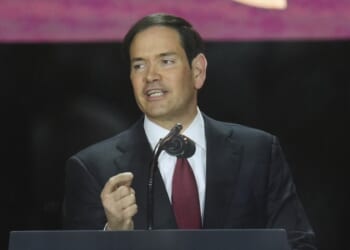
Mark Walker is the principal adviser on global religious freedom at the State Department. He and a panel of experts on Monday told the International Religious Freedom Summit in Washington that protecting global religious freedom is deeply intertwined with global security.
Mr. Walker highlighted the crisis in Nigeria, noting that “70% of all Christians who are martyred come out of the continent of Africa, and 90% of that number have come out of the country, specifically in Nigeria.”
He pointed to President Trump’s “bold step” in designating Nigeria as a Country of Particular Concern, signaling to the Nigerian government and the world that the U.S. is “monitoring these things.”
Christian advocates have long advocated for Western intervention in Nigeria to prevent a “genocide” against Christians, perpetrated by armed terror groups such as Boko Haram and the Islamic State. Reports from Intersociety, a human rights organization based in Nigeria, say that about 7,000 Christians were killed in the first 220 days of 2025.
Reports of mass killings of Nigerian Christians last year culminated in U.S. military strikes on militants in the country on Christmas Day. The strikes, which were coordinated with the Nigerian government, reportedly killed several IS militants.
Before the strikes, Mr. Trump and his allies had argued that Nigeria’s government had been too slow to counteract attacks against Christians, vowing to intervene. Defense Secretary Pete Hegseth insisted that there would be “more to come” as the U.S. looks to protect Christian communities abroad.
The connection to global security
Panelists argued Monday that the countries with the most religious freedom are often the ones that are the most stable and that autocratic regimes seeking to control the spiritual expressions of their citizens are fragile.
“These autocratic governments or violent nonstate actors that not only are going after what is the foundational human right that we have and share universally, but it is part of a larger effort of these regimes to consolidate their power,” said Nicole Bibbins Sedaca, a senior fellow at the George W. Bush Policy Institute. “People who believe and are following their conscience will not sit idly by. They will push back. They will go to the streets. They will push for them to be able to live freely. And that is what causes instability at times in a society, because people are choosing to push back on that repression.”
Ms. Sedaca pointed to a 2015 study from the Institute for Economics and Peace, which found a statistical link between a nation’s acceptance of religious faiths and its overall stability. Additionally, nations with lower religious diversity are the “least peaceful,” according to the study.
Given the connection between religious liberty and national stability, experts at the summit urged the Trump administration to fully embed religious freedom protection within its international security strategy.
Scott Busby, a senior associate at the Center for Strategic and International Studies, said advocacy for religious freedom was “most effective when it was effectively integrated into our general human rights advocacy as well as our national security,” ensuring it did not “stand on its own, making its own case.”