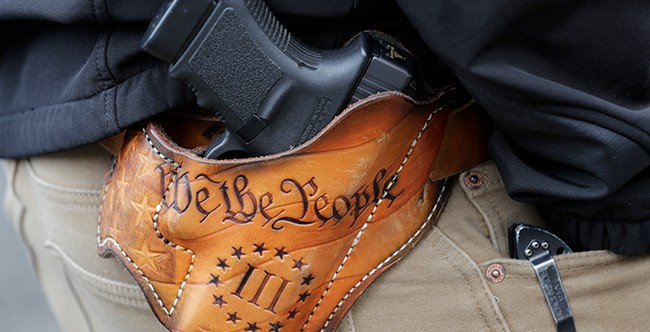
The U.S. Supreme Court heard oral arguments today in a Second Amendment case where the question is: Should it be legal for those with public-carry licenses to carry their guns while on private property that’s open to the public? For example, should they need permission from the owner of the property before they can carry in places like a grocery store, shopping mall, drive-thru, or gas station?
The case at the center of the debate is Wolford v. Lopez. It takes on a Hawaiian law that does not allow people with concealed carry permits to bring their handguns onto private property that is open to the public — that is, unless they receive prior permission from the owner.
The plaintiffs challenging Hawaii’s law are Maui residents Jason Wolford, Alison Wolford, and Atom Kasprzycki, and the Hawaii Firearms Coalition.
Hawaii Attorney General Anne E. Lopez is the defendant. Former Acting U.S. Solicitor General Neal Katyal is representing Lopez.
In today’s oral arguments, Justice Samuel Alito commented to Katyal, “You’re just relegating the Second Amendment to second-class status… I don’t see how you can get away from that.”
Chief Justice John Roberts pointed to other Supreme Court decisions like forced waiting periods for gun purchases, which he said frame the Second Amendment as a “disfavored right.”
If you’re wondering where the court will come down on this case, Roberts may have laid that out pretty clearly when he told Katyal, “It strikes me that one of the things that your side has to come to grips with is it is a very clear constitutional right.”
In other words, while there may be a very specific legal question at the center of this case, the court appears to see it as an attempt to put the entire Second Amendment on trial.
Roberts challenged Katyal to tell him the difference between the First Amendment and the Second Amendment in the context of this law, when it comes to people licensed to carry when they are on private property. He reminded Katyal that under the First Amendment, a candidate can walk up to and knock on a voter’s door and not require prior permission to do so.
But in Hawaii, Roberts said, someone who is legally carrying a handgun must first receive approval to enter the property.
In most states, private property owners do have the right to expressly prohibit weapons on their property if they so choose, but what makes the Hawaii law different is that it assumes you’re not permitted to carry by default. You must seek and obtain permission in advance, or the property owner would need to preemptively and publicly advertise or notify in some fashion to give permission in advance.
How many shopping malls or retailers are likely to present themselves that way? This is why the gun control lobby likes the Hawaii law so much. Meanwhile, if there’s a mass shooter on the premises of any one of these gun-free locations, he or she will have a much softer target, and the chance of more casualties rises exponentially.
The consensus among the conservative justices appeared to be that Hawaii applied an uneven or unfair standard to the Second Amendment when compared to other constitutional rights.
In Hawaii, if you carry a gun in violation of this law, you can be convicted of a misdemeanor and face up to one year behind bars.
Other states with similar laws include California, Maryland, New Jersey, and New York. Forty-five states, however, do allow licensed handgun owners to carry their handguns onto private property that’s open to the public without prior permission.
Recommended: French Activist Arrested On-Street While Asking Questions About Radical Islam and Women
Three Maui County residents and the Hawaii Firearms Coalition, a gun-rights group, sued the state in 2023 on Second Amendment grounds. They also claimed that measures that prohibit handguns in restaurants, bars, beaches, parks, and banks or other financial institutions are violations of their gun rights. The Supreme Court is not hearing arguments on those issues.
Hawaii enacted the law at the center of this case after the Supreme Court ruled in 2022 on the case of New York State Rifle and Pistol Association v. Bruen, where the court decided that the Second Amendment guarantees the right to carry handguns in public.
Speaking in support of the plaintiffs, Sarah Harris, an attorney in the Solicitor General’s Office, told the court that the Hawaii law “offends our history and tradition,” adding that someone legally carrying their handgun while running errands could be convicted of a crime simply by pulling over to a gas station.
Solicitor General D. John Sauer said in a court filing that the state’s default rule is “blatantly unconstitutional” and prevents public carry.
Because most owners do not post signs either allowing or prohibiting firearms, Hawaii’s law effectively means that ordinary citizens licensed to publicly carry may not carry firearms in public at all… That near-total ban defies the ‘general right to publicly carry arms.’
Justice Brett Kavanaugh made an even more blunt point when he said, “Here, there’s no sufficient history supporting the regulation. End of case.”
Katyal’s defense of the Hawaii law was weak. He said simply, “In some places, it’s reasonable to assume guns are welcome. In others, it’s pretty clear an invitation to shop is not an invitation to bring your Glock,” he said.
Find out what you’re missing behind the members-only paywall. It’s time for you to take advantage of the full catalogue of common-sense thinking that comes with a PJ Media VIP membership. You’ll get access to content you didn’t even know you wanted. The good news is, PJ Media VIP memberships are on sale! Get 60% off an annual VIP, VIP Gold, or VIP Platinum membership!