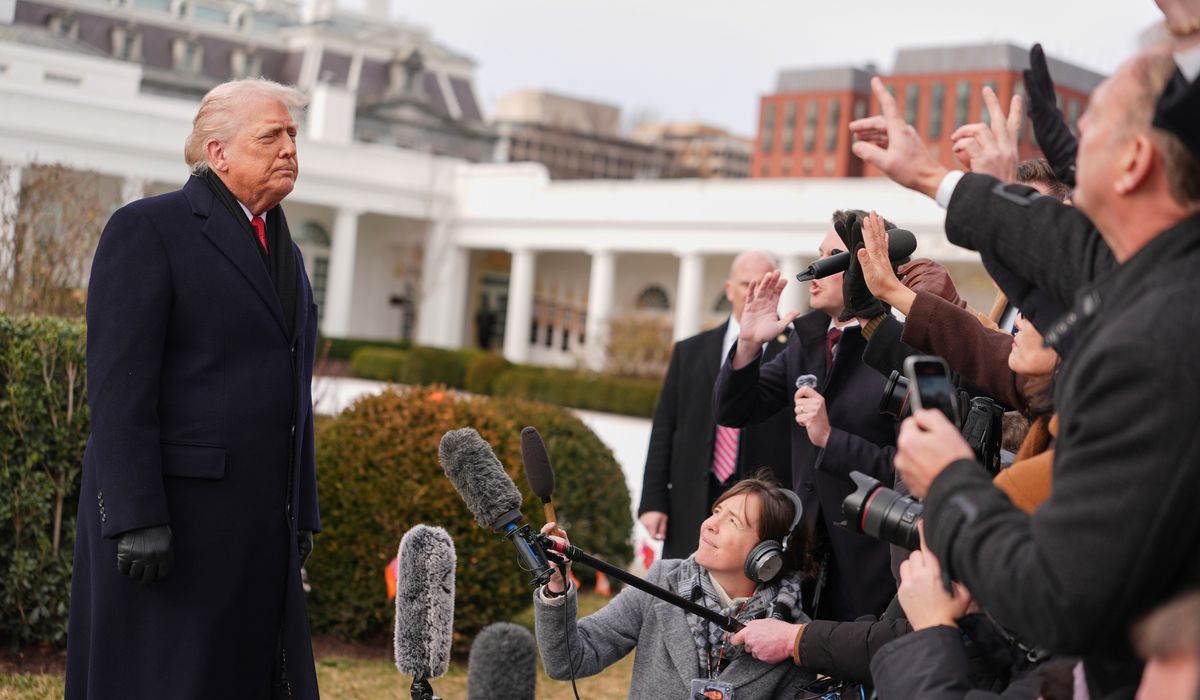

President Trump has unleashed a barrage of proposals in recent days aimed at lowering Americans’ cost of living and has pledged many more will be unveiled soon at the World Economic Forum in Davos, Switzerland.
The messaging blitz makes clear that Mr. Trump understands that the economy is the issue that will decide whether Democrats win House and Senate majorities in the November midterms. A Democratic victory in either chamber would reduce Mr. Trump to a lame duck for his final two years while Democrats thwart his agenda and investigate his administration.
Desperate to prevent that fate, Mr. Trump has even borrowed some ideas from the Democratic playbook, including capping credit card interest rates and barring institutional investors from purchasing single-family homes.
In recent days, Mr. Trump has floated initiatives that the White House says will lower the cost of living when combined with the principal tenets of his economic agenda — tax cuts, higher tariffs on America’s trading partners and expanding oil and gas drilling.
The proposals include:
— Redirecting health care subsidies to consumers from insurers to cut health costs.
SEE ALSO: New analysis identifies more House races with vulnerable GOP incumbents
— Directing the federal government to buy $200 billion in mortgage bonds to lower housing costs.
— Banning institutional investors from buying single-family homes to increase housing supplies.
— Capping credit card fees at 10%.
— Allowing Americans to take money out of their 401(k) tax-free to use as a downpayment on a home.
— Issuing $2,000 tariff refund checks to Americans.
— Requiring Big Tech companies to pay for data centers’ energy consumption, reducing utility costs.
SEE ALSO: Trump to propose allowing Americans to tap 401(k)s for home down payments
In addition to those ideas, Mr. Trump has also signed “most favored nation” agreements with 11 drug companies to reduce prescription medicine costs.
More ideas are on the way. Mr. Trump has promised “much more detail” about his housing affordability proposals at Davos, the annual forum that starts Monday.
Despite Mr. Trump repeatedly insisting the economy is hotter than ever, Americans are telling pollsters that they are dissatisfied and worried about the future. With the economy as the top issue for the midterms, it has created a contrast in which Mr. Trump is bragging about the economy but also scrambling for policies that will bring down prices.
A CNN poll released Friday found that 61% of Americans disapprove of Mr. Trump’s handling of the economy, the worst mark of his two terms. And just 42% of respondents think the economy will be very good or somewhat good in a year’s time, down from 56% who expressed that optimism when Mr. Trump returned to office in January 2025.
Critics of the president have accused him of just tossing out ideas and seeing what sticks without a coherent strategy.
“The president is throwing Hail Mary passes because it’s getting late in the game and he’s down with the American people,” said Antjuwan Seawright, a Democrat strategist. “He has failed on affordability and he’s desperate.”
James Mohs, an economics professor at the University of New Haven, said all the proposals fit together as a sound plan to give working-class Americans more disposable income.
“All these little things he’s taken together are part of a master plan,” Mr. Mohs said. “The plan is to reduce your mortgage expenses here, your health care costs there, along with the lower tax rates. It all puts more cash in your pocket.”
He also urged patience, saying it will take time for some of these plans to show results because it takes time for prices to decline.
But Mr. Mohs cautions that parts of the president’s plan needs congressional buy-in, which would likely not be easy to obtain.
Mr. Trump’s plan for a one-year cap on credit card interest rates at 10% and support of a bill that would increase oversight of credit card companies would almost certainly need congressional approval. Republicans have blocked such positions in the past when they’ve been proposed by Democrats.
Mr. Trump would also need Congress to codify his plan to ban institutional investors from owning single family homes, and this week called on lawmakers to support his health care proposals.
“A lot of these things are going to require congressional action. If they can stop fighting amongst each other and do the best thing for the people, then this is a great strategy,” Mr. Mohs said. “But both parties are so busy trying to discredit the other that nothing gets done.”
Banning institutional investors from buying up single-family homes was a key campaign promise by former Vice President Kamala Harris during the 2024 election, in which she lost in a blowout to Mr. Trump. Capping credit card interest rates has long been championed by the Democrats’ progressive wing, including Sen. Bernard Sanders, a Vermont independent who caucuses with Democrats, and Rep. Alexandria Ocasio-Cortez of New York.
Mr. Trump went so far as to call a long-time foe, Sen. Elizabeth Warren of Massachusetts, to discuss a plan to cap credit interest rates.
Mr. Seawright said he doesn’t expect the Democrats to give Mr. Trump any help on the Hill, even if Democrats have championed credit card caps and barring institutional investors from buying up homes.
“Democrats are not in charge. It’s the Republicans’ job to fix the problems they’ve created and so it’s not up to us to figure out our strategy or bail them out,” he said.
In a meeting with Republican lawmakers last week, Mr. Trump emphasized the need for them to go along with his affordability proposals. He told them that Democrats “can’t win” the midterms if Republicans follow his lead on health care.
The president even surprised some in the crowd when he told the Republican Conference to be “flexible” on the Hyde Amendment, which bans federal funding for abortion, if it means getting a deal on his health care plan. Some anti-abortion lawmakers and pro-life groups were frustrated with Mr. Trump’s suggestion.
Jimmy Keady, a national Republican strategist, said it doesn’t matter what Congress does. The only results that matter are the voters in November. He’s said voters will see that Mr. Trump improved the economy.
“Trump is delivering what he promised — lower costs, fewer regulations, energy dominance and an economy that works for people who actually earn a paycheck,” he said. “Results matter, especially when it comes to people’s wallets and that’s what voters are seeing.”
Soaring inflation under President Biden helped Mr. Trump and Republicans score sweeping victories at the ballot box in 2024 as they won the White House and Senate and retained their House majority.
But Democrats pulled off critical victories in the November 2025 elections and credited the wins to their focus on affordability, which will be their key message for the 2026 midterms.
Mr. Trump this week got some good news on the economy. The Consumer Price Index, a measure of the cost of everyday goods like gasoline, groceries and rent, increased only slightly in December, up from 0.3% from the previous month.
Core CPI, which does not include volatile food and energy costs, rose 0.2% from November to December and 2.6% compared to last year.
The inflation numbers were slightly better than expected, but remained well above the Federal Reserve’s 2% target rate.