Three years ago, keeping classified material at home justified not just full-on FBI raids but felony prosecutions of presidents … at least those who had not reached the non compos mentis stage. At the time, the media treated the search of Mar-a-Lago as a necessary defense of national security, and in some cases, evidence of Donald Trump’s risk to the country.
Now, however, FBI search warrants for classified material may suddenly become completely illegitimate when it comes to reporters, at least to the media covering the story. The FBI conducted a search pursuant to a warrant obtained by the Department of Justice in connection with a leak investigation. The target of the seach was Washington Post reporter Hannah Natanson, who normally covers issues relating to the federal workforce:
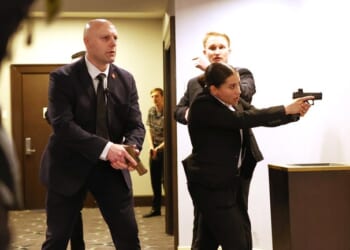
The FBI executed a search warrant Wednesday morning at a Washington Post reporter’s home as part of an investigation into a government contractor accused of illegally retaining classified government materials.
The reporter, Hannah Natanson, was at her home in Virginia at the time of the search. Federal agents searched her home and her devices, seizing her phone, two laptops and a Garmin watch. One of the laptops was her personal computer, the other a Washington Post-issued laptop.
Investigators told Natanson that she is not the focus of the probe. The warrant said that law enforcement was investigating Aurelio Perez-Lugones, a system administrator in Maryland who has a top-secret security clearance and has been accused of accessing and taking home classified intelligence reports that were found in his lunchbox and his basement, according to an FBI affidavit.
Why did the arrest of Perez-Lugones lead to the search of Natanson’s home? Thus far, the DoJ has remained mum on the details. Attorney General Pam Bondi has only said that the DoJ sought the warrant in response to a request from the Pentagon, and that the Trump administration “will not tolerate illegal leaks.” Natanson had been working on the force reductions in the federal workforce, the WaPo explains, and made contacts with over 1,000 employees frustrated by the efforts to reduce the bureaucracy. Those efforts have nothing to do with top-secret national-security information, however, or at least not directly.
However, it’s not too difficult to imagine what may have happened. Perez-Lugones faces a long prison sentence for violating the Espionage Act while not being Trump, Joe Biden, or Hillary Clinton. One way to mitigate the consequences of stealing classified material is to tell investigators who got access to it. Alternately, the DoJ may have analyzed the suspect’s electronic devices and discovered specific communications with Natanson and others.
In either scenario, the DoJ would have to act quickly to secure the material before it could be further disseminated or hidden. That would explain why the DoJ got a search warrant and surprised Natanson with the search. That would also explain why the FBI told Natanson that she is not a target in the investigation; federal law can be interpreted to allow prosecution for unauthorized possession of classified material, but that generally applies to people who have been granted clearance to access it. The DoJ is highly unlikely to prosecute those who passively received leaked material, especially not reporters.
Nevertheless, we can expect an eruption of outrage over this search warrant, and not for entirely hypocritical reasons. The predicate for this search had better be rock-solid, as it would be very dangerous to set precedents where the FBI can seize reporters’ materials on pretexts like national security to expose legitimate whistleblowers that expose real fraud or corruption. You can bet that Natanson’s sources are terrified at that possibility right now, and may be a lot less willing to share information that doesn’t have any relation to national security. Ask Catherine Herridge and Sharyl Attkisson about the risks involved.
At the moment, though, even the normal critics are taking a cautious approach:
- “While we won’t know the government’s arguments about overcoming these very steep hurdles until the affidavit is made public, this is a tremendous escalation in the administration’s intrusions into the independence of the press,” Reporters Committee for Freedom of the Press president Bruce D. Brown said in response to Wednesday’s news.
- “The Justice Department should explain publicly why it believes this search was necessary and legally permissible, and Congress and the courts should scrutinize that explanation carefully,” said Jameel Jaffer, executive director of the Knight First Amendment Institute.
Those are reasonable statements under the circumstances. It remains to be seen whether any explanation from the DoJ or the affidavit will suffice for these groups, or for the Protection Racket Media at large. The odds for that almost certainly approach absolute zero, but we should also approach this with some level of hesitation while waiting for the facts to emerge. And maybe, just maybe, we should ask the media to start covering classified-material handling issues consistently, rather than filtering them through the “it’s (D)ifferent” filter.
Editor’s Note: Here at Hot Air, we’ve been dealing with real government suppression of free speech for YEARS. Despite the threats and consequences, we refuse to go silent and remain committed to delivering the truth.
Help us fight back against government censorship. Join Hot Air VIP and use promo code FIGHT to get 60% off your membership!