This morning’s Gospel reading is Matthew 2:13–15, 19–23:
When the magi had departed, behold, the angel of the Lord appeared to Joseph in a dream and said, “Rise, take the child and his mother, flee to Egypt, and stay there until I tell you. Herod is going to search for the child to destroy him.” Joseph rose and took the child and his mother by night and departed for Egypt. He stayed there until the death of Herod, that what the Lord had said through the prophet might be fulfilled, Out of Egypt I called my son.
When Herod had died, behold, the angel of the Lord appeared in a dream to Joseph in Egypt and said, “Rise, take the child and his mother and go to the land of Israel, for those who sought the child’s life are dead.” He rose, took the child and his mother, and went to the land of Israel. But when he heard that Archelaus was ruling over Judea in place of his father Herod, he was afraid to go back there. And because he had been warned in a dream, he departed for the region of Galilee. He went and dwelt in a town called Nazareth, so that what had been spoken through the prophets might be fulfilled, He shall be called a Nazorean.
What does it mean to be a father? What does it mean to be the Father?
During our Advent season, we primarily focus on Jesus and His mother, Mary, the latter as the Mother of God, and in her profound acceptance of God’s will for her and for us. Advent sets us up in anticipation of the coming of the Savior, and of course, most of our attention is on Him as we move into the octave of Christmas.
On today’s Feast of the Holy Family, though, we turn our attention to Joseph and the role of fatherhood in our path to salvation. In modern times, we tend to think of Joseph as a younger man, destined for fatherhood as a man who is ready to strike out into the world. The 2006 film The Nativity Story – a beautiful film well worth watching every year – captures this modern view of the Holy Family, where Joseph is closer to a contemporary of Mary, as well as completely committed emotionally to her and the Christ child.
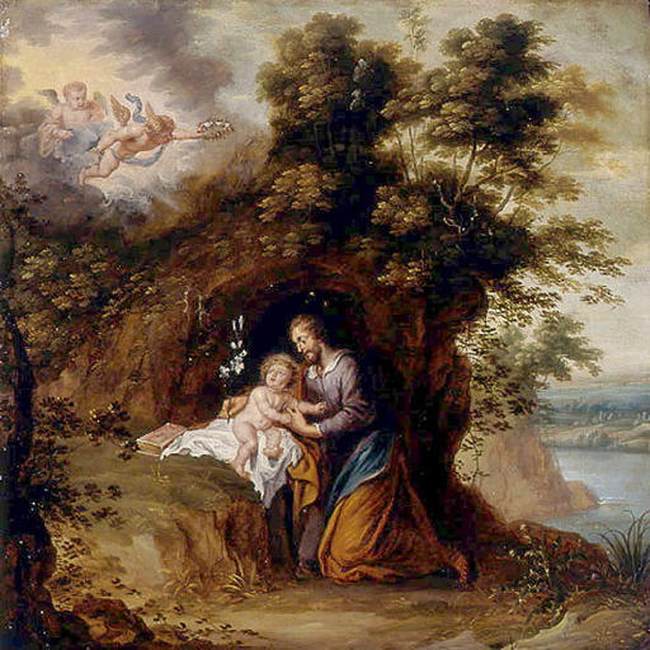
In centuries past, however, the view of Joseph captured in art gave a much different picture of the Holy Family. Joseph was often depicted as much older than Mary, suggesting a widower who had chosen to begin a new family. In some depictions, he seems distant from Mary and Jesus, likely a nod to the chastity of Mary in her role as the Mother of God. This age difference would explain Joseph’s absence after the scene with Jesus in the Temple, discoursing with elders while both of his parents sought frantically for him.
Either explanation works, but both are incomplete. The scriptures are indifferent to Joseph’s age, and even his absence in Jesus’ life at the start of His ministry can fit in either explanation, given the mortality of those times and that part of the world. Whether or not Joseph was older or younger, he played a vital role in Jesus’ life as a child, and today’s Gospel reading makes that clear. Rather than being withdrawn or an afterthought in the Holy Family, Joseph served it as its head – a role recognized by the Lord Himself.
We already know this from the Nativity narrative in the Gospels. The Lord sends an angel to a sleeping Joseph to ease his heart at the prospect of Mary’s pregnancy in Matthew 1:18-21.
18This is how the birth of Jesus the Messiah came about. His mother Mary and Joseph had promised to get married. But before they started to live together, it became clear that she was going to have a baby. She became pregnant by the power of the Holy Spirit. 19Her husband Joseph was faithful to the law. But he did not want to put her to shame in public. So he planned to divorce her quietly.
20But as Joseph was thinking about this, an angel of the Lord appeared to him in a dream. The angel said, “Joseph, son of David, don’t be afraid to take Mary home as your wife. The baby inside her is from the Holy Spirit. 21She is going to have a son. You must give him the name Jesus. That’s because he will save his people from their sins.”
This intervention can be explained as a necessity to ensure that Joseph understood the mission given to him by the Lord. The angel had already directly contacted Mary to allow her to consent to her mission. However, we can miss the significance of this direct contact if we do not consider what happens in today’s Gospel reading. When danger presented itself to Jesus’ life, the Lord’s instructions came to Joseph, not Mary, as did the later instructions to return. The angel comes to Joseph both times even though Mary carried Jesus and served as the Ark of the True Covenant.
Why? Today’s first reading from Sirach 3 offers us an explanation in its emphasis on respect for fatherhood:
God sets a father in honor over his children; a mother’s authority he confirms over her sons. Whoever honors his father atones for sins, and preserves himself from them. When he prays, he is heard; he stores up riches who reveres his mother. Whoever honors his father is gladdened by children, and, when he prays, is heard. Whoever reveres his father will live a long life; he who obeys his father brings comfort to his mother.
The Lord understands fatherhood better than all, and more importantly, wants us to recognize and love Him as our Father. From the Ten Commandments all the way through all of scripture, the Lord wants us to respect fathers and mothers, and to respect their different-yet-complementary roles in our formation and protection.
The Lord chose Mary to become the mother of His Son. But the Lord also chose Joseph to be the father of His son in Jesus’ human nature, not as a supporting character but as Jesus’ true father in this world. The Lord transformed Joseph into a prophet in a very real sense, using His angels to communicate His will and mission directly to Joseph in at least these three specific moments. More importantly, the Lord made Joseph the head of the Holy Family by respecting Joseph’s roles as husband and father. The Lord could have chosen to communicate these issues to Mary, given their close bond, but instead respected Joseph and his own sacrificial service in Jesus’ life.
This love that passes between the Lord and Joseph teaches us more than just Joseph’s true role in Jesus’ life. It teaches us the importance of fatherhood itself as a servant leader. Jesus Himself models this throughout His mission, and Paul teaches it in his epistles, but it is the mutual respect and love between the Lord and Joseph that foreshadows it all. The Lord treats Joseph the way He wishes us to address fathers and fatherhood, and Joseph responds by devoting his life to his family.
The commandments tell us to honor our fathers and mothers. The Lord wants us to learn that in part from the Holy Family, and modeled it for us by honoring both of them for their equal-yet-different roles in the life of Jesus. May we strive not just to honor our fathers and mothers in our own lives, but to fill those roles ourselves with the hearts of servants, just as Joseph and Mary did.
Previous reflections on these readings:
The front page image is “St. Joseph With the Infant Jesus” by Victor Wolfvoet, c. 17th century. On display at the Museum of Fine Arts in Dole, France. Via Wikimedia Commons.
“Sunday Reflection” is a regular feature that looks at the specific readings used in today’s Mass in Catholic parishes around the world. The reflection represents only my own point of view, intended to help prepare myself for the Lord’s day and perhaps spark a meaningful discussion. Previous Sunday Reflections can be found here.
Join Hot Air VIP and use promo code MERRY to get 74% off your membership!