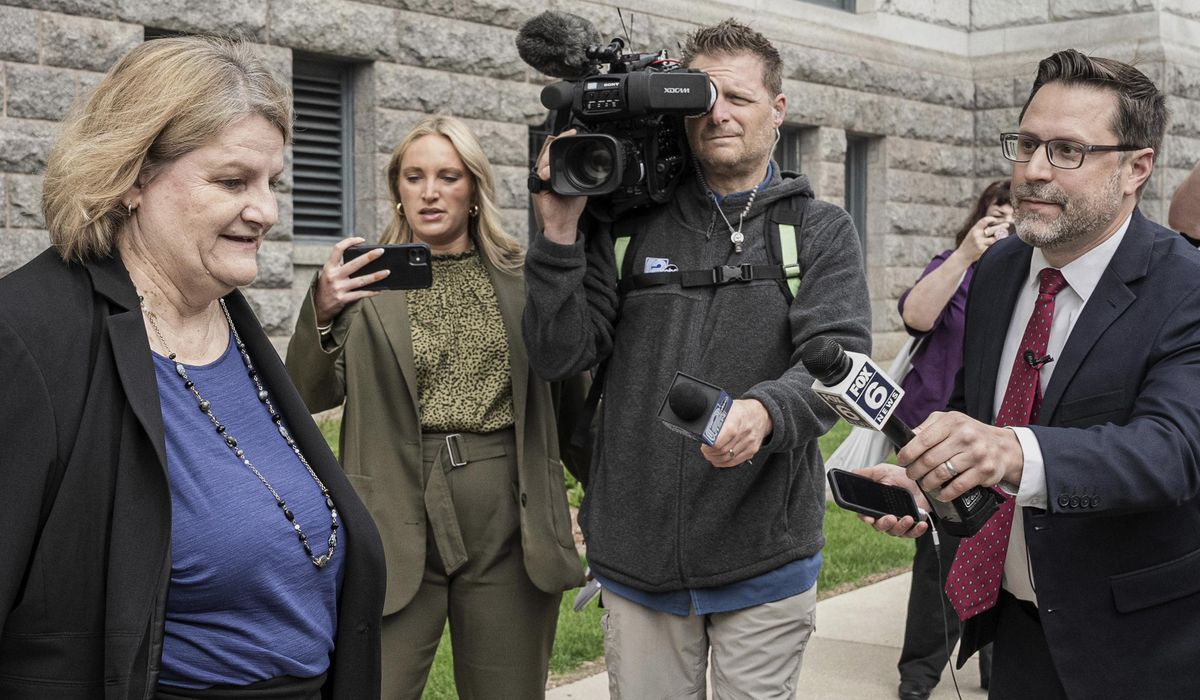
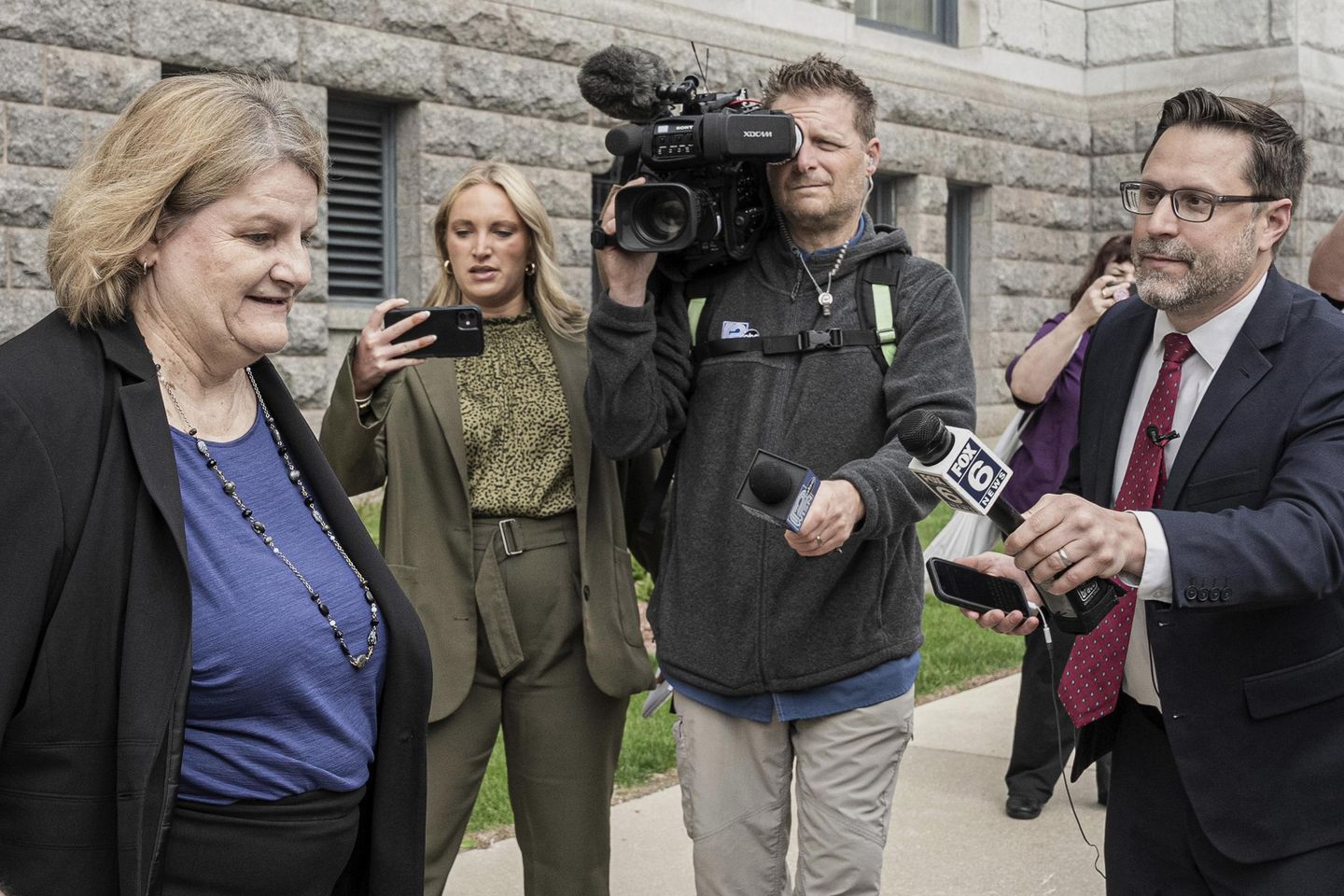
The Trump administration landed its first major scalp in its bid to quell anti-ICE resistance with the conviction of Hannah Dugan, the Wisconsin state judge who obstructed officers trying to arrest an illegal immigrant in her courtroom.
Brad D. Schimel, the U.S. attorney whose office led the prosecution, said the case was also a victory for the idea that immigration officers have to be allowed to make arrests in courthouses.
That is increasingly a contentious matter, with states such as New York adopting bans on arrests in state courthouses.
Mr. Schimel suggested those kinds of restrictions are misguided, taking away a key location where arrests can be made in a controlled environment with less danger of weapons — which are prevented by security at courthouse doors — and other chaos.
He said that’s as true for U.S. Immigration and Customs Enforcement officers as anyone else.
“Here they were carrying out their sworn responsibility to execute an arrest warrant. When they perform their duties, they should reasonably be entitled to do so in the safest possible conditions,” Mr. Schimel said.
“When someone, especially a sworn public official, puts them in unnecessary danger by obstructing those efforts to make an arrest as safely as possible, they must be held accountable,” he added.
Dugan was convicted by a federal jury on one felony count of obstruction.
The jury acquitted her on a misdemeanor charge of concealing a target from arrest.
After the verdict, Dugan’s legal team laid out its plans for an appeal.
“While we are disappointed in today’s outcome, the failure of the prosecution to secure convictions on both counts demonstrates the opportunity we have to clear Judge Dugan’s name and show she did nothing wrong in this matter,” the defense team said. “We have planned for this potential outcome and our defense of Judge Dugan is just beginning.”
They also made a plea for people to donate to cover Dugan’s legal costs.
A team led by ICE and joined by FBI and Customs and Border Protection personnel went to the Milwaukee County courthouse on April 18 to try to arrest Eduardo Flores-Ruiz, an illegal immigrant who’d previously been deported and then snuck back in — a federal felony.
He was appearing before Dugan on an unrelated state battery charge.
Prosecutors, in their case to the jury, said Dugan distracted the ICE team by challenging their civil arrest warrant then telling officers they had to go speak with the chief judge.
She then cut short the criminal proceeding against Mr. Flores-Ruiz and allowed him to leave her courtroom by a non-public door.
Dugan had argued her actions were covered by her duties as a judge.
She also said courthouses are special places where people need to be able to come and go without fearing entanglements in civil affairs.
Immigration proceedings are generally civil matters, with the consequence being deportation, rather than criminal matters.
“Whatever the accuracy of the government’s claim that there was a pending proceeding against E.F.R., he was out of reach in that courthouse on that day,” Dugan’s lawyers argued in briefs asking for a directed verdict of acquittal.
“In that place and on that day, the federal agents had no right to execute that civil warrant or otherwise serve civil process at all,” they wrote.
U.S. District Judge Lynn Adelman rejected that.
Homeland Security said the conviction of a judge should serve as a warning for other anti-ICE behavior.
“Hopefully this conviction will serve as an example to all others who would seek to do the same, because DHS will not be swayed from our mission to enforce the laws of the United States and protect the American people,” Assistant Secretary Tricia McLaughlin said.
Mr. Schimel, the U.S. attorney, said the case showed courthouses are not only acceptable, but preferred as locations.
After Mr. Flores-Ruiz went out the side door of Dugan’s courtroom he was able to make it out onto the street. Members of the ICE team chased after him as he dodged through traffic, then brought him down with a tackle.
Mr. Schimel said that sort of interaction is fraught with danger points and it was lucky that nobody was injured, including civilian bystanders.
Opponents of ICE courthouse arrests say they can scare people away from showing up for court. That goes beyond people facing charges, and includes witnesses who might not want to testify, thus imperiling other prosecutions.
Local prosecutors in New York cited some such cases in defending the state’s ban on ICE arrests in its courthouses.
Brooklyn’s district attorney, for example, said it had found “multiple cases” of domestic violence victims ending cooperation because they feared having to come to a courthouse to testify to grand juries from fear of an ICE arrest. Each of those cases had to be dismissed.
ICE, however, says the fear is unfounded but being stoked by its opponents. The agency says it doesn’t go to courthouses to arrest witnesses.
Rosemary Jenks, policy director at the Immigration Accountability Project, called the courthouse bans “ridiculous” and said those backing those policies are the ones pushing ICE to make arrests out in communities, where officers are often likely to nab more than just the person they were targeting.
“Do you want the safety and security and non-chaos of ICE going into a courthouse and detaining an unarmed person in a controlled environment, or do you want them to just go out into communities and find who they find?” she said. “You can choose safety or you can choose chaos. And they’re choosing chaos.”
The Justice Department sued earlier this year to stop New York’s courthouse ban.
U.S. District Judge Mae D’Agostino, an Obama appointee, rebuffed the lawsuit, saying the state had a right to block ICE. She said to do otherwise would be allowing the feds to “commandeer” the state’s police for its own purposes.
She ruled that since New York law enforcement provides security at the courthouse, and since New York officials publish the schedules of when people are expected to show up for cases, ICE is taking advantage of those efforts in order to make its own arrests.
“Compelling New York to allow federal immigration authorities to reap the benefits of the work of state employees is no different than permitting the federal government to commandeer state officials directly in furtherance of federal objectives,” she wrote.
But Matthew O’Brien, a former immigration judge and now deputy director of the Federation for American Immigration Reform, called courthouse bans “absurd.”
He said immigration is the one area where states want to thwart the federal government.
Mr. O’Brien said the fact that Dugan was convicted by a jury in Wisconsin, a politically moderate state, was significant.
“It sends a signal that a jury looked at this and said this judge was engaging in behavior and involved herself in trying to prohibit the exercise of a legitimate federal authority,” he said.