Somewhere past the half-hour mark of my conversation with Wade Miller, I said a word you’re not supposed to say warmly.
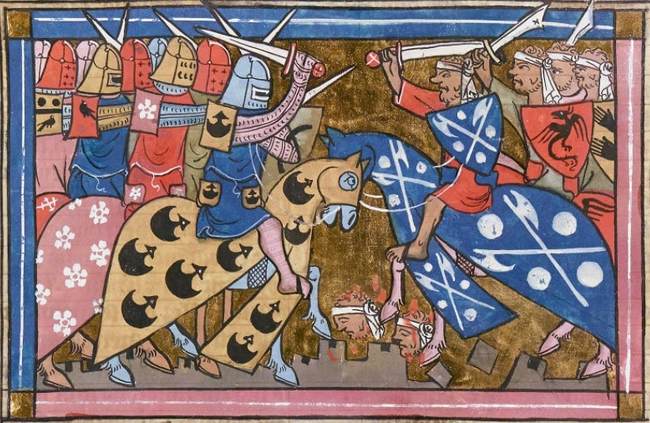
Crusades.
We were talking about why the West no longer defends its own culture, and whether the fading of Christian conviction explains it. And I said, half testing him, half testing myself: why don’t we think of ourselves as the Christians who fought the Crusades? Christians defended Western Europe for centuries. Successfully. Then one day we decided to hold the door open.
Wade nodded and moved on. He’s a Marine and a political operator, and his mind was already three moves ahead on tactics. That’s what I invited him on to do, and he does it well.
But the word deserved more air. Because the flinch it produces, that small automatic wince every educated Westerner has been trained to perform at the mention of the Crusades, is one of the most revealing reflexes in modern life.
Try it at a dinner party. Say the word without apologizing. Watch the room.
For three generations the Crusades have served as the West’s permanent Exhibit A. Proof of original sin. The all-purpose indictment produced whenever anyone suggests this civilization might be worth defending. Well, what about the Crusades? As though a thousand years of history could be settled with a wince.
And many Christians have internalized the prosecution’s case completely. They apologize for the Crusades the way a beaten man apologizes for once having had a spine.
I’ve seen this at close range. Almost thirty years ago I was introduced, in a private meeting, to the Episcopal bishop at the National Cathedral in Washington, the man holding the closest thing America has to a national pulpit. He assured me that all the major religions were equally great. I remember reaching for the word Crusades even then. Here was a man whose entire office existed to defend one faith, announcing his neutrality among all of them. And he plainly believed this was graciousness. It was abdication. The surrender did not begin in the universities. It began in the pulpits, and it was offered freely, decades before anyone demanded it. The white flag went up as early as 1893, when the American Protestant establishment gathered at the World’s Parliament of Religions in Chicago to proclaim that every great faith was a path up the same mountain. My bishop was not improvising. He was reciting.
Here is what almost nobody asks: what were the Crusades an answer to?
By 1095, four centuries of Muslim conquest had taken Jerusalem, Antioch, Alexandria, North Africa, and most of Spain out of the Christian world, and the Muslim armies pressing on Constantinople were not there to dialogue. The Crusades came after four hundred years of losing. Whatever else they were, and they were many things, including at times disgraceful, they were not unprovoked. They were the response of a civilization that had finally decided it did not wish to disappear.
You can judge the conduct. Serious historians have, for centuries, and should. But the conduct is not the question. The question underneath the question is this: what does a civilization that still believes in itself do when it faces a coordinated challenge to its existence?
In 1095, the West had an answer. The answer had failures and a body count. It also had a premise: this is worth keeping.
What’s our answer now?
We need one, because the conquest did not end in the Middle Ages. It changed methods. The armies that were stopped at Tours and turned back at the gates of Vienna have given way to migration, birthrates, and patience, aided at every step by Western governments that mistake surrender for hospitality. Muhammad is now the most popular name for baby boys in England. Sharia councils operate openly across Britain. And the project has reached America. Texas alone now has more than 300 mosques, a count that has grown by a third in a decade.
That is the territory Wade and I spent an hour mapping, and I’d urge you to watch the whole conversation, because Wade has done the accounting. Islamist networks that have been organizing on American soil since the 1950s. The long march through the schools of education that turned Gramsci’s prison notebooks into your child’s curriculum. The Chinese Communist Party’s patient campaign on many fronts. An administrative state that funds much of the apparatus with your own taxes. Wade once audited 3,000 federal grants and found fewer than thirty that were politically neutral. He also tells the story, largely unreported, of how the Pentagon is quietly removing the senior officers who spent a decade injecting racial ideology into the ranks. It will raise your blood pressure in a useful way.
But every one of those campaigns has one thing in common: none of them works against a civilization that still knows what it is. They only prevail against a people who have forgotten why they ever fought.
And that forgetting didn’t grow wild. It was farmed.
Gramsci saw it a century ago. You don’t beat a confident civilization on a battlefield. You capture the institutions that tell it who it is, the schools, the seminaries, the newsrooms, the faculty lounges, and you teach it to be ashamed. Rewrite every act of self-defense as aggression. Every inheritance as theft. Every founder as a criminal. Do that for three generations and you never fire a shot. The target disarms itself and thanks you for the therapy.
A man who has been taught to be ashamed of his father cannot defend his house. He will negotiate, accommodate, explain. Anything but stand in the doorway. Not because he lacks strength. Because he has been persuaded he lacks standing.
That is where we are. The strength is intact. The wealth, the technology, the men. What’s been confiscated is the permission.
So here is the unfashionable thought. The question is not whether the Crusades were good. Serious history doesn’t grade in gold stars. The question is whether we are still allowed to understand what they were for, and whether a civilization that has criminalized its own memory of self-defense can mount any defense at all.
Nobody is marching on Jerusalem. The fight in front of us runs through school boards, citizenship standards, grant reform, personnel decisions at the Pentagon, and through the plain, unglamorous willingness to say true things in public without flinching. Wade lays out those fronts better than anyone I’ve talked to, which is why the episode is worth your hour.
But no tactic survives contact with self-hatred. Before any front can be won, something older has to be recovered: the settled conviction that what we inherited is worth keeping, that defending it is not a hate crime, and that our ancestors, flawed as all ancestors are, were not wrong to stand in the doorway.
The men of 1095 had less than we have. Less wealth, less knowledge, none of the comforts we mistake for civilization itself. What they had was memory. They knew what they came from, and they knew what would be lost.
That memory is recoverable. It’s lying right where we left it, in the history we stopped teaching. Pick it up, and the age gets a little easier to breathe in.
Editor’s Note: Do you enjoy PJ Media’s conservative reporting that takes on the radical left and woke media? Support our work so that we can continue to bring you the truth.
Join PJ Media VIP and use promo code FIGHT to receive 60% off your membership.