KYIV, Ukraine — At the Karansky Quarry in occupied Donetsk, Chinese machinery has helped revive an industrial site that had been idle for more than a decade.
Located near the village of Myrne, not far from the devastated port city of Mariupol, the crushed-stone quarry had been shut down since 2008. After Russia’s 2022 invasion of Ukraine, occupation authorities moved to reopen it.
In November 2023, Yevgeny Solntsev, then head of the Moscow-installed “government” in the self-proclaimed Donetsk People’s Republic, announced agreements with two Chinese firms involved in crushing and screening equipment.
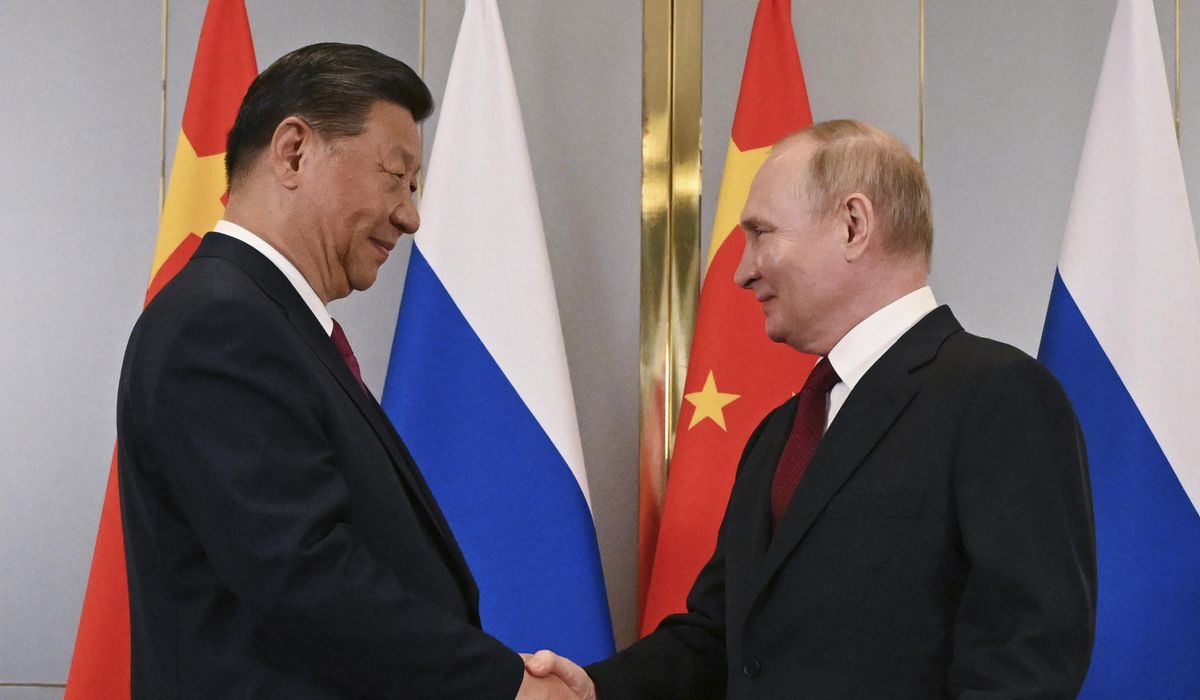
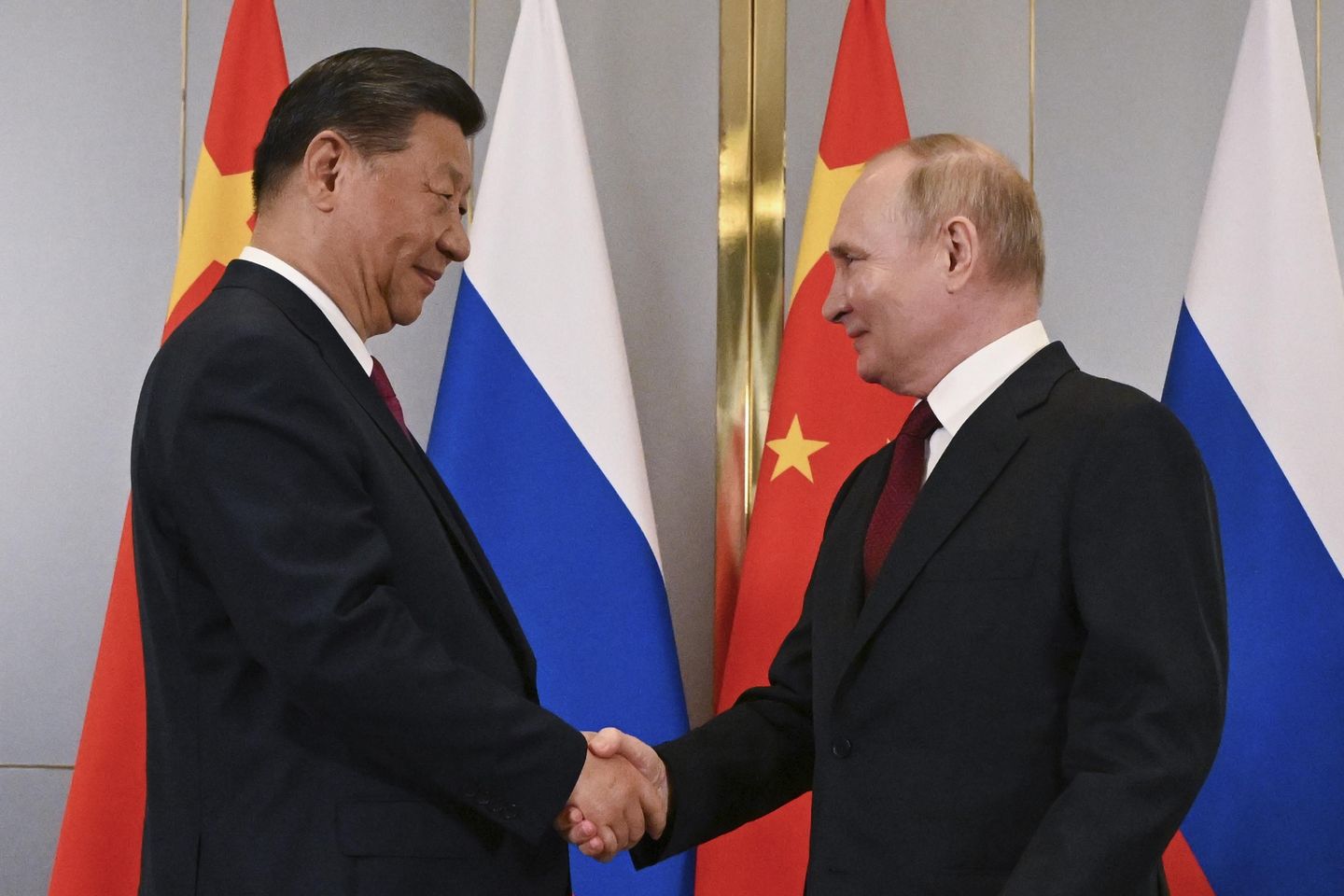
Photos released by occupation authorities showed Chinese representatives posing with Russian-backed officials in front of Chinese, Russian and separatist flags. The stone produced at the site now feeds construction projects in occupied Ukraine, including what Moscow calls reconstruction in regions destroyed by its own war.
Local residents have reportedly taken to calling it the “Chinese quarry.”
The site has become one of the clearest examples of a wider trend: Chinese companies, often operating through Russian intermediaries, are helping build and sustain the occupation economy in parts of Ukraine seized by Moscow.
A report by Ukrainian NGO Eastern Human Rights Group and the British Institute for Strategic Studies and Security identified at least 17 Chinese companies tied in some form to activity in occupied Donetsk, Luhansk, Zaporizhzhia and Kherson.
Their activities range from the supply of mining equipment and construction machinery to telecommunications, financial services, transport links and infrastructure.
Beijing has not recognized Russia’s annexation of Crimea or its claims over four additional Ukrainian regions. Its official position remains that it respects state sovereignty and supports peace talks.
On the ground, however, Chinese business activity is helping Russia make its occupation less isolated — and more difficult to reverse.
“China operates through a format of de facto integration without de jure recognition,” said Vira Yastrebova, director of the Eastern Human Rights Group. “Beijing does not formally recognize the annexation of Ukrainian territories, but Chinese companies are entering them en masse through Russian companies.”
Kyiv and Ukrainian analysts see a deeper shift: Occupied territories are being pulled out of Ukraine’s economic orbit and plugged into a Russian-Chinese system, with secondary links to Iran and other sanctioned states.
“This creates a new model of occupation economy: opaque, militarized, dependent on clandestine routes, low-cost political decisions and external suppliers who are not interested in developing the region, but only in its functional exploitation,” Ms. Yastrebova said.
Mining and machinery
China’s role is most visible in heavy industry.
In occupied Donbas, cut off by war and sanctions, Chinese equipment has steadily replaced European and Ukrainian machinery. The Eastern Human Rights Group report names companies including SANY Heavy Industry, Liming Heavy Industry Science & Technology, Shandong Mining Machinery, Taiyuan Heavy Industry and WISDRI, a metallurgical engineering institute based in Wuhan.
SANY reportedly supplied tunneling equipment for Donbas mines in 2024. Shandong Mining Machinery has been linked to conveyor systems at the Komsomolets Donbassa mine. Liming Heavy Industry is reported to have supplied equipment to the Nedra group, which works in mineral resources in occupied Donetsk. WISDRI has been approached about possible modernization work at metallurgical plants.
The pattern is lopsided: Chinese firms provide equipment, technology and consumer goods, while occupied territories send out mostly coal and raw materials. The report says occupied Luhansk has become especially dependent on Chinese goods, which accounted for about 60% of its imports in 2023.
Christopher Walker, vice president at the Center for European Policy Analysis, said China’s activity in occupied Ukraine should be seen as part of Beijing’s larger support for Moscow.
“It is very hard to imagine in the Ukraine context that China’s commercial engagement is somehow happening divorced from the larger package of support that China has been affording to Russia,” Mr. Walker told The Washington Times. “China’s support for Russia is pivotal to Russia’s ability to maintain its war effort against Ukraine.”
Yuan and workarounds
Chinese involvement in the financial sector is growing as well.
According to the Eastern Human Rights Group, about 79 bank branches in occupied territories now offer transactions in yuan. In some areas, the Chinese currency has become the second reference currency after the Russian ruble.
Chinese payment tools are also appearing in gray-market schemes. Alipay, WeChat Pay, cryptocurrency transfers and Telegram-based currency exchanges are used to bypass Western banking restrictions.
These mechanisms help finance imports and keep trade channels open with China, Russia and intermediaries in Kazakhstan, Turkey, the United Arab Emirates and Kyrgyzstan.
Maksym Butchenko of the Institute for Strategic Studies and Security has called the process “shadow integration” and warned that it sets “a threatening precedent” in international law.
While the yuan does not replace the ruble in daily life or in Russian budget payments, it is becoming more important for industrial imports and sanctions evasion.
Huawei and digital control
Telecommunications may be the most strategic sector.
The Eastern Human Rights Group says thousands of mobile base stations in occupied Ukraine use Chinese equipment.
The report also says Miranda Media, a Russian-controlled operator active in occupied areas, has relied on Huawei equipment, including optical terminals, servers, licenses and core network systems.
The issue goes beyond phone coverage: In occupied territory, telecom networks have long been tools of control and coercion.
Russian authorities have disconnected residents from Ukrainian systems, pushed Russian SIM cards and linked mobile access to Russian identity documents, administration and propaganda.
Chinese equipment adds a durable technological layer to this system.
“This is not just about foreign trade or importing equipment,” Ms. Yastrebova said. “It is an attempt to deeply change the civilizational, technological and political trajectory of these territories, making their future return to the Ukrainian and European legal, economic and humanitarian space more difficult.”
Roads, ports and propaganda
Chinese interest is also tied to logistics.
The report points to transport corridors linking China, Russia and occupied Ukraine, including the Manzhouli-Zabaikalsk rail crossing, Russian Black Sea and Azov Sea routes, and projects such as the Eurasian Agroexpress.
One key route is Russia’s R-280 “Novorossiya” highway, which links Rostov-on-Don to Crimea through Mariupol, Melitopol, Dzhankoi and Simferopol.
Officially, Moscow presents it as infrastructure for its “new regions.” In practice, it is a strategic artery for military, commercial and industrial movement across occupied southern Ukraine.
Meanwhile, Crimea has long attracted Chinese interest.
Before Russia’s 2014 annexation, the Ukrainian government discussed a Chinese-backed deepwater port project that would have made the peninsula part of a broader maritime trade network. The project died after the 2014 Maïdan revolution and Russia’s annexation of Crimea.
More recently, reports have surfaced about Chinese-linked shipping to Sevastopol and discussions around a possible Kerch Strait tunnel, though Beijing has avoided any formal commitment that would invite sanctions.
Some Ukrainian analysts warn against overstating Beijing’s direct role.
Kostyantyn Batozsky, founder of the Azov Development Agency, has noted that China sells components to both sides. “Every Ukrainian drone contains 50 to 70% Chinese components,” he said. “Does that mean China supports Ukraine? China sells equipment to Russia openly, but it also sells to Ukraine. It sells to everyone.”
Major Chinese state firms have little incentive to openly operate in territories whose legal status is rejected by most of the world. Hence, much of the activity appears to run through smaller companies and Russian intermediaries, making it harder to verify.
The economy, however, is only one side of the story.
Moscow uses every Chinese visit, contract or cultural exchange as evidence that the occupied territories are not isolated. Chinese bloggers, journalists and artists have visited Russian-held areas. In one widely criticized episode, Chinese singer Wang Fang performed “Katyusha” in the ruins of the Mariupol Drama Theater, where hundreds of civilians were killed by a Russian airstrike in 2022.
“Any external interaction with the occupied territories is used by Russia as propaganda,” Ms. Yastrebova said.
Meanwhile, Mr. Walker said Beijing’s behavior contradicts its public claim to neutrality. “China is simply not neutral in this war,” he said. “It has put its chips on the side of Russia.”
A costly future problem
If Kyiv manages to liberate the occupied territories, it will not only have to dismantle Russian administrative structures but may also have to replace telecom networks, banking infrastructure, machinery and logistics chains now tied to Russia and China.
The longer that process continues, Ukrainian analysts warn, the more expensive reintegration will become.
The Eastern Human Rights Group argues that Western governments have tools at their disposal: Secondary sanctions, export controls and pressure on logistics firms, banks and intermediaries. But going after Chinese companies is politically and economically difficult.
Ukraine itself depends heavily on Chinese components, especially in drones and electronics.
Yet, doing nothing also carries a price, as Moscow tries to anchor the territories it seized in an alternative economy, linked to Beijing and other authoritarian partners.
A better-equipped, better-connected occupation might prove considerably harder to undo.