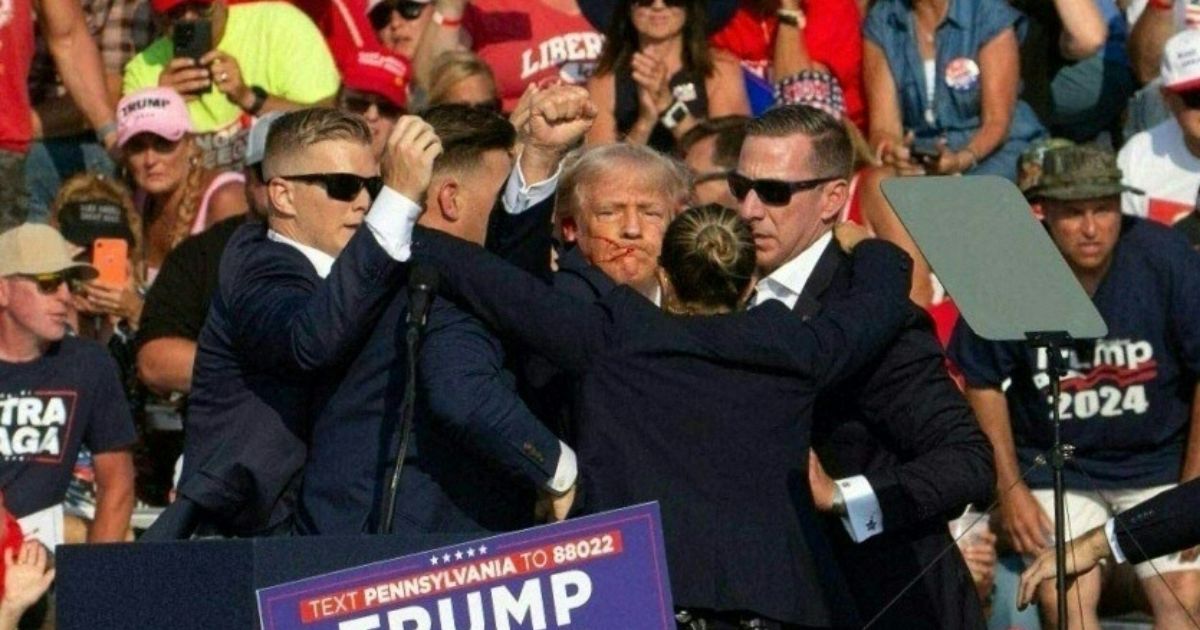
On Tuesday, the Department of Homeland Security’s Office of Inspector General released its final report on Secret Service failures that preceded the July 13, 2024, assassination attempt against then-former President Donald Trump in Butler, Pennsylvania.
The report featured five key findings, the fifth of which included some strange details.
In short, the Secret Service site agent counterpart — usually a member of state or local law enforcement who coordinates event protection with the lead Secret Service agent, per NBC News — showed inappropriate deference to Trump’s staff on a question of major security-related significance.
Specifically, the report’s fifth key finding blamed the Secret Service for failing to block line of sight to President Trump.
Shortly after 6:00 p.m. on July 13, would-be assassin Thomas Crooks climbed the roof of an American Glass Research International building 155 yards away from Trump and fired eight shots, wounding Trump and killing rally attendee Corey Comperatore.
Prior to the event, the counterpart had identified that building as a threat.
“In Butler, the Secret Service site agent counterpart proposed blocking line of sight from the AGR complex to the stage where President Trump would be speaking,” the report read.
“On July 12, 2024, the site agent counterpart spoke with protectee staff about placing trucks already on location to block the line of sight from the AGR complex to the stage.”
The Trump campaign, however, rejected the counterpart’s suggestion for blocking line of sight.
“The site agent counterpart told us she proposed placing the trucks between the AGR complex and the stage,” the report added, “but protectee staff denied the request because the trucks would be ‘too close to [President Trump’s] press shot.’”
Aesthetic preferences notwithstanding, the Secret Service maintains responsibility for security. And in this instance, according to the report, the counterpart failed.
“The site agent counterpart then proposed moving the trucks to a nearby location instead, which would block line of sight from a different area; protectee staff agreed,” the report continued.
“However, the site agent counterpart did not inform the lead agent or her supervisors that the protectee’s staff rejected her request to place equipment already at the site to block line of sight from the AGR complex to the stage and that the line of sight from the AGR complex would be exposed.”
In other words, the site agent counterpart identified a threat but acquiesced to an inferior consideration. She also failed to follow up on the line-of-sight threat.
“Regardless of whether Secret Service and local law enforcement officers secure a particular area, training still instructs Secret Service members to place objects to block lines of sight, which in this instance included the AGR complex,” the report added two paragraphs later.
According to RealClearPolitics, the site counterpart was Dana DuBrey, “a mid-level agent in the Pittsburgh Field Office.”
DuBrey’s overall negligence, according to Fox News, preceded the on-site threat assessment.
“The Secret Service also said local police emailed the senior counterpart their plans to secure the area, but she never opened or read the plans,” the outlet reported.
Documents show that in April 2025, DuBrey received a mere two-week unpaid suspension.
To prevent such failures in the future, the OIG recommended that the Secret Service’s Office of Protective Operations “develop and implement a process to document the identification and blocking of line of sight vulnerabilities and the approval of mitigation plans before events.”
OPO addressed the problem in February 2026, though not to OIG’s full satisfaction.
“Secret Service provided documentation of the process for site agents to document the identification and elimination of line of sight concerns but did not provide evidence of a process for lead agents, supervisors, or others to approve mitigation plans before the event,” the report read. “We will close this recommendation when we receive documentation of the approval process.”
In other words, nearly two years after the Butler assassination attempt, the Secret Service still had not developed a complete plan to prevent a repeat of the site counterpart’s failures.
Advertise with The Western Journal and reach millions of highly engaged readers, while supporting our work. Advertise Today.