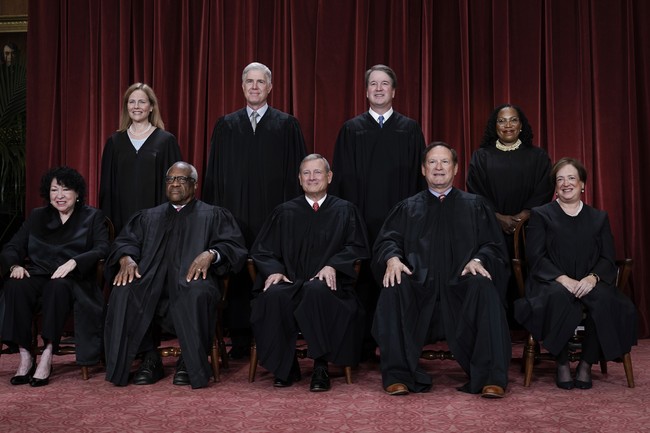
Two miracles took place at the Supreme Court today in two cases involving Title IX and women’s sports. The first miracle is that common sense and biology prevailed. The second miracle is that the decision was unanimous … at least in part.
Both West Virginia v BPJ and Idaho v Hecox confronted legislative actions that barred biological males from women’s sports. The court consolidated the cases in the final opinion written by Justice Brett Kavanaugh that made clear the biological reality and its reflection in Title IX. Congress created Title IX to allow biological females equal access to all educational opportunities, including competitive sports, which necessitates separate competitions. If women could compete with men on an equal basis in sports, Title IX would hardly be necessary, Kavanaugh writes for the majority:
In assessing the reasonableness of the regulations, we also must recognize the distinctiveness of competitive sports—and the safety and competitive fairness issues that can arise when females are forced to compete against males.
With respect to safety, allowing biological males to play on women’s and girls’ sports teams can put women and girls at significant risk of injuries. The safety risks are particularly severe in contact sports.
And as to competitive fairness, allowing biological males to play on women’s and girls’ sports teams can put female athletes at a serious disadvantage. That is because sports are generally zero sum. Allowing a biological male athlete to compete on a girls’ team necessarily displaces or disadvantages a female athlete—replacing her on the roster, knocking her out of the starting lineup, reducing her playing time, depriving her of a medal, and the like. That hard reality of sports cannot be ignored or swept under the rug. On the contrary, that reality must and does inform interpretation of the term “reasonable” in the Javits Amendment.
Whether biological males may participate on women’s and girls’ sports teams may be a debated policy question. But the legal question for Title IX purposes is whether West Virginia may limit women’s and girls’ sports teams to biological females. As a matter of text and history, West Virginia may do so.
That is essentially the entire case – at least as it applies to Title IX. And as it applies to Title IX, this got unanimous support from the justices. However, both cases also raised an Equal Protection claim, which did split the court along the usual 6-3 axis. Kavanaugh notes that the states raised the following arguments: physical differences by sex, safety concerns, the deterrence factor that pushes women from pursuing competitive opportunities, and the clear pattern established that male entries create that zero-sum disadvantage for women.
That’s enough to substantiate a strong state interest in light of the Equal Protection Clause, Kavanaugh writes:
Based on all of the above, the States argue—and we agree—that the interests in safety and competitive fairness are important for purposes of equal protection analysis. And the States’ sex-based classification—limiting women’s and girls’ sports to biological females—is substantially related to those interests. See Skrmetti, 605 U. S., at 510; Tuan Anh Nguyen v. INS, 533 U. S. 53, 70 (2001); Michael M. v. Superior Court, Sonoma Cty., 450 U. S. 464, 472–473 (1981) (plurality opinion). Therefore, schools may maintain women’s and girls’ sports for biological females. In other words, schools may determine eligibility for women’s and girls’ sports based on biological sex.
This is where the three liberal jurists part company with Kavanaugh. Justice Sonia Sotomayor scolds the majority for not applying judicial restraint in the EPC argument:
Applying a form of heightened scrutiny divorced from this Court’s cases, the majority holds that transgender girls like B. P. J. who wish to play girls’ sports are not protected by the Constitution, even if B. P. J. is correct that neither of the State’s interests is furthered by their exclusion. Yet the Equal Protection Clause demands much more when a State deploys a sex classification to achieve legislative aims. Perhaps West Virginia could meet those demands. Perhaps not. In either event, because unresolved factual questions prevent the Court from assessing the merits of B. P. J.’s equal protection claim at this time, the Court should allow the District Court to address those factual questions in the first instance. Yet in an opinion unencumbered by fact or law, the majority today cuts off that process prematurely, deciding instead that B. P. J.’s case must end now.
This litigation implicates deeply sensitive, contentious, and evolving issues. These circumstances demand exercising judicial restraint, not rushing to answer conclusively difficult questions without sufficient evidentiary development. In opting otherwise, the majority extends great sympathy to those it favors: the young cisgender girls and women who play sports. I share that sympathy. Playing sports can lead to benefits that are immeasurable, and many are understandably invested in ensuring that competition stays fair and safe. Because the majority, however, inflicts a hardship on those it disfavors without giving them the fair and full opportunity the Constitution requires to litigate their contentions, I respectfully dissent.
This reasoning strains credulity. The transgender students brought the lawsuits; they made their EPC arguments. Kavanaugh discussed those in great detail, in fact, as their EPC claims take up a significant portion of the majority opinion. Furthermore, the lower courts would do nothing more than chew over the same arguments that went into the Title IX discussion. And the unanimity among the justices on Title IX pretty much moots the EPC debate, except for academic purposes.
The result of this decision will be to allow states to restrict entry into women’s sports to biological females. It does not require states to take that action, but it does give states (and lower jurisdictions, presumably) the ability to pass rules and regulations to that effect. That is perhaps the biggest boost to Title IX and female access since its initial passage – and perhaps the biggest boost to common sense in law as well.
Editor’s Note: Every single day, here at HotAir, we will stand up and FIGHT, FIGHT, FIGHT against the radical Left and deliver the conservative reporting our readers deserve.
Help us continue to tell the truth about the Trump administration and its successes. Join HotAir VIP and use promo code FIGHT to receive 60% off your membership.