Peru officially announced that it finally has a new president on Monday: The more conservative candidate, Keiko Fujimori, won by a slim margin of 50.1% to 49.9%.
🇵🇪#AHORA – Elecciones Peru: Resultado final al 100%
🟧 Fujimori — 9.223.396 votos 50.1%
🟩 Sanchez — 9.173.755 votos 49.9%Diferencia final: Fujimori +49.641 pic.twitter.com/GcR88XoyIU
— DatoWorld (@DatosAme24) June 29, 2026
We are cautiously optimistic about this news. Normally, I’d celebrate this as another new right-leaning leader in the Western Hemisphere, but Peru is a bit of a mess. It’s had something like nine presidents over the last decade, but most of them have been impeached or have faced corruption scandals, congressional gridlock, and various other issues.
Fujimori also comes with a little baggage. Her father is a former Peruvian president, and she’s run for election something like four times. But many say she could be the game-changer and bring some stability to the nation, especially economically. She’s also likely to be a good partner to the United States. We’ll just have to see how it plays out.
The actual run-off election was held earlier this month, and it’s taken over three weeks to count the ballots. Fujimori has held the lead for much of that time, though Sanchez did for a while. That said, I couldn’t help but notice that many media outlets have been reporting her as the winner for weeks without actually waiting for the final tally. I’ve had several people ask me why I wasn’t reporting on it, and while I knew it was highly likely she’d win, it wasn’t confirmed. And that’s about the slimmest of slim margins you can have between two candidates in an already chaotic country — anything was possible.
It’s just like when I reported on the Colombian elections and how the more conservative Abelardo de la Espriella (“El Tigre”) defeated Gustavo Petro’s hand-picked commie candidate Iván Cepeda. In the days following the election, Petro did what he does and spent hours mouthing off about it on social media — blaming Israel, blaming the United States, etc. So many media outlets ran to report that the election was being contested, that El Tigre’s win would not be honored. I actually had a few of you go after me for being naive to think it would.
Well, if that’s the case, I’m still being naive. Petro has big plans for himself post-presidency, and that’s mostly what he cares about: himself. Due to sanctions Donald Trump, Marco Rubio, and Scott Bessent have placed on him or threatened him with, he won’t be able to do those things — I believe he’s mentioned traveling the world, giving talks on *checks notes* climate change and writing erotic poetry — and he knows all eyes are upon him. It’s why Trump endorsed El Tigre multiple times and Rubio congratulated him on his win almost instantly. A subtle reminder. Petro can talk all he wants, but he knows he needs to be on his best behavior if he wants his freedom after he leaves office in August. Even Cepeda wasn’t really playing along with his shenanigans and has officially conceded.
The current president of Colombia likes to talk. Most of the time, it should be ignored.
Which leads me to something else. Some of you aren’t going to like this, but there’s another false story that’s going around about the Latin American elections that a lot of my colleagues in conservative media keep touting but that I feel like I need to correct. It goes something like this: the closing of USAID is why the region is swinging to the right.
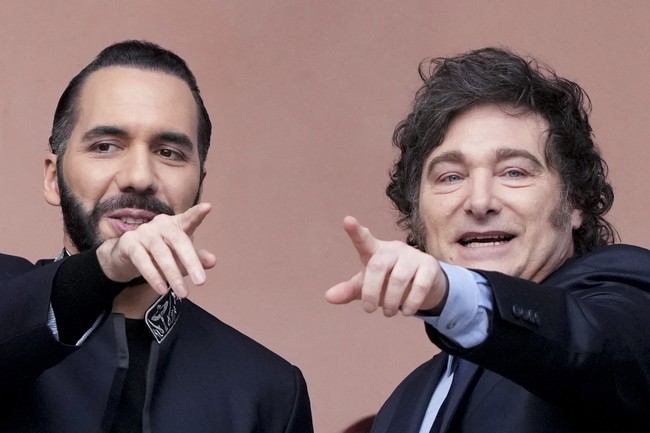
While it would be fun if that were true, it’s not correct. I’d say the real influence was Nayib Bukele, followed by Javier Milei, and then Donald Trump. But we have to give the voters themselves a little credit because this was in the works before Trump was even re-elected in 2024.
Back in February, I wrote an article called “The Real Reasons Why Latin America Is Moving to the Right.” I won’t rehash it all, but crime, economic frustration, and mass migration backlash were the top three reasons I listed.
Crime is certainly number one. People are tired of gangs and cartels taking over their communities and bringing violence with them. They saw how Bukele turned the so-called “Murder Capital of the World” into a safe, desirable place to be, and they wanted that for themselves. Nearly every single person I’ve spoken to over the past year or so who lives in or is from Latin America has hailed Bukele as a hero, claiming they want someone like him to fix this. And almost every single “right-wing” candidate who has been elected in Latin America in recent years has promised exactly that — some have even brought him on as a consultant.
Economically, they saw what happened in Argentina. They saw Milei inherit 211% inflation and turn that into the low thirties in two years. In 2026, he’s expected to bring it down to 20%. The country’s government also has a surplus budget for the first time in 14 years.
“Despite these savings, the Argentine economy is growing this year: the IMF expects 4.5% growth on an annual basis, the highest growth rate in Latin America,” according to the Friedrich Naumann Foundation for Freedom.
I always laugh when I see protests in these countries that have been stuck under socialism for years — unlike the ones here in the United States, they’re often asking for jobs and the ability to earn a living rather than receiving government handouts. We’ve seen it a lot in Venezuela lately.
Other reasons I mentioned in my February article were socialism fatigue and cultural pushback. They’ve seen the misery in countries like Cuba, Nicaragua, and Venezuela. They’ve seen the way criminal organizations are allowed to control parts of Mexico, Brazil, and Colombia without any repercussions. They’ve seen it impact their own countries through issues like mass migration, and they fear becoming just like them.
Culturally, a lot of people in Latin America are socially conservative Christians who aren’t crazy about things like gender ideology nonsense and abortion on demand. They’re rejecting this way of thinking. Here’s something I wrote in February:
These leaders are giving them what they want. Bukele has banned gender ideology talk in schools.
Milei stood up on the world stage at Davos a few weeks ago and said, ‘Therefore, the Americas will be the beacon of light that will once again illuminate the entire West, thereby repaying the civilizational debt with expressions of gratitude towards the foundations in Greek philosophy, Roman law, and Judeo-Christian values.’
[Chile’s President José Antonio] Kast, a devout Catholic with nine children, is a staunch conservative who opposes even the morning-after pill and same-sex marriage.
These are what’s driving these countries, just like the same issues drove people in the United States to vote for Trump in 2024. The Americas are a lot more connected politically, socially, and culturally than many want to admit, and that’s why I think it’s great we have an administration that is embracing this.
According to Congress, “For FY2025, the Biden Administration requested $2.2 billion in foreign assistance for Latin America and the Caribbean under accounts managed by the State Department and the U.S. Agency for International Development (USAID).”
That’s a big number, sure, but in the grand scheme of things, when you add context, it’s not that much. The majority goes to Africa, Asia, and the Middle East. Those numbers are much, much higher.
And that’s not to say that Trump and the United States haven’t played a role. Trump has strategically endorsed several more recent candidates. When the administration captured Nicolás Maduro, our president became the most popular man in the Western Hemisphere. The MSM doesn’t report on that much, but I’ve seen numerous polls proving just how popular he is in Central and South America. Heck, I’ve witnessed it myself in Costa Rica.
As Trump and Rubio continue to court these countries and bring help with security and economic investments — real public and private investments, not like the ones the Chinese offer them — I expect that love to double. If he rescues Cuba soon, it will be immeasurable.
The best thing we can do is continue down that path: to grow our efforts like the Shield of the Americas coalition, to continue offering help fighting the cartels, to continue working to eradicate communist and corrupt governments in the region, and to continue making deals that bring actual jobs and money to these countries without big red Chinese strings attached. In the end, we’re all safer and more prosperous for it.
Finally, I just want to say that I’m not writing this to bash anyone in the media — I’m paraphrasing here, but Rubio likes to say that all foreign policy experts aren’t alike. Most are well-versed in the Middle East, China, Europe, etc. Few have made it a point to learn Latin America, yet they pretend to understand it the same way, despite the fact that it’s like comparing apples and oranges. And I don’t say this to claim to be some sort of expert on the region, but I have learned a lot, both through personal experiences and research. When I see people repeat things that aren’t true — even if they feel nice to say — I just think the record should be corrected.
Editor’s Note: Thanks to President Trump and his administration’s bold leadership, we are respected on the world stage, and our enemies are being put on notice.
Help us continue to report on the administration’s peace through strength foreign policy and its successes. Join PJ Media VIP and use promo code FIGHT to receive 60% off your membership.