I once asked B.F. Skinner, the famed behaviorist known as the father of operant conditioning, “if all of our behavior is based upon either genetics or conditioning, what value should guide intentional conditioning? To what do we aim it?” He answered in one word – survival. As a college student at the time, I thought the answer entirely inadequate. I no longer think so.
When we consider “survival of the fittest” in Darwinian terms, the key is adaptability. Similarly, if we were to intentionally set up conditions for a culture to survive and prosper, especially in modern history where changes in conditions are rapid, adaptability and stability would be the prime concerns. In a sense, we set those conditions, with the enumeration and separation of powers, as well as other checks and balances, in our Constitution, causing it to survive as long as it has. It takes account of the reality of human nature.
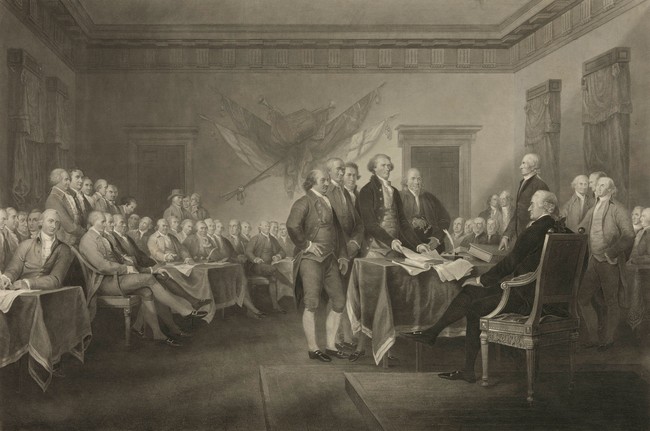
Behind our Constitution is our Declaration of Independence, and behind that is the philosophy of the Enlightenment; i.e., the limitations of the power of government, and the individual liberty to pursue life as we see fit.
It was John Stuart Mill who, in his essay “On Liberty,” described the practical necessity of well-ordered liberty without appealing directly to divine providence. Mill did not derive his principles from social contract theory the way Locke did. Mill was a utilitarian, but he wrote that “it must be utility in the largest sense, grounded in the permanent interests of man as a progressive being.”
Mill held that toleration of dissenting opinion was critical to a complete and thorough understanding of truth:
But the peculiar evil of silencing the expression of an opinion is that it is robbing the human race, posterity as well as the existing generation – those who dissent from the opinion, still more those who hold it. If the opinion is right, they are deprived of the opportunity of exchanging error for truth; if wrong, they lose, which is almost as great a benefit, the clearer perception and livelier impression of the truth produced by its collision with error.
This is, of course, in accordance with Oliver Wendell Holmes, Jr.’s Constitutional comparison to a “marketplace of ideas.”
Mill understood that the human mind had a quality (which I would say is part of being made in the image of God) that made his errors “corrigible.” Facts and arguments can correct wrong opinions as to truth, but to “to produce any effect upon the mind they must be brought before it.”
It would not do to simply wall off “heretical” opinions, else they would “…continue to smolder in the narrow circles of thinking and studious persons among whom they originate, without ever lighting up the general affairs of mankind with either a true or deceptive light.” (Do you think Mill would have applauded Elon Musk opening up “X” f.k.a. Twitter to such a broad range of views? I do, and I think Holmes would too.)
According to Mill, in order for a man to lead a fulfilling life (and I would add as God intended for him), he must think for himself: “He who lets the world, or his own portion of it, choose his plan of life for him has no need of any other faculty than the ape-like one of imitation. He who chooses his plan for himself employs all his faculties.”
Since the birth of our nation 250 years ago, where has there been a more opportune place for a person to choose his own plan of life? I submit nowhere else, in the history of civilization.
Where but in the well-ordered liberty of America is the culture such fertile ground for genius to arise? For as Mill pointed out, “Persons of genius it is true, are, and are always likely to be, a small minority; but in order to have them, it is necessary to preserve the soil in which they grow. Genius can only breathe freely in an atmosphere of freedom.”
Returning to Skinner, in an interview with William F. Buckley, Jr. on his show Firing Line, he posited that the struggle for so-called “freedom” was due to “the genetic endowment of the human species to free oneself from certain kinds of aversive, coercive, punitive conditions. This includes freeing oneself … from the punitive control by other people, for instance by tyrants.” I would posit that God, in making mankind a social creature and in commanding us to love Him as well as one another, installed that “genetic endowment,” intending it to be not only for our survival, but for us to flourish.
Whether one comes from the view, shared by our founders, that we are “endowed by our Creator with certain unalienable rights,” or from Mills’s utilitarianism, or from Skinner’s behaviorism, all roads lead to well-ordered liberty. Skinner’s most famous work was Beyond Freedom and Dignity. Did he arrive there? Based upon his own maxims, methinks he did not.
Editor’s Note: Do you enjoy PJ Media’s conservative reporting that takes on the radical left and woke media? Support our work so that we can continue to bring you the truth.
Join PJ Media VIP and use promo code FIGHT to receive 60% off your membership.