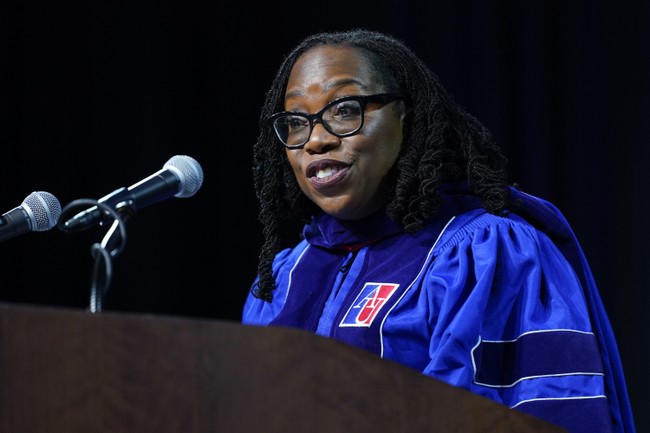
You really have to hand it to Supreme Court Justices Elena Kagan, Sonia Sotomayor, and Ketanji Brown Jackson. When it comes to trying to stop lawful immigration enforcement, they are willing to twist the law and themselves like pretzels to please the open-borders crowd.
There really is no other way to read their dissents in the three important immigration cases decided by the Court in the last two weeks. Their dissents are also very revealing because they spend a great deal of time criticizing the policies in each case, apparently forgetting that they are not policymakers but judges tasked with one job: determining whether the policy implemented by the executive branch (whether they like it or not) is within the authority granted by the Constitution or federal law.
They abandoned that role in each of these cases.
Mullin v. Al Otro Lando was an easy case to decide. During the Obama administration, the number of aliens mobbing ports of entry overwhelmed immigration agents. The administration put in a metering system that only allowed a certain number of aliens to be processed and to claim asylum. Other aliens were prevented from crossing the border and the Trump administration continued that system.
The aliens remaining in Mexico sued claiming they were unlawfully prevented from entering the U.S. and still had a right to assert asylum. Unfortunately, some lower federal courts issued injunctions agreeing with them.
But as the six-member majority of the Supreme Court said on June 25, the statute providing aliens with the ability to claim asylum only applies to aliens “arriving in the United States.” It should be obvious to anyone with any common sense – which seems to exclude the three dissenters – that you don’t arrive “in” a location until you actually arrive in the location. The Court held that under the plain text of the statute and the ordinary, everyday meaning of arriving “in,” aliens still in Mexico can’t claim a right to enter the country and claim asylum because they never arrived “in” the U.S.
But in a dissent by Sotomayor, joined by Kagan and Jackson, she chastised the majority for its “illogical interpretation” of the law and its “fixation” on the word “in.” She claimed the word “in” doesn’t really mean “in” and that anyone arriving on “our doorstep” is the same as being “in” the country. In addition to this illogical interpretation, she and her comrades spent much of their time discussing the supposedly terrible consequences of the majority’s decision, claiming it will cause “more people [to] die,” a totally outrageous claim that has no basis in fact.
But most importantly, the rightness or wrongness of the policy has absolutely nothing to do with the question that was before the Court. The issue was whether implementing this policy is within the authority of the administration under the language of the statute. It clearly is, something the three liberals refused to acknowledge.
Mullin v. Doe was a similarly easy case to decide, at least for the majority and anyone who can read plain English. In 1990, Congress gave the president, acting through the secretary of Homeland Security, the authority to provide temporary lawful status to aliens whose countries have been hit with natural disasters and other problems. Syrians were granted Temporary Protected Status (TPS) in 2012 and Haitians in 2010. The Trump administration ended TPS for both groups in 2025, but federal courts once again issued injunctions telling the president he couldn’t do that.
But the TPS status has specific language barring all judicial review of any determination to grant or end TPS. The Court’s six-member majority enforced this provision, concluding that it wipes out all claims of statutory violations (which the Syrians made) although it does not bar constitutional claims (which the Haitians made). The Court dissolved the injunctions against the termination of TPS for both the Syrians and the Haitians.
As to the Haitians’ claim that the termination was “racist” and violated the Equal Protection Clause, the majority pointed out that the Haitians had contradicted their own claim by arguing that the administration has terminated multiple TPS designations because it simply opposes the TPS program in general. Thus, the Haitians were unlikely to ultimately succeed in their litigation challenging the termination of their TPS status, so no injunction was appropriate while the litigation continues.
This time, Kagan, joined as usual by Sotomayor and Jackson, dissented, claiming the statutory bar on all judicial review doesn’t really apply to all judicial review. While courts cannot review the “substantive” decision to terminate an alien’s TPS designation, she said, they should be allowed to review the “procedures” used by the administration to terminate that status. This was Kagan’s way of trying to void the ban since it is obvious that liberal judges would use that procedural loophole to circumvent the ban and block the substantive decision made to end TPS.
But there is no such distinction in the statute. The law says, clearly and unambiguously, there is “no judicial review of any determination…with respect to the …termination” of TPS. Clear and unambiguous except to the dissenters who claimed that the word “determination” does not include all the steps leading up to the final determination. But as Justice Samuel Alito pointed out in his majority opinion, the word “determination” bars all judicial review (at least of nonconstitutional claims) whether you define it as the “individual decision or the whole process leading to a final decision.”
Kagan also talks about how “dangerous” the decision to end TPS is and how our country will suffer a loss of benefits, pointing to a Haitian who “works in a laboratory researching Alzheimer’s,” and how other individuals will suffer, pointing to a Syrian who she says will have to “return to a still ravaged, violent, and dangerous country.”
But again, these are policy considerations that are irrelevant to the legal question that was presented, which was whether the president has the authority to terminate TPS without interference by federal courts. The federal statute is clear on that point, but the three liberal justices refused to accept that statutory limitation on their authority.
Finally, a brief word on Blanche v. Lau, another 6-to-3 decision issued on June 23. Lau is a Chinese citizen who was granted permanent resident alien status. When he was returning to the U.S. from China, instead of being simply readmitted, he was “paroled” by the border agent because Lau was under a criminal indictment for trademark counterfeiting. The difference can be significant because an individual who is admitted has a recognized legal status, while someone who is paroled is allowed into the country, at least temporarily, without being formally admitted, thereby making it easier to deport that individual at a later time. The government moved to deport him after he pled guilty, a felony violation of the law, but Lau said the border agent should have admitted him instead of paroling him unless he had “clear and convincing” evidence he had committed the crime at the time Lau returned from his trip to China.
The majority concluded that under the applicable immigration statute, the “clear and convincing” evidence standard only applies at the immigration hearing and the government had obviously met that standard since Lau had been convicted of a felony by the time of that hearing. But the three liberal justices, led this time by Jackson, claimed that the government had to meet the “clear and convincing” evidence standard at the border, a claim not found in the statute.
Anyone who has stood in the long Customs line at an airport returning from a trip abroad knows how impractical this dissent is. You hand your passport to the Customs agent, who checks his computer to see if there are any problems listed in the database that would prevent your entry. Here, that check obviously turned up the fact that Lau had a criminal charge pending. Yet that is not good enough for Jackson. In her view, the Customs agent acted improperly because he didn’t conduct an independent investigation to determine whether there was “clear and convincing” evidence that Lau had, in fact, committed the crime with which he had been charged.
The only way to meet that standard would be to set up a hearing process at the border complete with prosecutors, defense lawyers, judges, and who knows what else. That’s absurd.
The bottom line here is that the dissenters wanted to make it virtually impossible to keep out aliens who have been charged with criminal offenses. Or even grant them a parole entry instead of being admitted to the country. Jackson claims that the “majority’s view makes no sense.” If there is anyone’s view that makes no sense, it is that of Jackson, Kagan, and Sotomayor.
Thank goodness they – and other would-be justices with their mindset – are not a majority on the Supreme Court.
Editor’s Note: Unelected federal judges are hijacking President Trump’s agenda and insulting the will of the people.
Help us expose out-of-control judges dead set on halting President Trump’s mandate for change. Join PJ Media VIP and use promo code FIGHT to receive 60% off your membership.