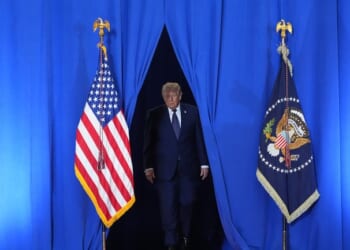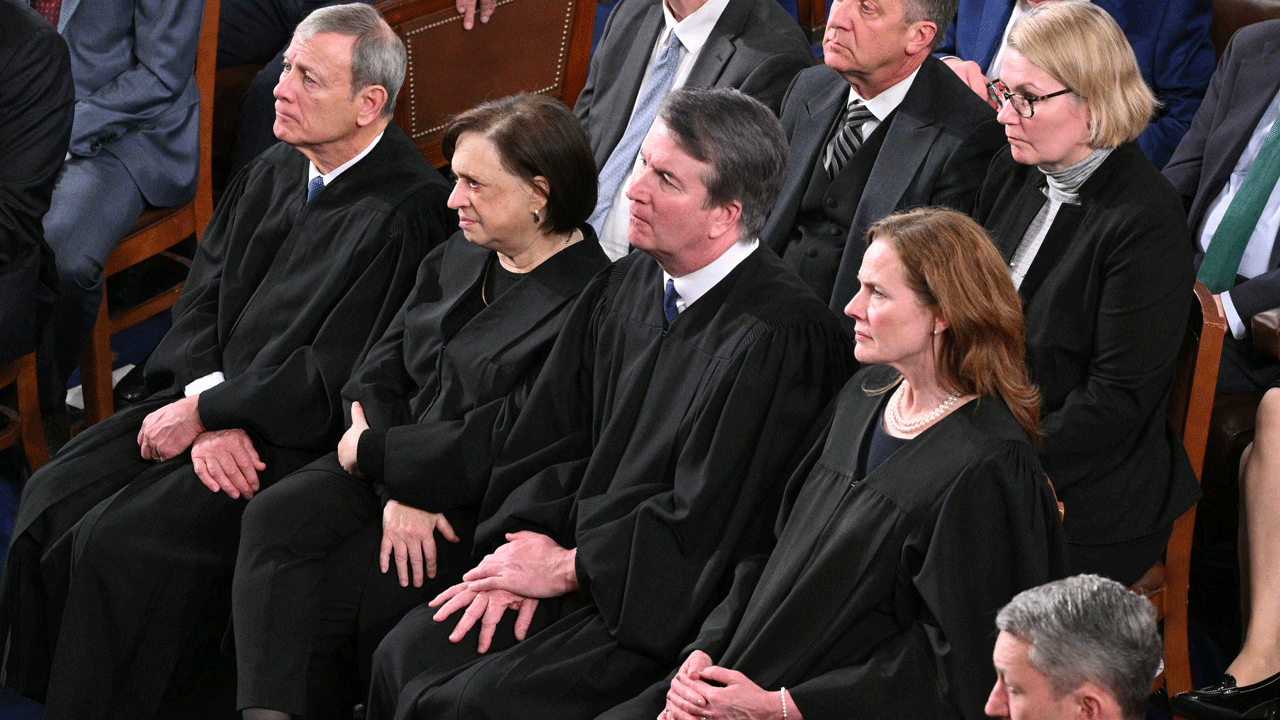
Supreme Court Chief Justice John Roberts, Supreme Court Justice Elena Kagan, Supreme Court Justice Brett Kavanaugh, and Supreme Court Justice Amy Coney Barrett listen as President Donald Trump delivers the State of the Union address in the House Chamber of the U.S. Capitol on Feb. 24. (Mandel NGAN/AFP via Getty Images)
The Supreme Court ruled 6-3 that a Hawaii law banning licensed permit holders from carrying concealed handguns in public accommodations, without the property owner’s authorization, violates the Second and Fourteenth Amendments.
Justic Samuel Alito wrote for the majority in the case of Wolford v. Lopez.
The ruling applies to private property open to the public, such as stores, restaurants, and gas stations, as well as other locations covered by public accommodation laws.
Plaintiffs argued that carrying a firearm is an “implied right” unless the property owner opposes it. They said Hawaii’s law flips that presumption and requires the property owner’s consent prior to accessing the property with a handgun.
Hawaii, represented in oral arguments by Neal Katyal, a former acting U.S. solicitor general, argued the law protects private property rights.
The ruling could apply to any state that seeks to regulate guns. At least four other states have laws similar to Hawaii’s restrictions.
Hawaii points to a 1771 New Jersey law and an 1865 Louisiana law as precedent for states requiring the prior consent of a property owner for someone to enter with a gun.
The Supreme Court in 2022 struck down New York’s requirement that concealed carry holders demonstrate a need for self-defense, in New York State Rifle & Pistol Association v. Bruen.
Hawaii’s Act 52, enacted after the ruling, states that someone with the license to carry a handgun may not “enter or remain on private property of another person while carrying a loaded or unloaded firearm … unless the person has been given express authority.” The law applies regardless of whether the property is open to the public. Four other states have similar laws: California, Maryland, New York, and New Jersey, according to SCOTUSblog.
The high court heard the case because of a circuit split. The 2nd U.S. Circuit Court of Appeals struck down the New York law. The 3rd U.S. Circuit struck down New Jersey’s law. However, the 9th U.S. Circuit upheld Hawaii’s law.