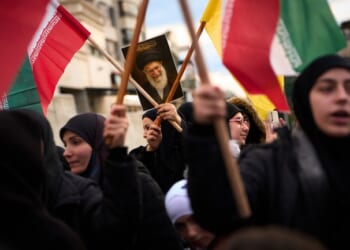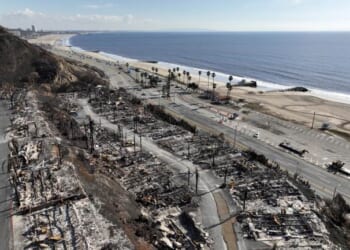
Iran escalated tensions in the Middle East on Wednesday by bombing a Kuwaiti airport and targeting a U.S. fleet in Bahrain in the biggest flare-up since the start of a ceasefire in April.
The U.S. military said it intercepted attempts to strike American bases overseas, but the attack on Kuwait International Airport killed at least one civilian — an Indian national — and wounded dozens of others.
Separately, President Trump said his blockade of Iranian ports could last until Labor Day, unsettling the oil markets.
Renewed violence and the prospect of an economic stalemate raised new questions about whether the Middle East ceasefire existed in name only and if negotiators could land a deal to end the conflict.
“I’d say in that part of the world, a ceasefire is when you’re shooting in a more moderate manner,” Mr. Trump said in the Oval Office. “A ceasefire there is much different than a ceasefire in other parts of the world.”
Mr. Trump is working to approve a memorandum of understanding with Iran that would lift the U.S. blockade of Iranian ports and reopen the Strait of Hormuz while setting the table for final talks over Tehran’s nuclear program.
The president, speaking to the New York Post, said he would like to meet Ayatollah Mojtaba Khamenei to talk about the conflict — a surprising proposal, given that initial strikes killed the ayatollah’s father, Ali Khamenei, ending his decades-long rule.
Efforts to reach a peace deal have been stymied, in part, by divisions within Iran, according to senior U.S. officials.
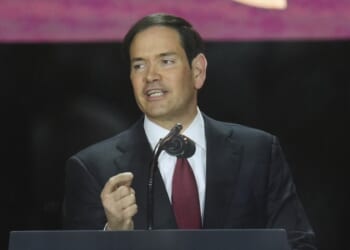
“There are some that believe they actually have to do a deal, because their economy is in shambles,” Secretary of State Marco Rubio told the House Appropriations Committee.
Mr. Trump said negotiations remain on track despite recent turmoil.
“I hear the negotiation itself is going very well,” he said in the Oval Office. “It might not happen, who knows. But if it happens it could happen like over the weekend.”
Administration officials say U.S. strikes are defensive in nature as Mr. Trump squeezes Iran economically, hoping to tilt negotiations in his favor.
Mr. Rubio said the offensive part of the war, called Operation Epic Fury, is over because the U.S. decimated Iran’s military capabilities.
“That was the purpose of Epic Fury,” he said.
Democrats rejected the idea that the war is over, pointing to high gas prices from the closure of the Strait of Hormuz and the lack of a peace deal.
“It’s now Day 97 of the war that the president said he wanted to end quickly,” Rep. Sara Jacobs, California Democrat, told Mr. Rubio.
Both sides of the conflict claimed self-defense after an exchange of firepower in the Middle East.
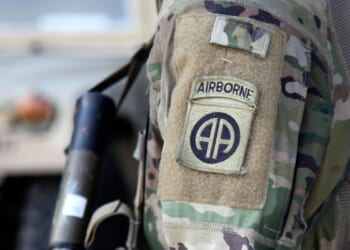
U.S. Central Command said its air defense repelled new attempts to hit U.S. bases in Kuwait and assets in Bahrain on Wednesday, downing multiple drones and ensuring no American personnel were harmed.
Since the U.S.-Iran war began in late February, Iran has repeatedly launched missile and drone strikes at Gulf states over their hosting of American bases. Kuwait hosts several U.S. installations, including Camp Arifjan, a major logistics hub for the U.S. Army.
Iranian Foreign Minister Abbas Araghchi said on social media, “Our Armed Forces are conducting self-defense strikes on sites the U.S. is permitted to use to attack civilian shipping and violate the ceasefire. Any hostile act will be met with an immediate, decisive response. What sanctions and war failed to achieve won’t be won with more war.”
Kuwait suspended flight operations and launched a formal protest with the Iranian Embassy over Wednesday’s attack on its airport, plus expelled Iranian diplomats.
The Kuwaiti Foreign Ministry said it “stresses that the security of the State of Kuwait, its sovereignty, and the safety of its citizens and residents on its territory are a red line that cannot be crossed, affirming that the repetition of these aggressions represents an organized aggressive approach, which the State of Kuwait will neither accept nor tolerate.”
Other Gulf states, including Saudi Arabia, Qatar and the United Arab Emirates, condemned the attack on Kuwait, asserting that they hurt regional stability.
Iran has not claimed responsibility for the attack, and there was no immediate statement from Tehran.
Mr. Trump brushed off the developments, saying Iran was retaliating for U.S. defensive strikes earlier in the week.
Elsewhere, Israel’s bombardment of Iran-backed terrorists in Hezbollah in Lebanon remained a sticking point in broader peace talks.
Mr. Trump confirmed that he cussed out Israeli Prime Minister Benjamin Netanyahu over his repeated incursions into Lebanon. The operation is complicating peace talks with Iran.
“I was a little bit perturbed at his constantly fighting with Lebanon,” Mr. Trump told the Post.
The president said he works well with Mr. Netanyahu, however, and said the tough conversation came with the territory of being a “wartime president” and a “wartime prime minister.”
Mr. Netanyahu on Wednesday said the two have common goals and, like many families, have spats at times.
“We do so as great friends,” Mr. Netanyahu told CNBC. “He respects me, I respect him.”
Mr. Trump raised eyebrows by claiming he’s trying to make another friend in the unlikeliest of places — the top of Iran’s theological power structure.
The president said Supreme Leader Mojtaba Khamenei could be an ally in settling the conflict because he’s heavily involved in Iran’s decision-making.
“I’d like to meet him,” Mr. Trump said. “I’d love to meet everybody. I would like to meet him, and we probably will meet at some point, depending on how it all works out.”
The ayatollah rose to the top cleric position after his father died. The surviving Khamenei, 56, has not been seen in public and is believed to have been severely injured in military strikes.
Yet U.S. officials say he holds sway over Iran’s decisions in peace talks.
“He’s involved, absolutely,” Mr. Trump said. “I think they have a lot of respect for him.”