SEOUL, South Korea — A high-profile arms deal under which the U.S. and Britain were to supply Australia with nuclear subs looks increasingly sickly at a time when Indo-Pacific democracies — worried about Chinese aggression and unsure of American resolve — are building cutting-edge weapons that are in demand around the world.
The East Asian industrial powerhouses that took flight in the 1970s and ’80s before gaining primacy in global manufacturing in the millennium are spreading their wings into defense exports.
While U.S. admirals nervously eye China’s fast-expanding navy, two more Asian supply-chain giants are muscling into the arms race: Japan and South Korea.
Good news for U.S. strategists. Less so for U.S. industrialists.
The wider picture is defense connectivity in a world where design and build are increasingly going cross-border to ensure economies of scale.
Japan, a late entrant to global arms sales, is jointly developing a stealth fighter with Britain and Italy and seeks to build a frigate fleet uniting itself with Australia, Indonesia and New Zealand.
South Korea has similar deals with Poland, selling kits and shifting manufacturing “offset” to Warsaw, though Seoul is now facing blowback.
In the high-stakes bid to build Canada’s submarine fleet, a German-Norwegian alliance has entered from left field.
In shipbuilding especially, Asian economies, empowered by decades of top-down governmental industrial policy, pack a punch.
According to Visual Capitalist, China was the world’s largest builder in 2024, with 51% of global capacity, followed by South Korea with 28% and Japan with 15%.
The U.S. is 14th, with 0.10%.
“Building ships does not give you profit unless you do it at scale, which is a beautiful economic model,” said Alexander Clarke, a naval historian. “This model underpins naval shipbuilding.”
Even so, Washington seems reluctant to buy Asian.
AUKUS subs sink to three
Language, culture and history have traditionally underpinned the alliance of Australia, Britain and the U.S. — commonly referred to as AUKUS. But AUKUS is under stress.
A major reveal this weekend at East Asia’s biggest defense conference, Singapore’s Shangri-La Dialogue Forum, was that “Pillar 1” of the AUKUS deal will see the transfer of just three, used, U.S. nuclear attack submarines.
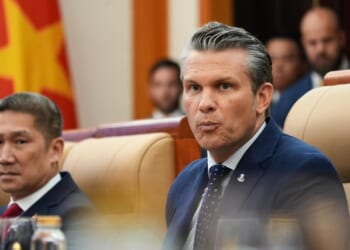
Details came in a joint statement issued by U.S. Secretary of Defense Pete Hegseth and his Australian and British counterparts, and posted on the Defense Department’s website.
The “streamlined” deal will ” … enable Australia to acquire three in-service VCS,” or Virginia-class submarines. Despite “significant progress in the design and delivery timeline” of bespoke, next-generation AUKUS nuclear attack boats, the statement mentioned no hull count or delivery timeline.
The prominent intra-Anglosphere, East-West deal, signed in 2021, has underperformed.
The stumbling block? The inability of London and Washington to supply themselves with sufficient boats, let alone Australia. According to the U.S. Naval Institute, the U.S. needs to build 2.33 nuclear attack subs per year, but is producing only 1.3.
AUKUS aimed to offer Canberra powerful naval forward-defense capabilities and represents the biggest defense investment in Australian history: $239 billion.
Pundits and media were underwhelmed.
With the first used VCS expected in 2032, the Australian Broadcasting Corp. called the deal a “stopgap” until new, bespoke AUKUS boats appear in the 2040s.
“Any talk of a range of 3-5 Virginias has disappeared — 3 is now a hard number and 3 means a minimum of 1 operational,” wrote Euan Graham, a senior fellow at the Australian Strategic Policy Institute on X. He called widespread opposition to AUKUS a “reptilian pile-on.”
Former Australian Environment Minister Peter Garrett — the frontman of rock band Midnight Oil — has announced a crowd-funded public review into AUKUS, with a former head of the Australian Defense Force on board. Reported supporters include retired MPs, admirals, rock stars and unionists.
While AUKUS Pillar 1 for subs is wheezing, some clarity emerged on Pillar 2.
That will see the transfer and joint development of advanced naval technologies for underwater drones, including sensors. The assets are capable of both naval warfare and underwater cable protection — an emergent frontline in hybrid wars worldwide.
“These capabilities are theater-agnostic,” tweeted Alessio Patalano, a King’s College professor of War and Strategy who praised Pillar 2. “They point to the maritime fabric of cross-theater links.”
AUKUS’ multilateral format is being mirrored elsewhere.
Japan joins the fray
Since 2014, Japan has been quietly upgrading its forces’ deployability, while acquiring over-horizon assets, including light carriers, marines and most recently, Tomahawk cruise missiles.
Local firms are also looking abroad. In 2022, Mitsubishi announced its participation in the “Global Air Combat Program,” alongside Italy and the U.K., to jointly build a sixth-generation stealth fighter.
More recently, Tokyo has revised its post-World War II practice of not selling weapons overseas. In April, Mitsubishi announced the sale of 12 “Mogami”-class stealth frigates to Australia.
Since then, Tokyo has offered Mogamis to New Zealand and Indonesia, focusing on the desirability of joint funding, manufacturing and sourcing.
Headwinds have appeared from an unusual source: London.
The British firm Babcock is pitching frigates to Wellington, and Jakarta is already building Type 31 frigates, a British design.
“I’d be surprised if they follow the ’Mogami’ model as they have a shipyard set up [to build Type 31s],” Mr. Clarke said. “They would have to retool — take the entire yard down to basics and rebuild it.”
More problematically, widespread expectations in British defense circles are for an exit from GCAP, the Global Combat Air Program, a joint U.K.-Japan-Italy venture.
Former Defense Minister Ben Wallace tweeted on Tuesday that a strangled defense budget will force a choice between AUKUS subs and GCAP, and London has “no clear guarantees to commit” to the stealth jet.
“If Britain doesn’t fully commit to GCAP, Japan will walk away,” added British Army veteran and pundit Nicholas Drummond on X.
South Korea battles for Canada’s subs
Since Russia’s 2022 Ukraine invasion, Korean arms firms have earned billions selling tanks, mobile artillery, tactical rocketry and jet trainers to NATO nations, as well as air-defense systems to the UAE. Their richest deal yet awaits — for Canada’s new flotilla of 12-strong Arctic-capable diesel-electric attack submarines. That contract is reportedly worth $40 billion, plus post-sales servicing.
Korean yards Hanwha Ocean and Hyundai Heavy Industries have teamed up with Babcock. Seoul’s public relations tactics include deploying an in-service submarine — a record voyage for a Korean boat — and its chief of naval operations to Canada.
The consortium has promised early timelines — first deliveries in 2032 — and generous offsets to Canadian industries.
German competitor ThyssenKrupp Marine Systems is firing back. It has bought national customer Norway on board, arguing for a trilateral NATO fleet.
Ottawa will announce a winner by the end of June.
Only home-grown for U.S.
Despite weak domestic shipyard capacities, Washington isn’t using the sectoral strength of its Asian allies.
Though classified gear — weapons, command-and-control suites, sensors — would likely have to be installed stateside, modular builds are feasible technically, if not politically.
“They could, in theory, do hulls and propulsion, then come to America for fitting out,” Mr. Clarke said. “But that would be a big act of political courage — these ships are meant to be built at home.”
In April, the Pentagon asked Congress for $1.85 billion in 2027 to research buying frigates or destroyers overseas.
In May, specialist media Breaking Defense quoted an unnamed U.S. official from the White House’s Office of Management and Budget saying, “No one spends $1.85 billion studying something. … That money is there for procurement of assets.”
Mr. Clarke is unimpressed. The sum “does not buy a lot of ships,” he said.
Suggestions in specialist media are that it is enough to buy two Korean and/or Japanese-built frigates, an under-represented class in the U.S. fleet.
U.S.-based broadcaster WTKR News reported in May opposition from the Shipbuilders Council of America — even though the $1.85 overseas sum is dwarfed by a $65 billion Defense Department request for domestic warship manufacturing.