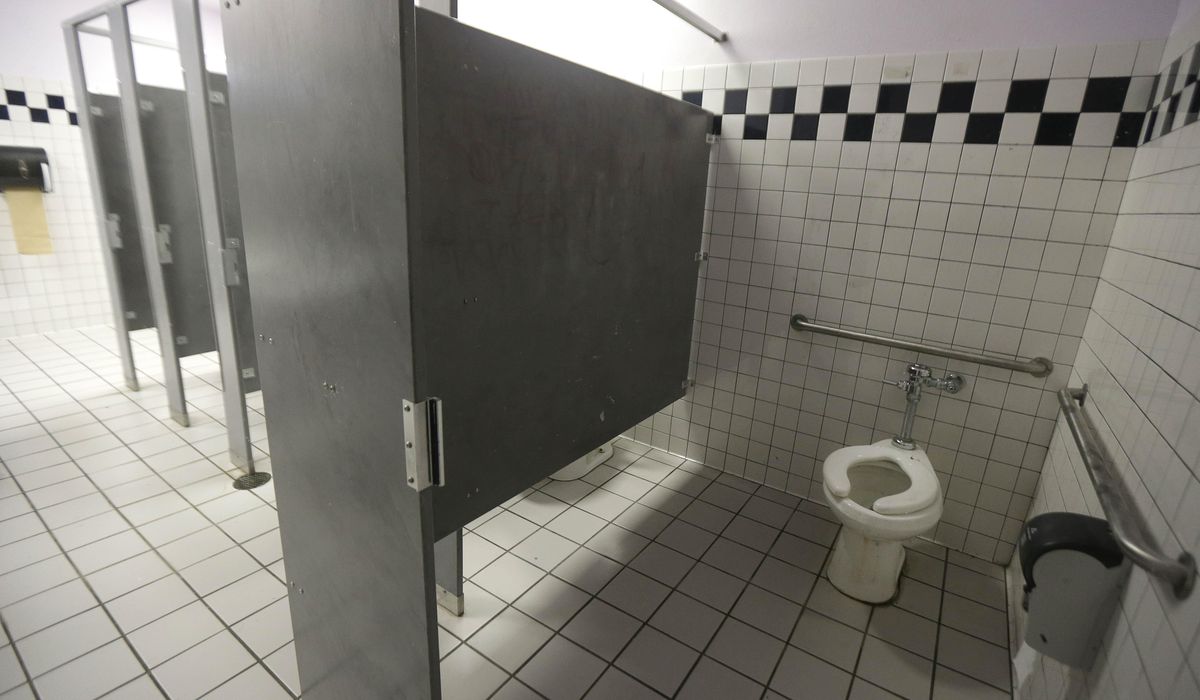
The four largest school districts in Maryland have implemented a state policy requiring teachers to provide potty training to children up to age 5 as taxpayer-funded “pre-K for all” expands among low-income families.
Maryland is the only state that directs teachers to assist students in toilet training. New York allows school districts to designate whether aides, nurses or teachers provide such assistance.
Anne Arundel County Public Schools, which includes the state capital of Annapolis, became the latest to enforce the policy in May. It’s Maryland’s fourth-largest district, with roughly 84,000 students.
Anne Arundel’s new regulation makes pre-kindergarten and kindergarten staff “responsible for implementing personal care and toileting strategies to move students toward personal care and toileting independence.”
Montgomery County, Baltimore County and Prince George’s County implemented similar policies after a 2021 state law expanded full-day early education programs to more “historically underserved” immigrants and minorities.
“All staff strictly adhere to Maryland state reporting laws and personal safety curriculum guidelines to ensure that any necessary bathroom assistance is conducted legally and safely,” said Liliana Lopez, a spokeswoman for Montgomery County Public Schools, the state’s largest district, with roughly 156,000 students.
She cited the Blueprint for Maryland’s Future, a 2021 law that included an $84.8 million increase for the Prekindergarten Grant Program. The money allows districts to provide full-day preschool free of charge to 3- and 4-year-olds from families living at 300% of the federal poverty level.
In October 2022, the Maryland State Department of Education distributed a guidance document to answer an avalanche of toilet-training questions that districts submitted after the blueprint became law.
The document formally extended an existing state law requiring “individualized accommodations and supports for all students” to include “toileting supports.”
“BCPS follows the requirements and guidance outlined by the Maryland State Department of Education,” said Gboyinde Onijala, a Baltimore County Public Schools spokesperson.
Officials in Prince George’s County Public Schools, the state’s second-largest district at over 126,000 students, also cited the guidance as their reason for adopting Administrative Procedure 5166.
“The procedure establishes clear expectations for staff support, parent collaboration, and individualized planning to meet students’ needs while maintaining compliance with state law and educational access requirements,” said Lynn McCawley, a district spokeswoman.
The Washington Times reached out to the Maryland State Department of Education for comment.
According to the department’s website, enrollment in the state’s pre-K programs jumped from 23,616 children in 2021 to a record high of 47,811 last year. That prompted the state to initiate an indefinite enrollment freeze, leaving nearly 3,800 children on a wait list.
Some education experts noted a growing trend of children going to school without basic hygiene skills after the blueprint became law — including those whose toilet struggles lasted well beyond kindergarten.
Erin O’Connor, director of New York University’s early childhood education program, said Maryland’s requirement that teachers clean up the situation could set an example for other states and benefit children who would otherwise fall behind in school.
But she warned that making staff responsible for toilet-training all children could infringe on family boundaries, shame students, unfairly burden teachers and encourage child abuse with “lasting psychological effects.”
“It should not become a blanket policy,” Ms. O’Connor said. “Schools that pursue this must do so with trained staff, clear protocols, and strong family partnerships. Without those foundations, the risks outweigh the benefits.”
Sheri Few, president of the conservative United States Parents Involved in Education, emphasized concerns about Maryland’s policies encroaching on family duties.
“Perhaps too many parents have accepted the idea that the state will feed their children, clean them, and indoctrinate them as it sees fit,” Ms. Few said. “The [policies] reveal a system that increasingly treats children as belonging to the state, not their parents.”
Toileting responsibilities
The National Education Association, the nation’s largest teachers’ union, does not track toilet-training policies nationally.
A page on the website of the Maryland State Education Association, the NEA’s state affiliate, states that the state’s new policy makes teachers responsible for students’ toileting needs at school.
The page nevertheless urges teachers to document every toilet accident, ensure two adults are present to assist a student, and “use praise and avoid chastising” children.
“Communication with parents regarding their child’s needs and the school’s toileting protocols should be the first step once a toileting issue is identified,” a statement on the website reads.
Federal Head Start programs, which serve low-income children from birth to age 5, have long included toileting support as part of a comprehensive child development model.
No states currently require teachers to provide such services to all children, but several states and schools have pushed to expand them.
In April, New York became the second state to implement a statewide “diapering and toileting” requirement, but suggested aides or nurses rather than teachers to handle it.
State education officials passed the emergency rules shortly before the start of a $4.5 billion universal child care program that is expected to bring 100,000 more children into state-funded daycare and prekindergarten programs.
Other states leave it up to individual school districts to devise toilet assistance policies for students with disabilities — including Colorado, Maine, Texas and Florida. Some districts in those states, such as Florida’s Pasco, Pinellas and Hernando counties, have policies declaring that it is not the duty of teachers to change diapers.
Compromised wellbeing
It remains unclear whether Maryland’s example will spread to other states. But some education insiders have noted a broader surge in toilet-training issues since the pandemic.
Officials at Focus on the Family, an evangelical Christian family advocacy group, said Maryland’s policies point to a deeper breakdown in family care standards nationwide.
“You always want to look at each child and case individually and not cast judgment – struggling moms and dads need help,” said Geremy Keeton, the group’s senior director of counseling services. “But if this is the trend, we must think that the overall provision and wellbeing in American home life is compromised.”
Elizabeth Fraley, a former early childhood teacher who leads the California school readiness company Kinder Ready, noted that the Los Angeles Unified School District has provided videos and written materials for years to the families of children transitioning into kindergarten.
She said it would likewise be helpful for teachers to “teach potty training without physically being in the restroom with a child.”
“The assistance could range from teachers providing auditory directions, modeling, and self-guided practice,” Ms. Fraley said. “For example, a teacher could model how to wipe after using the restroom by using a baby wipe on two balloons taped to the back of a chair the child is sitting in.”