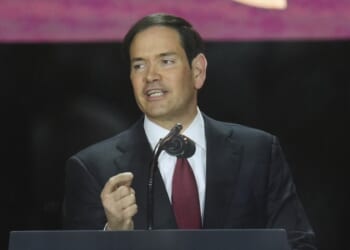
Texas Attorney General Ken Paxton’s routing of Sen. John Cornyn in Tuesday’s Republican Senate primary runoff is reverberating far beyond the Lone Star State, crystallizing a realignment within the GOP that rewards personal loyalty to President Trump above legislative record, institutional seniority or electoral pragmatism.
Mr. Paxton’s victory ended more than three decades of Mr. Cornyn’s electoral dominance in what amounts to a watershed moment for GOP politics in Texas. It was not close. Mr. Paxton captured roughly 64% of the vote — a margin of nearly 28 percentage points — declaring in his victory speech: “Tonight we just sent a Texas-sized message to Washington.”
The margin laid bare just how decisive a last-minute endorsement from Mr. Trump can be — and how limited the Senate’s institutional prestige has become as a shield against the MAGA base. Mr. Cornyn was no anti-Trump rebel. He did not vote to convict Mr. Trump in either impeachment trial, endorsed him after briefly questioning his electability in 2023 and spent years as one of the chamber’s most reliable conservative votes. His colleagues viewed Mr. Trump’s decision to back Mr. Paxton as punishment for insufficient fawning rather than genuine ideological apostasy — a warning to every Republican senator watching from the sidelines.
Mr. Paxton arrived at the race already well-tested by fire. The Texas Senate acquitted him in 2023 of 16 charges of bribery, abuse of office and obstruction — charges that more than 70% of his own party had supported in the House. Before that, he spent nine years fighting a felony securities fraud indictment, ultimately settling by paying nearly $300,000 in restitution and performing community service. Whistleblowers from his own office reported him to the FBI for alleged bribery and abuse of power, claiming he used his office to benefit a real estate developer who employed a woman with whom he was having an extramarital affair. The Justice Department closed that investigation, but several of the whistleblowers successfully sued Mr. Paxton for $6.6 million — a bill paid by Texas taxpayers.
None of it stuck at the ballot box. Far from disqualifying him, Mr. Paxton’s legal battles appeared to burnish his standing with a MAGA base that views him as a fellow victim of political persecution. He is the first primary challenger to defeat an incumbent U.S. senator from Texas since Lloyd Bentsen beat Ralph Yarborough in 1970.
The ripple effects for Senate Republicans are considerable. The twin defeats of Mr. Cornyn and Sen. Bill Cassidy of Louisiana — who failed to survive his May 16 primary after Mr. Trump targeted him for voting to convict the president on impeachment charges — represent, according to the New York Times, the most Senate incumbent primary losses in a single cycle since 2010. Some analysts have compared Mr. Trump’s willingness to topple members of his own party to Franklin Roosevelt’s 1938 effort to purge conservative Democrats — with one key difference: Where FDR failed, Mr. Trump has largely succeeded. Senators who have stayed largely in line with the White House are now openly asking why they should continue to bend if even reliable allies are at risk.
The general election presents the GOP with a costly and uncertain path forward. Mr. Paxton raised just $2.2 million in the first quarter of 2026 across his campaign and joint fundraising committees — roughly one-fourth of what Mr. Cornyn raised in the same period. His Democratic opponent enters the fall in a dramatically stronger position: State Rep. James Talarico raised more than $27 million in the first quarter alone — the largest first-quarter haul ever reported by a Senate candidate in any state — with an additional $10 million raised since the March primary.
No Democrat has won statewide in Texas in more than 30 years, and Senate Republicans now fear that resources will have to be siphoned away from competitive races elsewhere to prop up Mr. Paxton in a state that should not require that investment. Mr. Trump, for his part, struck a conciliatory note Wednesday, praising Mr. Cornyn on social media for “a truly great career” while predicting Mr. Paxton would become “a fantastic, common sense Senator.” Whether that goodwill extends to the broader GOP conference — and whether Mr. Paxton can survive a well-funded Democratic challenge in November — will be among the defining tests of the MAGA era’s grip on the Republican Party heading into the midterms.
This article was constructed with the assistance of artificial intelligence and published by a member of The Washington Times’ AI News Desk team. The contents of this report are based solely on The Washington Times’ original reporting, wire services, and/or other sources cited within the report. For more information, please read our AI policy or contact Steve Fink, Director of Artificial Intelligence, at sfink@washingtontimes.com
The Washington Times AI Ethics Newsroom Committee can be reached at aispotlight@washingtontimes.com.