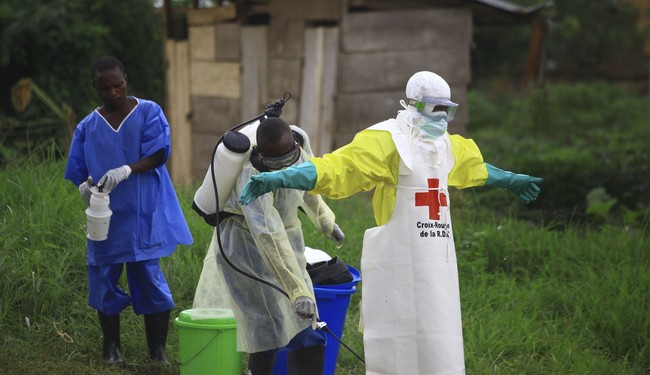
A new Ebola outbreak should never get shrugged off; it kills too many people, spreads through bodily fluids, tears through weak health systems, and leaves families afraid to touch the dead.
The current outbreak in the Democratic Republic of the Congo and Uganda involves the Bundibuguyo virus, a rarer Ebola strain that’s fast-moving in parts of Central Africa and still far from a reason for Americans to panic.
The World Health Organization declared the outbreak a Public Health Emergency of International Concern after WHO Director-General Tedros Adhanom Ghebreyesus reviewed the emergency committee’s advice.
That same committee also said the event does not meet the criteria for a pandemic emergency, which deserves as much, if not more, attention as the emergency declaration.
As of May 22, the committee listed the outbreak as a major international concern because of insecurity, population movement, cross-border risk, and the lack of approved vaccines or specific treatments for Bundibugyo Ebola.
The numbers continue to be fluid: the CDC’s May advisory listed 246 suspected cases and 80 deaths in the DRC as of May 16, while later updates and regional reports put suspected cases closer to 750 with roughly 177 deaths.
Today, Uganda’s Health Ministry confirmed three new cases, bringing the total to five. The new Ugandan cases involved known contacts, including a driver, a health worker, and a Congolese woman who traveled into Uganda before returning and testing positive.
Historical context helps lower the temperature without minimizing the danger.
Ebola first emerged in 1976, and outbreaks have repeatedly hit Central Africa. The 1995 Kikwit outbreak in the DRC killed 245 of 315 reported patients. Uganda’s 2000 outbreak reached 425 cases and 224 deaths. The 2014 to 2016 West Africa epidemic remains the giant in the record, with over 28,600 cases and 11,300 deaths.
Bundibugyo Ebola also changes the conversation. Zaire Ebola has approved vaccine tools, including Ervebo, but Bundibugyo has no approved vaccine yet. Scientists are studying whether existing platforms can help or whether a new vaccine will be needed.
The Bundibugyo strain has often carried a lower fatality rate than Zaire Ebola, but lower doesn’t mean harmless; a disease can remain containable and still be brutal for the communities trapped inside the outbreak zone.
ICYMI: Here We Go Again: WHO Says Ebola Is Global Emergency as U.S. Virologist Smuggles in Pathogens
Americans have earned some suspicion after COVID-19, and that is a massive understatement. There’s strong circumstantial evidence that it was intentionally leaked from a lab in Wuhan. Add the various decisions made by Dr. Fauci and others, such as the six-foot distance rule that came from nowhere. Fauci’s work to limit the reach of the Great Barrington Event ruined any chance of objective views of the doctor’s intentions.
I have to admit, it was hard for me to write that without flying off the reservation. My feelings aren’t just my own; I know full well millions of Americans developed suspicions that didn’t appear from thin air. Lockdowns, shifting guidance, school closures, censorship fights on social media, and elite hypocrisy left millions of Americans less willing to accept any claims from public health officials on command.
That dog don’t hunt anymore.
Ebola coverage should account for that reality, yet the outbreak deserves attention because people are dying, health workers face danger, and Central Africa’s instability can turn a hard outbreak into a worse one.
The same facts also show why pandemic theater helps nobody. No related U.S. outbreak has been identified, and the main risk remains regional.
The proper response involves vigilance through surveillance, screening where needed, contact tracing, and, most critically, honest communication.
While fear makes people click, accuracy helps people think. The lack of accuracy destroyed confidence in many states’s governors who enjoyed newfound power.
That’s a lesson that we can’t forget.
Bundibugyo Ebola is serious; we can’t discount the lethality of the disease, and we shouldn’t pretend families in the DRC and Uganda aren’t facing something frightening and real.
But seriousness doesn’t require panic; it requires discipline, honest reporting, medical humility, and enough institutional memory to know that Americans will no longer accept fear as a substitute for evidence.
The hopeful part is that the world knows far more about Ebola than it did decades ago. Health workers understand isolation, contact tracing, supportive care, and the danger of delayed detection.
Today’s scientists have built better tools, governments have learned painful lessons (I hope), and ordinary Americans have learned to ask sharper questions when official voices start speaking in emergency tones.
That’s not cynicism; it’s maturity.
America can care about the sick, respect the doctors and nurses on the front lines, pray for the communities facing Bundibuguy Ebola, and still refuse to be herded into another national panic.
A healthy republic doesn’t need hysteria to show compassion; it needs truth, steadiness, and the confidence to face danger.
All without surrendering its judgment.
Public health emergencies demand clear facts, not panic packaged for clicks. PJ Media keeps asking the questions many Americans learned to ask after COVID, while still respecting the truth when lives are at stake. Join PJ Media VIP today and use promo code FIGHT for 60% off.