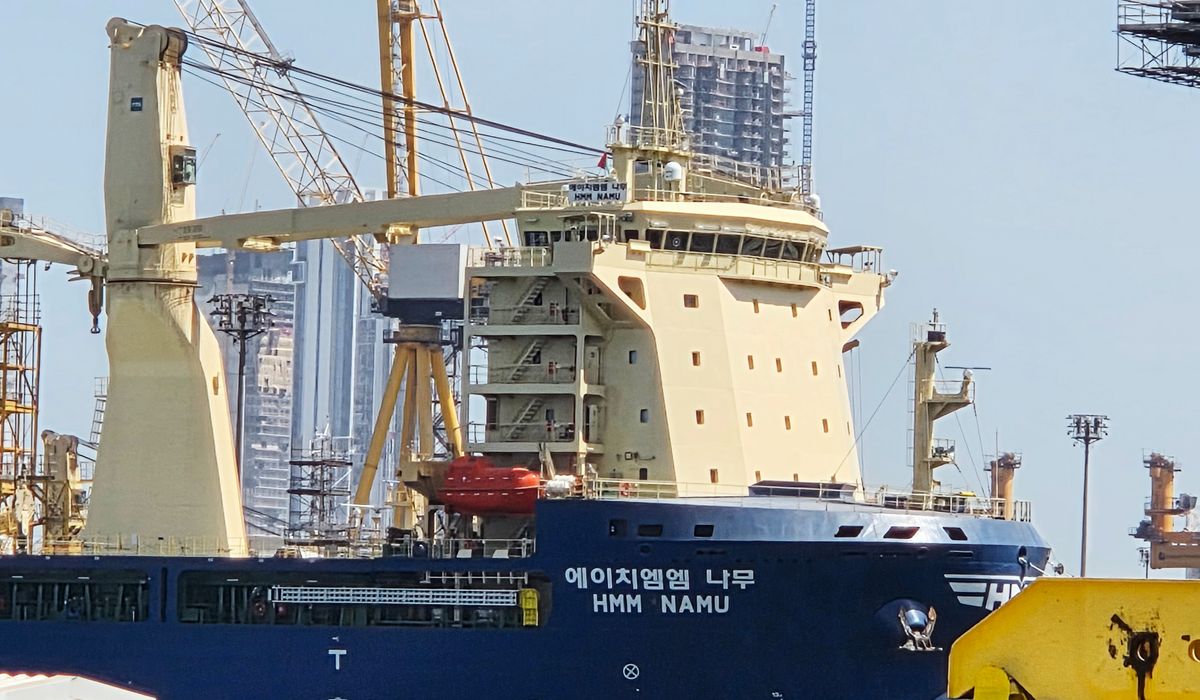
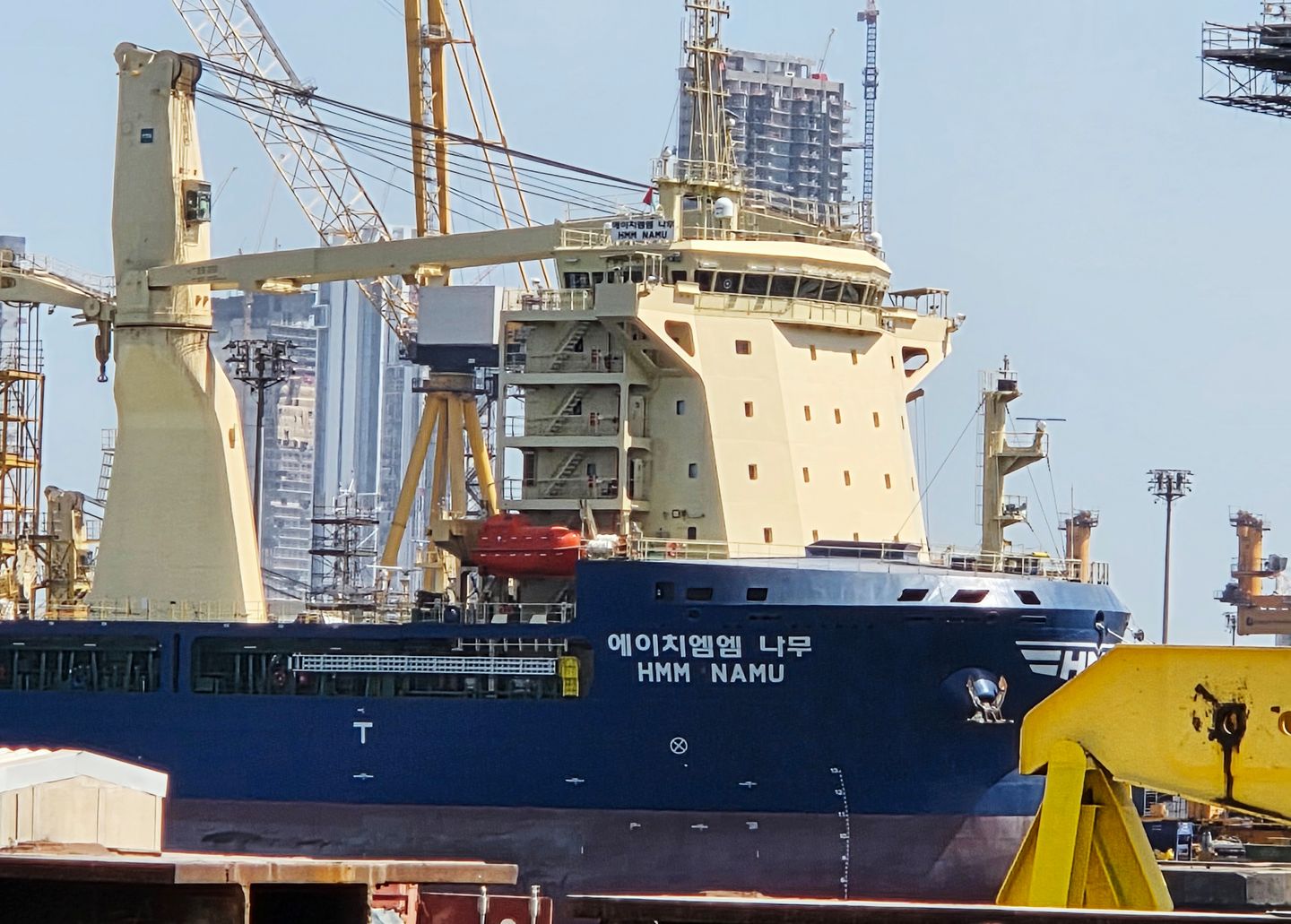
SEOUL, South Korea — Newly released images and data about hull damage to a South Korean-operated ship sustained on May 4 in the Persian Gulf indicate a strike by a brace of unmanned aerial vehicles, likely from Iran.
Images of the damage to the vessel HMM Namu were released Sunday. On Monday, Seoul remained reluctant to point fingers.
“Our government maintains that attacks on privately operated vessels, including the HMM Namu, can neither be justified nor tolerated, and we strongly condemn them,” National Security Advisor Wi Sung Lac told a Monday press conference.
He added that Seoul is working to identify who was behind the attack and determine the exact type of objects involved.
Previously released images and footage strongly indicate projectiles fired into the Namu from the Iranian side of the Gulf.
The situation puts the South Korean government in a bind.
Like other U.S. allies, it has declined U.S. President Trump’s requests for assistance in forcing open the Strait of Hormuz.
Now that a domestic asset has been struck, pressure may rise for a more muscular stance.
Legally, however, Seoul is not obligated to respond with force.
The Namu, though operated by South Korean shipping firm HMM, flew the flag of Panama, a so-called “flag of convenience.”
Under the U.N. Convention on the Law of the Sea, or UNCLOS, a strike on a vessel is considered an act of war against the state whose flag it flies, not the operating state.
Many first-world nations use foreign-flagged vessels — “flags of convenience” — to cut operating and salary costs, and to evade stringent domestic regulations and taxes.
More than 70% of global merchant marine vessels are foreign-flagged.
On May 4, the Namu suffered an incident while anchored off the coastline of Umm Al Quwain, a city in the United Arab Emirates, approximately 60 nautical miles from the entrance to the Strait of Hormuz.
The ship was towed into port in Dubai.
Film shot from the coast showed the Namu’s bow pointed toward the strait, indicating that damage to her port — left side — faced the direction of the Iranian coast.
Early indications were that she had suffered an onboard fire. However, after seven investigators flew into Dubai from Seoul, it became clear that the incident was more nefarious.
Images released late Sunday showed a tear 23 feet wide by 16 feet high in her hull just above and in front of the rudder. Internal images showed a scorched, blackened compartment.
“At approximately 3:30 p.m. local time on May 4, two unidentified flying objects struck the outer hull plating of the port side ballast tank at the stern of the vessel HMM Namu twice at roughly one-minute intervals,” a spokesman for the Ministry of Foreign Affairs told a press conference Sunday.
Multiple media analyses suggested the Namu suffered a “double-tap” strike by a brace of drones. The first wave penetrated her hull near the rudder, and the second generated additional damage inside the engine room.
There were no fatalities among the crew, but one crew member was injured.
If Iranian forces were behind the attack, it is unclear why a South Korean vessel was struck and on whose orders.
The fog of war may be to blame. The strike took place the same day that Iran launched multiple missile and drone attacks on the UAE.
Correction: An earlier version misidentified the Namu’s vessel classification.