SEOUL, South Korea — South Korea’s conservative opposition leader Friday unleashed a blistering political attack on progressive President Lee Jae-myung and his ruling Democratic Party of Korea — but admitted that his own party’s ability to influence events is severely limited.
Meeting foreign reporters in Seoul on Friday, People Power Party Chair Jang Dong-hyeok accused the government of turning away from its ally, the United States; warned of the dangers of the ruling party extending control over the judiciary; and slammed its promotion of legislation that he says is unconstitutional.
However, his party remains divided in the long aftermath of conservative ex-President Yoon Suk Yeol’s 2024 martial law declaration.
Subsequent to that failed gambit, which saw commandos deployed to the National Assembly, Yoon was impeached, tried for insurrection and jailed for life.
U.S. Army soldiers operate their drone …
more >
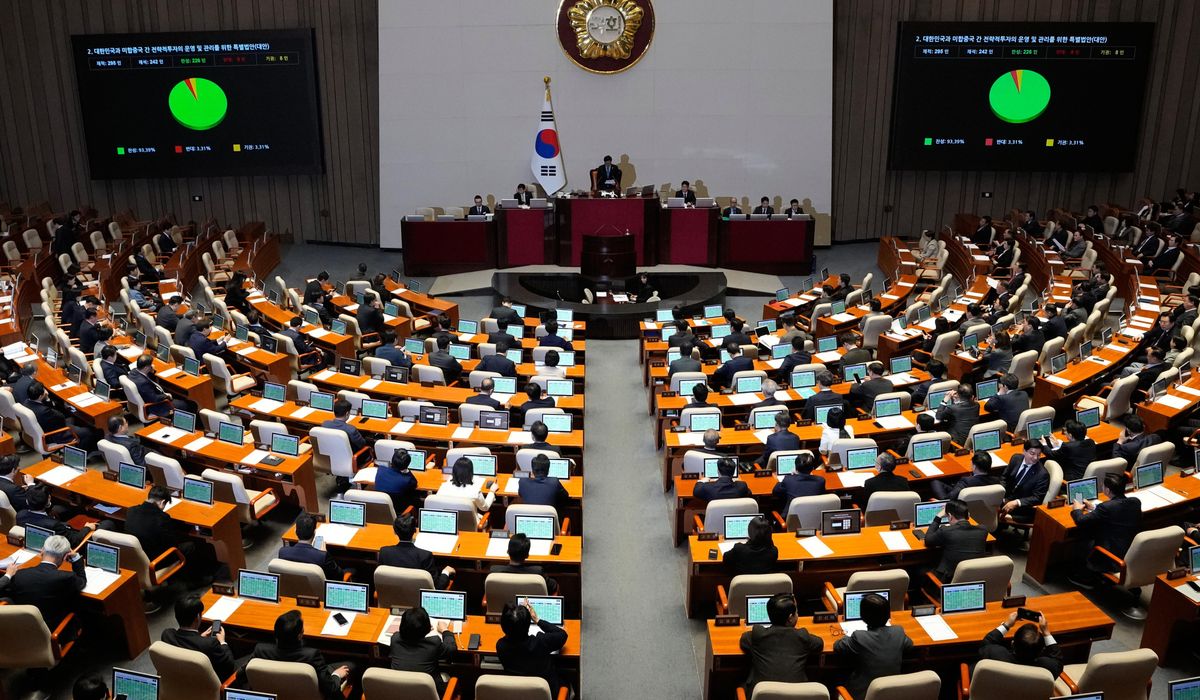
Now, Mr. Lee’s DPK controls not just the presidential Blue House, but also the single-chamber National Assembly.
The PPP, meanwhile, holds no lever of power. And yet another disaster looms for the opposition party.
Public opinion polls indicate the PPP will suffer another spanking in June 3 local elections for governors and mayors. A May 7 poll found national support for the PPP to be just 18%, compared to 48% for the DPK.
Conversely, a Thursday poll found that Mr. Lee’s approval ratings stand at 68% — just 1 percentage point south of his record high of 69% in March.
Not only is Mr. Lee, who took power in a snap presidential election in June 2025, enjoying a long political “honeymoon,” but he has presided over a stunning surge in South Korea’s stock markets that have defied the ongoing oil shock to repeatedly breach record highs.
Challenges on all fronts
The divisions within his own party, and its limited ability to confront the ruling party, put Mr. Jang, 56, under pressure on all fronts.
A good-looking and persuasive ex-judge, he was one of just 18 PPP lawmakers who entered the National Assembly to join DPK lawmakers in voting down Yoon’s martial law declaration.
That puts him at odds with many of his colleagues. Yet pending issues demand a united and effective opposition.
South Korea’s relations with its only ally face multifaceted tensions.
Mr. Jang admitted that the DPK has, customarily, leaned further from the alliance than has the PPP, but accused it of going further than ever before.
“President Lee has questioned whether Korea should have to rely on foreign troops and has prematurely pushed forward transfer of wartime operational control,” Mr. Jang said. “Many South Korean citizens worry this is a prelude … for the withdrawal of U.S. troops from Korea.”
The transfer of operational control, also known as the OPCON Transfer, was initiated by a liberal Seoul administration in power from 2003-2008, but has been slow-walked by conservative governments.
While the U.S. side insists the process must be “conditions-based,” Mr. Lee has made clear he wants it done by the end of his term, 2030.
Some fret the OPCON Transfer could spell the implosion of the war-ready Combined Forces Command and reductions in the 28,000-strong U.S. Forces in Korea.
A chasm yawns between Washington’s stance on USFK — that the force should have “strategic flexibility” to operate regionwide — and Seoul’s position — which is that it is in-country to deter North Korea, rather than irritate China.
“Many Koreans are asking if Korea is drifting from the alliance and community of liberal democracies,” Mr. Jang said. “During my recent visit to Washington, I confirmed a broad range of U.S. officials shared deep concerns about [bilateral] relations.”
Legal-constitutional issues also loom. The DPK is pursuing sweeping changes to Korea’s judiciary — the third and last node of national power not fully within the ruling party’s grip.
Key ambitions include dissolving the present prosecution service — Mr. Lee’s widespread legal campaign against the hapless ex-President Yoon and his associates was spearheaded by highly empowered teams of special counsels — and massively expanding the bench of the Supreme Court.
“This is drawn from the authoritarian playbook. … [These are] authoritarian instruments deployed by autocrats across the globe,” Mr. Jang fumed. “The PPP is fighting to defend Korea’s constitutional order and protect the freedoms and rights of the Korean people.”
So far, the opposition had filibustered those issues by walking out of the chamber. Whether that tactic is sustainable in the face of the government’s political determination is questionable.
Within the DPK, there are signs that party zealots are moving too fast on legal changes even for the president.
Earlier this week, Mr. Lee suggested the DPK canvas public opinion before pushing for legislation that would allow him to appoint special counsels to investigate eight charges against himself that have lingered from his pre-presidential political career.
There were signs that the self-serving move, if pushed through, could have impacted the DPK’s reputation ahead of the June local elections.
Freedom of religion is also under fire.
The PPP is opposing legislation, filed this year, that would permit the government, rather than the courts, to dissolve a religious group if it undertakes political activities, violates electoral laws or commits acts deemed “harmful to the public interest.”
The legislation appears to target minority religions and politically active Protestant churches; heads of some have already been jailed.
Opponents of the legislation argue that most countries define related constitutional principles as separating religion from state, rather than separating religions from politics.
“Like any democratic country around the world, Korea acknowledges freedom of religion for all citizens,” said Mr. Jang. “In accordance with the structure of the constitution, freedom of religion is admitted as a very important right, but with the Lee Jae-myung government, this important value has been significantly infringed.”
One long-time Korean observer expressed discomfort at the starkly tilted nature of the current political landscape.
“I don’t think one side is perfect and the other is composed of scoundrels, but I don’t think the DPK are being sufficiently principled,” said Michael Breen, author of ‘The New Koreans.’ “Martial law was so egregious that we forget how out-of-control the DPK was.”
While in opposition, the party broke all prior records for impeachments of government officials, slowing political processes and frustrating Mr. Yoon.
Pending changes to the judiciary also concern Mr. Breen.
“Lee is planning to change the legal system but is not doing it in a bipartisan way, he is going it in a way that is incredibly self-serving,” the author, a Seoul resident since the 1980s, said. “Korean democracy has been very well served by this mistrust that makes voters bounce from one party to another, but if — like in other Asian democracies — one party can get a lock on power, you could see the DPK in power forever.”
In Taiwan, the current ruling party has won three presidential elections in a row but faces stiff opposition in the unicameral legislative Yuan.
In Japan, the ruling party has been in power, with the exception of two brief periods, since the nation emerged from World War II. However, the Diet is split into two chambers, dispersing political power.