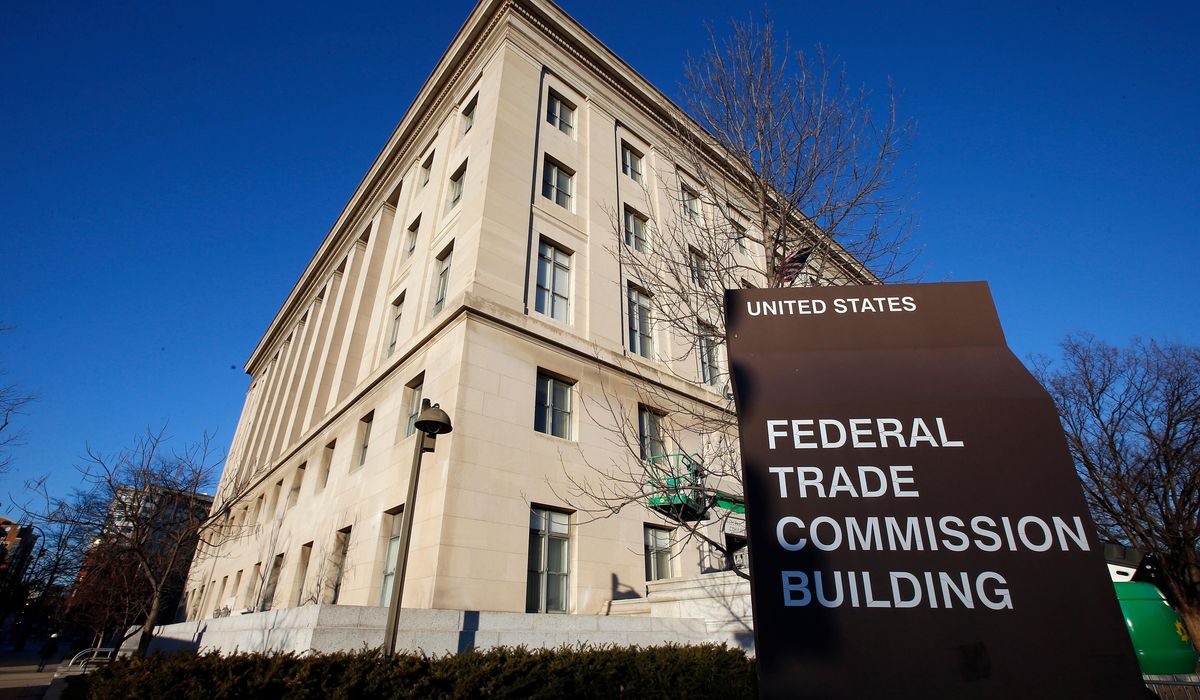
The Federal Trade Commission has rescinded its investigation of Media Matters, a left-wing group that monitors the news, marking the second retreat in less than a week for the FTC.
Government lawyers announced the end of the probe in a court filing Monday, saying the FTC no longer saw it necessary.
The FTC said it had secured a settlement in a separate case involving major ad-buying agencies that agreed to forgo the use of political or ideological tests in deciding where to place ads. The government had argued that the ad agencies were using information from liberal-leaning groups such as Media Matters to justify limiting their ad buys with conservative-leaning outlets.
That settlement “resolved the issues related to Media Matters,” FTC lawyers told the judge.
Media Matters didn’t respond to an inquiry for this story, but in its own court filing Tuesday it asked federal judges to keep the case alive, saying it wants the chance to prove the government was illegally retaliating against the organization.
FTC lawyers said “several other” probes — officially known as civil investigative demands — were also withdrawn.
The lawyers didn’t list the companies involved, but one is NewsGuard, which produces ratings of news websites.
Conservatives have accused NewsGuard of a liberal bias in its approach to the ratings and said ad buyers were using NewsGuard to justify not running advertisements on conservative-leaning websites.
NewsGuard and Media Matters had each filed lawsuits to try to block the FTC probes.
A federal court last year issued an injunction halting the FTC probe of Media Matters, saying the investigation was a “straightforward First Amendment violation.”
Judge Sparkle Sooknanan, a Biden appointee, said the FTC’s probe appeared to be political retaliation. She also said the scope of the FTC’s inquiry was so broad, it belied the reasoning the agency gave.
The Washington Times has sought comment from the FTC for this story.
The FTC has also used civil investigative demand letters to probe organizations that support “gender affirming care” for people seeking to transition their gender identity.
Lawsuits challenging those CIDs are pending.